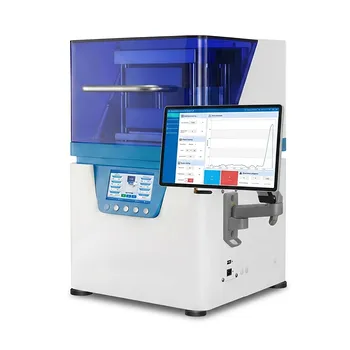
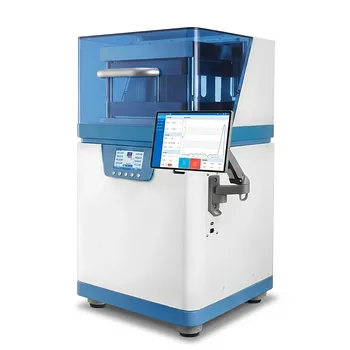
The laboratory hydraulic press is the critical bridge between raw chemical components and a functional electrochemical device. It is used to apply precise, uniform pressure to compress an electrode slurry—typically a mixture of active materials, conductive agents, and binders—onto a current collector substrate. This process transforms a loose coating into a dense, high-performance electrode capable of efficient energy storage.
The primary role of the hydraulic press is to minimize interfacial contact resistance and ensure structural integrity by physically bonding active materials to the current collector. This optimization of the mechanical-electrical interface is vital for maximizing charge transfer efficiency and long-term cycling stability.
Enhancing Electrical and Ionic Conductivity
Minimizing Interfacial Contact Resistance
The hydraulic press forces the active material slurry into tight mechanical contact with the current collector, such as nickel foam or stainless steel mesh. This physical compression reduces the gaps between the material and the substrate, effectively lowering the interfacial contact resistance. By establishing a robust ohmic contact, the press ensures that electrons can move freely between the active material and the external circuit.
Improving Charge Transfer Efficiency
Beyond the substrate interface, the press compacts the internal particles of the slurry, including the active materials and conductive carbon black. This high-pressure environment (often ranging from 10 to 30 MPa) creates a continuous conductive network. This network is essential for rapid electron transport and reduced ion transport impedance, which directly enhances the rate performance of the supercapacitor.
Ensuring Structural Integrity and Consistency
Strengthening Mechanical Adhesion
Supercapacitor electrodes undergo significant stress during the immersion in electrolytes and repeated charge-discharge cycling. The hydraulic press strengthens the mechanical bonding between the porous carbon slurry and the conductive substrate. This prevents the active material from delaminating or "shedding" during operation, which is critical for maintaining long-term cycling stability.
Precise Control Over Electrode Geometry
The use of a hydraulic press equipped with precision molds allows researchers to control the final thickness and density of the electrode. For example, a press can be used to achieve a specific thickness, such as 30 μm, which is necessary for standardized testing. Consistent thickness and density ensure that electrochemical measurements are reproducible and that the electrode can perform under high current densities.
Understanding the Trade-offs
Pressure Calibration vs. Material Damage
While high pressure improves conductivity, excessive force can damage the internal structure of the electrode. Over-compression may collapse the porous structure of the active material, such as activated carbon, which reduces the surface area available for ion adsorption. Finding the optimal pressure—typically between 10 and 30 MPa—is a delicate balance between maximizing density and preserving porosity.
Impact of Binder Distribution
The pressing process also influences how the binder (like PTFE) is distributed within the electrode. While the press helps the binder lock the active materials in place, improper pressure can cause "binder migration," leading to uneven mechanical strength. Accurate, constant pressure application is required to ensure the binder functions uniformly across the entire electrode surface.
Optimizing Your Electrode Fabrication Process
How to Apply This to Your Project
To achieve the best results with a laboratory hydraulic press, you must tailor the pressure settings to your specific material composition and substrate type.
- If your primary focus is High Rate Performance: Apply higher pressures (near 30 MPa) to minimize resistance and maximize particle-to-particle contact for faster electron flow.
- If your primary focus is Maximizing Capacitance: Use moderate pressure (around 10 MPa) to ensure electrical contact while preserving the delicate pore structure of high-surface-area carbons.
- If your primary focus is Long-Term Cycling Stability: Prioritize uniform pressure distribution to ensure the active material is deeply embedded into the current collector mesh, preventing delamination.
By mastering the precise application of pressure, you ensure that your laboratory-scale electrodes translate into reliable, high-performance energy storage solutions.
Summary Table:
| Key Role | Physical Impact | Electrochemical Benefit |
|---|---|---|
| Compression | Minimizes interfacial contact resistance | Improved electron transport & power density |
| Compaction | Creates a continuous conductive network | Enhanced charge transfer efficiency |
| Adhesion | Strengthens bond between slurry and substrate | Superior long-term cycling stability |
| Precision Control | Maintains uniform electrode thickness/density | Reproducible results for standardized testing |
Elevate Your Energy Storage Research with KINTEK Precision
High-performance supercapacitors require absolute precision in electrode fabrication. KINTEK specializes in advanced laboratory equipment designed to bridge the gap between material science and functional devices.
Our extensive portfolio includes:
- Laboratory Hydraulic Presses: Precision pellet, hot, and isostatic presses for optimal electrode compaction.
- Thermal Processing: A wide range of muffle, tube, vacuum, and atmosphere furnaces for material synthesis.
- Energy Research Tools: High-temperature high-pressure reactors, autoclaves, and dedicated battery research consumables.
- Sample Prep & Lab Solutions: Crushing systems, sieving equipment, and cooling solutions like ULT freezers and freeze dryers.
Whether you are a researcher focused on maximizing capacitance or a manufacturer looking for reliable lab-scale consistency, KINTEK provides the high-quality tools and consumables (PTFE, ceramics, crucibles) you need to succeed.
Ready to optimize your lab's workflow? Contact KINTEK today for a consultation and a tailored quote!
References
- Chang‐Min Yoon, Won‐Chun Oh. 3D Hierarchically Structured Tin Oxide and Iron Oxide-Embedded Carbon Nanofiber with Outermost Polypyrrole Layer for High-Performance Asymmetric Supercapacitor. DOI: 10.3390/nano13101614
This article is also based on technical information from Kintek Solution Knowledge Base .
Related Products
- Laboratory Hydraulic Press Lab Pellet Press Machine for Glove Box
- Laboratory Hydraulic Press Split Electric Lab Pellet Press
- Fully Automatic Heated Hydraulic Lab Press for Materials Sintering and Sample Preparation
- Laboratory Hydraulic Press Lab Pellet Press for Button Battery
- Automatic Laboratory Hydraulic Press for XRF & KBR Pellet Press
People Also Ask
- How do laboratory hydraulic presses contribute to zero-gap electrolyzers? Optimize Performance & Safety
- Why is a laboratory hydraulic press necessary for ZrO2/Cr2O3 interface analysis? Optimize Sample Density and Accuracy
- How do a precision laboratory hydraulic press and specialized molds contribute to the fabrication of spherical ceramic samples? Achieving High-Density Material Precision
- What is the role of a laboratory hydraulic press in the preparation of rare earth denitrification catalysts?
- How does pressure control of a laboratory hydraulic press affect W-Ti alloys? Optimize Grain Structure & Density