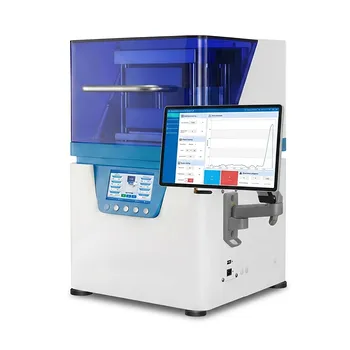
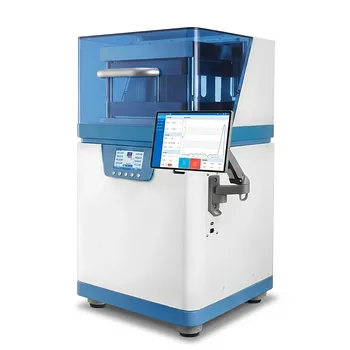
The laboratory hydraulic press serves as the critical instrument for creating high-density benchmarks in magnetic material research. By applying extreme fixed pressure—often reaching 800 MPa—the press transforms loose composite powders into precision-engineered "green compacts." These standardized specimens provide the essential baseline data required to evaluate the performance of traditional molding against modern processes like laser additive manufacturing.
The laboratory hydraulic press facilitates the controlled rearrangement of powder particles to achieve maximum density and mechanical interlocking. This process creates a consistent physical foundation, ensuring that subsequent performance evaluations of iron-based soft magnetic materials are both accurate and reproducible.
Mechanisms of Powder Compaction
Overcoming Internal Friction
In traditional molding, the primary role of the hydraulic press is to provide enough force to overcome the friction between individual powder particles. When combined with specific lubricants, this high-tonnage pressure allows particles to slide past one another. This movement is essential for the material to transition from a loose state to a solid, cohesive form.
Precision Particle Rearrangement
The press utilizes specific holding times and precise pressure control to manage the rearrangement of the internal microstructure. Under a stable load, the particles settle into the most efficient configuration possible. This eliminates large voids and ensures the material achieves the high-density required for superior magnetic properties.
Establishing an Experimental Baseline
Creating the "Green Compact"
The result of the pressing process is a green compact, a specimen that has been compressed into a specific shape but not yet sintered. The laboratory hydraulic press ensures these compacts have sufficient mechanical strength to be handled and measured. These compacts act as the "standard" against which all other manufacturing variations are measured.
Standardization via Ring Molds
In experiments involving iron-based soft magnetic materials, the press is typically equipped with precision ring molds. The resulting ring-shaped specimens are the industry standard for evaluating magnetic flux and permeability. By producing regularly shaped specimens, the press removes geometric variables that could skew the comparison between traditional and additive manufacturing.
Impact on Material Microstructure
Reducing Internal Porosity
High-precision pressing significantly reduces internal pores and density gradients within the sample. A lower porosity directly correlates to better magnetic performance and structural consistency in the final product. The hydraulic press provides the "high-pressure physical foundation" necessary for successful solid-phase sintering.
Enhancing Mechanical Interlocking
The application of directional pressure ensures close contact between powder particles, promoting mechanical interlocking. In certain materials, such as bismuth telluride or iron-based composites, this can even create a lamellar structure. This structure is vital for researchers studying how the direction of pressing affects the material's electrical or magnetic properties.
Understanding the Trade-offs and Pitfalls
Density Gradients and Internal Stress
While high pressure is beneficial, it can lead to uneven density distribution if the mold is not properly lubricated or designed. Parts of the specimen closer to the punch may be denser than the center, leading to internal residual stresses. These stresses can cause "springback" or cracking when the specimen is ejected from the mold.
Limitations Compared to Additive Manufacturing
Traditional hydraulic pressing is limited to simpler geometric shapes, such as rings, pellets, or briquettes. Unlike laser additive manufacturing, it cannot easily produce complex internal lattices or optimized cooling channels. Researchers must balance the high density of pressed parts against the design flexibility offered by newer technologies.
How to Apply This to Your Research
Making the Right Choice for Your Goal
To achieve the best results in your molding experiments, align your press parameters with your specific research objectives:
- If your primary focus is Benchmarking: Use a fixed pressure of 800 MPa with a precision ring mold to create a control group for comparison with 3D-printed samples.
- If your primary focus is Microstructural Analysis: Utilize longer holding times to ensure maximum particle rearrangement and the elimination of internal voids.
- If your primary focus is Sintering Preparation: Prioritize uniform pressure application to minimize density gradients, which prevents warping during the subsequent heating phase.
- If your primary focus is Anisotropic Properties: Apply directional pressure to induce specific particle orientations, allowing you to study how properties differ parallel and perpendicular to the press direction.
By mastering the precise control of the laboratory hydraulic press, you ensure that your material specimens are the highest possible quality for definitive technical evaluation.
Summary Table:
| Process Phase | Primary Role of Hydraulic Press | Key Research Benefit |
|---|---|---|
| Compaction | Overcomes internal particle friction (up to 800 MPa) | Transforms loose powder into solid green compacts |
| Microstructure | Facilitates precision particle rearrangement | Minimizes internal porosity and voids |
| Standardization | Utilizes precision ring molds | Creates consistent benchmarks for magnetic evaluation |
| Mechanical Setup | Enhances mechanical interlocking and lamellar structure | Ensures structural integrity for sintering preparation |
Precision Compaction for Definitive Research Results
Achieving the perfect high-density benchmark requires more than just force—it requires the stability and precision found in KINTEK laboratory hydraulic presses. Whether your research involves pellet, hot, or isostatic pressing, our systems are engineered to deliver the uniform pressure and controlled holding times essential for iron-based soft magnetic materials.
Beyond our industry-leading presses, KINTEK offers a comprehensive ecosystem for material science, including high-temperature furnaces (muffle, vacuum, CVD), crushing and milling systems, and specialized crucibles. Partner with KINTEK to ensure your specimens meet the highest standards for technical evaluation.
Ready to elevate your lab's capabilities? Contact KINTEK today to find the ideal pressing solution for your research.
References
- Hengtong Wang, Liang Zou. Iron-based soft magnetic materials fabricated by laser additive manufacturing. DOI: 10.30919/es8d809
This article is also based on technical information from Kintek Solution Knowledge Base .
Related Products
- Laboratory Hydraulic Press Lab Pellet Press Machine for Glove Box
- Laboratory Hydraulic Press Split Electric Lab Pellet Press
- Fully Automatic Heated Hydraulic Lab Press for Materials Sintering and Sample Preparation
- Laboratory Hydraulic Press Lab Pellet Press for Button Battery
- Automatic Laboratory Hydraulic Press for XRF & KBR Pellet Press
People Also Ask
- How do laboratory hydraulic presses contribute to zero-gap electrolyzers? Optimize Performance & Safety
- Why is a laboratory hydraulic press necessary for ZrO2/Cr2O3 interface analysis? Optimize Sample Density and Accuracy
- How do a precision laboratory hydraulic press and specialized molds contribute to the fabrication of spherical ceramic samples? Achieving High-Density Material Precision
- What is the role of a laboratory hydraulic press in the preparation of rare earth denitrification catalysts?
- How does pressure control of a laboratory hydraulic press affect W-Ti alloys? Optimize Grain Structure & Density