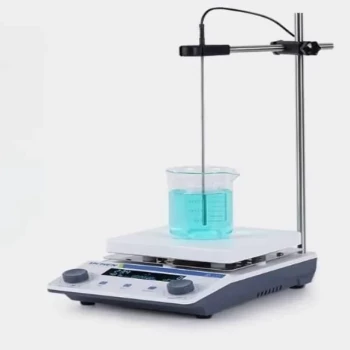
A magnetic stirrer acts as the critical driver of mass transfer in electrochemical dye degradation experiments, ensuring that the reaction is not limited by how fast molecules can move through the liquid. By inducing forced fluid convection, it maintains electrolyte homogeneity and ensures that the pollutant molecules continuously reach the electrode surface where the degradation occurs.
The Core Takeaway In electrochemical setups, the electrode surface is where the "work" happens, but it is often starved of reactants due to slow natural diffusion. A magnetic stirrer solves this by thinning the diffusion layer and forcing reactant-rich solution to the electrode, thereby maximizing reaction kinetics and ensuring experimental data accurately reflects the bulk solution state.
Optimizing Reaction Kinetics
Overcoming the Diffusion Limit
In a static solution, a stagnant layer of liquid forms next to the electrode. This "diffusion layer" acts as a barrier, slowing down the movement of dye molecules toward the electrode.
The magnetic stirrer creates forced fluid convection, which physically scrubs this layer. By significantly reducing the thickness of the diffusion layer, the stirrer accelerates the transport of organic pollutants from the bulk solution to the reactive electrode surface.
Enhancing Reactant-Radical Contact
Dye degradation relies on the pollutant coming into contact with active species (such as radicals) produced at the anode.
High-speed stirring ensures thorough contact between the reactants and these active radicals. This physical action shortens the time required for diffusion, effectively increasing the overall rate of the electrolytic oxidation process.
Preventing Product Accumulation
Just as fuel must move toward the electrode, waste products must move away.
Continuous mixing accelerates the transport of reaction products away from the electrode surface. This prevents local saturation near the active sites, allowing fresh dye molecules to take their place and keeping the reaction moving efficiently.
Ensuring Data Accuracy and Homogeneity
Eliminating Concentration Gradients
Without stirring, the solution can develop "dead zones" or areas of varying concentration.
The magnetic stirrer provides continuous mixing to maintain electrolyte homogeneity. This eliminates concentration gradients, ensuring that the chemical conditions (such as dye concentration) are uniform throughout the reactor.
Validating Sensor Readings
Accurate monitoring is impossible if the solution is not uniform.
Because the stirrer ensures the bulk solution is well-mixed, sensors such as pH meters or thermometers provide data that is representative of the entire solution, rather than just a localized pocket of fluid near the probe.
Common Pitfalls to Avoid
The Risk of Surface Passivation
In the absence of sufficient mechanical shear force, reaction products or "passivation films" can accumulate on the electrode or catalyst surface.
This accumulation blocks active sites, effectively "choking" the reaction. A magnetic stirrer generates constant shear force that helps prevent the formation of these films, ensuring the electrode remains active and exposed to the solution throughout the experiment.
Relying on Natural Diffusion
A common mistake is underestimating the resistance of liquid-phase mass transfer.
Relying solely on natural diffusion (without stirring) often leads to artificially low reaction rates. This can result in misleading data where the efficiency of the electrode material appears lower than it actually is, simply because the reactants couldn't reach the surface fast enough.
Making the Right Choice for Your Goal
To maximize the effectiveness of your setup, consider your specific experimental focus:
- If your primary focus is Reaction Speed: Ensure high RPMs to minimize the diffusion layer thickness and maximize the mass transfer of dye molecules to the electrode surface.
- If your primary focus is Kinetic Analysis/Modeling: Maintain a constant, moderate stirring speed to ensure a stable mass transfer coefficient, allowing for reproducible calculation of reaction rate constants.
- If your primary focus is Electrode Longevity: Use sufficient shear force to prevent the accumulation of passivation films or reaction byproducts on the active sites of your anode.
Effective stirring transforms your experiment from a diffusion-limited crawl into a reaction-controlled process.
Summary Table:
| Feature | Impact on Electrochemical Degradation | Benefit for Researchers |
|---|---|---|
| Forced Convection | Thins the stagnant diffusion layer at the electrode | Accelerates reaction kinetics and dye removal rates |
| Fluid Shear Force | Prevents accumulation of passivation films | Maintains electrode activity and extends material life |
| Homogenization | Eliminates concentration and thermal gradients | Ensures sensor accuracy and reproducible kinetic data |
| Mass Transport | Rapidly moves products away from active sites | Prevents local saturation and maintains steady oxidation |
Elevate Your Electrochemical Research with KINTEK
Don't let diffusion limits compromise your experimental results. KINTEK specializes in precision laboratory equipment designed to optimize every stage of your research, from high-performance magnetic stirrers and shakers to advanced electrolytic cells and electrodes.
Whether you are performing dye degradation, battery research, or complex synthesis, our comprehensive portfolio—including high-temperature reactors, crushing systems, and cooling solutions—ensures your lab operates at peak efficiency.
Ready to scale your results? Contact KINTEK today to discover how our high-quality consumables and equipment can streamline your workflow and deliver more accurate, repeatable data.
References
- B. Chirsabesan, M. Vijay. MEMBRANE ASSISTED ELECTRO CHEMICAL DEGRADATION FOR QUINOLINE YELLOW, EOSIN B AND ROSE BENGAL DYES DEGRADATION. DOI: 10.34218/ijdmt.4.2.2013.30320130402003
This article is also based on technical information from Kintek Solution Knowledge Base .
Related Products
- Laboratory Small Constant Temperature Heated Magnetic Stirrer Heater and Stirrer
- Custom PTFE Teflon Parts Manufacturer for Magnetic Stirring Bar
- High Performance Laboratory Stirrers for Diverse Applications
- Three-dimensional electromagnetic sieving instrument
- Custom PTFE Teflon Parts Manufacturer for PTFE Stirring Bar Recovery Rod
People Also Ask
- What role does a magnetic stirrer with heating play in ZnO nanoparticle synthesis? Precision Control for Quality Results
- What role does a constant temperature heating magnetic stirrer play in MFC-HAp synthesis? Achieve Material Homogeneity
- What is the function of a laboratory magnetic stirrer in Ni–Cr–P electrodeposition? Optimize Ion Transport & Coating
- Why is a laboratory magnetic stirrer required for benzoic acid esters? Boost Reaction Speed & Yield with High RPM
- What role does a laboratory magnetic stirrer play in TiO2 and TiO2-Ag sol preparation? Master Chemical Kinetics