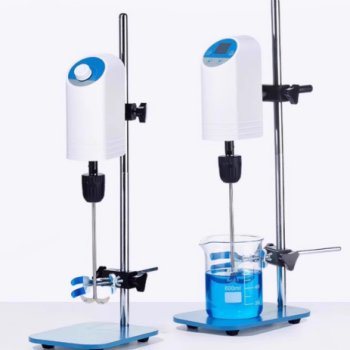
The magnetic stirrer serves as the primary driver for homogeneity during the liquid-phase co-precipitation of alpha-FeOOH precursors. Its function is to provide continuous, uniform mechanical power that ensures the complete integration of the sodium hydroxide solution with the ferrous sulfate and zinc sulfate solution.
The core value of magnetic stirring lies in its ability to facilitate molecular-level mixing. By eliminating concentration gradients, it strictly controls the nucleation process, directly resulting in precursors with a consistent fibrous morphology and uniform particle size.
The Mechanics of Mixture and Reaction
Delivering Continuous Mechanical Power
In liquid-phase co-precipitation, the physical interaction between reactants determines the chemical outcome. The magnetic stirrer provides the constant kinetic energy required to move fluids throughout the reaction vessel.
Achieving Molecular-Level Mixing
Mere contact between liquids is insufficient for high-quality synthesis; they must mix at the molecular level. The stirrer ensures that sodium hydroxide molecules are evenly distributed among the ferrous and zinc sulfate molecules.
Eliminating Reaction Dead Zones
Without active mechanical agitation, localized "hot spots" of high concentration can occur. Stirring ensures that the reaction environment is identical in every cubic millimeter of the solution.
Controlling Nucleation and Morphology
Regulating the Nucleation Process
The speed and uniformity of mixing directly influence how solid particles begin to form from the liquid phase. By controlling the mixing rate, the stirrer allows for a regulated nucleation event rather than chaotic precipitation.
Synthesizing Fibrous Precursors
The primary reference indicates that this specific mixing process favors a distinct geometry. Proper agitation directs the growth of the material into fibrous (fiber-like) precursors with a regular morphology.
Ensuring Uniform Particle Size
Consistency is the hallmark of a successful synthesis. The mechanical power of the stirrer guarantees that the resulting particles fall within a narrow, uniform size distribution, avoiding a mix of overly large and small particles.
Understanding Process Sensitivities
The Consequence of Inadequate Mixing
If the magnetic stirrer fails to provide sufficient power, the reactants will not achieve molecular-level uniformity. This lack of integration leads to uncontrolled nucleation rates.
Morphology Deviations
The desired fibrous structure is dependent on the flow dynamics created by the stirrer. Irregular or intermittent stirring will likely result in irregular particle shapes rather than the intended fibrous precursors.
Optimizing Your Synthesis Protocol
To ensure the successful preparation of alpha-FeOOH precursors, consider the following outcome-based guidelines:
- If your primary focus is Geometric Consistency: Ensure the stirrer provides uninterrupted power to maintain the regular, fibrous morphology of the precursor.
- If your primary focus is Particle Uniformity: Prioritize mixing speeds that achieve molecular-level integration to prevent broad particle size distributions.
The magnetic stirrer is not just a mixing tool; it is a control mechanism that defines the structural quality of your final material.
Summary Table:
| Stirring Function | Synthesis Impact | Key Outcome |
|---|---|---|
| Continuous Mechanical Power | Constant kinetic energy distribution | Complete reactant integration |
| Molecular-Level Mixing | Elimination of concentration gradients | Controlled nucleation process |
| Homogenization | Elimination of reaction dead zones | Uniform particle size distribution |
| Flow Dynamic Regulation | Directed crystal growth orientation | Regular fibrous (fiber-like) morphology |
Elevate Your Synthesis Precision with KINTEK
High-quality alpha-FeOOH precursors require absolute control over reaction dynamics. KINTEK provides the specialized laboratory tools necessary for sophisticated liquid-phase co-precipitation, including high-performance magnetic stirrers, precision crushing and milling systems, and advanced cooling solutions.
Whether you are focusing on battery research, material science, or chemical engineering, our comprehensive portfolio—from high-temperature furnaces and reactors to PTFE consumables and electrolytic cells—is designed to ensure your results are consistent, uniform, and reproducible.
Ready to optimize your lab’s morphology control? Contact KINTEK experts today to find the perfect equipment for your specific synthesis protocol.
References
- Yuanyuan Zhang, Jian‐Tang Jiang. Continuous iron spreading on carbon-shell composite nanotubes for electromagnetic wave absorption. DOI: 10.1038/s43246-024-00471-x
This article is also based on technical information from Kintek Solution Knowledge Base .
Related Products
- Laboratory Small Constant Temperature Heated Magnetic Stirrer Heater and Stirrer
- Custom PTFE Teflon Parts Manufacturer for Magnetic Stirring Bar
- High Performance Laboratory Stirrers for Diverse Applications
- Three-dimensional electromagnetic sieving instrument
- Custom PTFE Teflon Parts Manufacturer for PTFE Stirring Bar Recovery Rod
People Also Ask
- What role does a magnetic stirrer with heating play in ZnO nanoparticle synthesis? Precision Control for Quality Results
- What role does a constant temperature heating magnetic stirrer play in MFC-HAp synthesis? Achieve Material Homogeneity
- What is the function of a laboratory magnetic stirrer in Ni–Cr–P electrodeposition? Optimize Ion Transport & Coating
- Why is a laboratory magnetic stirrer required for benzoic acid esters? Boost Reaction Speed & Yield with High RPM
- What role does a laboratory magnetic stirrer play in TiO2 and TiO2-Ag sol preparation? Master Chemical Kinetics