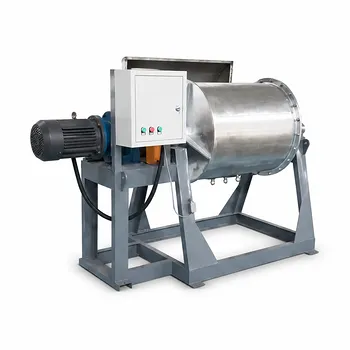
The planetary ball mill serves as the critical homogenization engine in the preparation of aluminum-based crucible slurry. Through the generation of intense impact and shear forces via high-speed rotation, it ensures the thorough dispersion of alumina powder, silica auxiliaries, and mullite fibers within deionized water.
Core Takeaway The planetary ball mill does more than simply mix ingredients; it structures the material at a microscopic level. By effectively breaking down powder agglomerates and disentangling reinforcing fibers, it creates a rheologically stable suspension essential for defect-free molding and uniform crucible strength.
The Mechanism of High-Energy Mixing
Generating Impact and Shear
The planetary ball mill operates by rotating a grinding jar around its own axis while simultaneously rotating around a central axis.
This dual-rotation creates significant centrifugal force. This force drives the grinding media (balls) to collide with the slurry materials, generating the high-energy impact and shear forces necessary to overcome the natural cohesion of fine powders.
Breaking Powder Agglomerations
Alumina and silica powders have a natural tendency to clump together, or agglomerate, when introduced to water.
The ball mill uses mechanical force to physically shatter these agglomerations. This ensures that every particle is individually wetted and dispersed, preventing dry pockets or weak spots in the final ceramic matrix.
Fiber Dispersion and Matrix Reinforcement
Uniform Distribution of Mullite Fibers
A unique challenge in aluminum-based crucible slurry is the inclusion of mullite fibers, which act as a reinforcing agent.
Standard mixing often leaves fibers bundled or segregated. The planetary ball mill's shear force effectively disentangles these fibers, distributing them evenly throughout the slurry.
Creating a Homogeneous Suspension
The result of this process is a highly uniform mixture where the reinforcing phase (fibers) and the matrix phase (alumina/silica) are perfectly integrated.
This homogeneity is critical for establishing stable rheological properties. A stable slurry ensures that the material flows predictably during the molding process, resulting in a crucible with consistent wall thickness and density.
Understanding the Trade-offs
The Risk of Over-Processing
While high-energy milling is effective, there is a balance to be struck regarding the mullite fibers.
Excessive milling time or speed can result in fiber degradation. If the impact forces grind the fibers down too finely, they lose their high aspect ratio, effectively stripping them of their ability to mechanically reinforce the crucible.
Contamination Concerns
High-energy collisions inevitably cause wear on the grinding media and jar linings.
If the grinding media material is not compatible with the slurry formulation, this wear can introduce impurities into the mixture. For high-purity applications, this can degrade the thermal or chemical resistance of the final crucible.
Making the Right Choice for Your Goal
To optimize your slurry preparation, tailor your milling parameters to your specific priorities:
- If your primary focus is Structural Integrity: Limit milling time to the minimum required for dispersion to preserve the length and reinforcing capability of the mullite fibers.
- If your primary focus is Surface Finish: Increase the milling energy slightly to ensure maximum de-agglomeration of the silica and alumina for a smoother final microstructure.
- If your primary focus is Process Stability: Prioritize consistent rotational speeds to maintain identical rheological properties from batch to batch, ensuring predictable molding behavior.
The planetary ball mill bridges the gap between raw ingredients and a high-performance ceramic composite.
Summary Table:
| Process Phase | Function of Planetary Ball Mill | Outcome |
|---|---|---|
| Powder Dispersion | Shatters alumina/silica agglomerates via high-energy impact | Prevents dry pockets; ensures uniform wetting |
| Fiber Integration | Disentangles mullite fibers using shear forces | Creates a reinforced matrix with even distribution |
| Slurry Stabilization | Homogenizes reinforcing and matrix phases | Establishes stable rheological properties for molding |
| Microstructure Control | Regulates particle size and fiber aspect ratio | Balances surface finish with structural integrity |
Upgrade your material synthesis with KINTEK’s advanced laboratory solutions. As experts in material processing, KINTEK specializes in high-performance crushing and milling systems, including planetary ball mills designed for the most demanding ceramic and slurry applications. Whether you are optimizing aluminum-based crucibles or researching battery materials, our comprehensive portfolio—from high-temperature furnaces and hydraulic presses to precision cooling solutions and PTFE consumables—ensures your lab achieves consistent, defect-free results. Contact us today to find the perfect equipment for your research!
References
- Hongna Fan, Xiqing Xu. Alumina-based crucibles with enhanced thermal shock resistance via reinforcement of mullite fibers. DOI: 10.23977/jmpd.2023.070303
This article is also based on technical information from Kintek Solution Knowledge Base .
Related Products
- High Energy Planetary Ball Mill for Laboratory Horizontal Tank Type Milling Machine
- Laboratory Planetary Ball Mill Rotating Ball Milling Machine
- High-Energy Omnidirectional Planetary Ball Mill Milling Machine for Laboratory
- High Energy Planetary Ball Mill Milling Machine for Laboratory
- Laboratory Horizontal Planetary Ball Mill Milling Machine
People Also Ask
- What is the role of a planetary ball mill in sulfide-based solid-state batteries? Engineer High-Performance Cathodes
- What are the parameters of a planetary ball mill? Master Speed, Time, and Media for Perfect Grinding
- What is the function of a planetary ball mill for nanostructured eutectic steel? Essential Prep for High-Strength Alloys
- What role does a planetary ball mill play in the preparation of NASICON-type solid electrolytes like LATP and LAGP?
- What is the function of a planetary ball mill in solid-state electrolyte prep? Milling vs. SDS Methods Explained