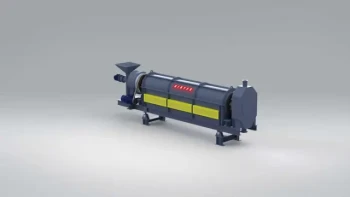
The primary role of a rotary kiln in treating waste composite materials is to facilitate thorough incineration by precisely managing residence time through rotational motion. This mechanical action ensures that the composite material remains in the high-temperature zone long enough to fully combust the organic polymer matrix.
Core Takeaway The rotary kiln serves as an energy recovery and volume reduction tool rather than a material preservation device. While it successfully converts the thermal value of polymers into heat or electricity, it intentionally destroys the reinforcement fibers, leaving behind ash and slag that can be repurposed as construction aggregates.
The Mechanism of Action
Controlled Residence Time
The defining feature of the rotary kiln is its ability to control how long waste remains inside the combustion chamber. Through its rotational speed and slight inclination, the kiln dictates the residence time of the material.
This ensures that complex composite structures are exposed to heat for a sufficient duration to achieve complete burnout.
Uniform Heating Through Agitation
As the cylinder rotates, it continuously stirs and turns the waste charge. This prevents cold spots and ensures that the composite materials are heated uniformly.
This agitation is critical for exposing all surface areas of the waste to the combustion air, facilitating a complete chemical reaction.
Energy and Material Outcomes
Converting Polymers to Energy
Composite materials consist of a reinforcement fiber embedded in a polymer matrix. The rotary kiln incinerates this polymer component, releasing its stored chemical energy.
This energy is captured and converted into heat or electricity, making the process a form of waste-to-energy recovery.
Significant Volume Reduction
By incinerating the bulky polymer matrix, the kiln drastically reduces the physical volume of the waste. This is essential for managing large quantities of scrap material that would otherwise consume massive amounts of landfill space.
Production of Construction Aggregates
Once the combustion is complete, the process leaves behind residual ash and slag. Because the high temperatures fuse these inorganic remains, the resulting byproduct is chemically inert.
This material is typically collected and utilized as aggregates for the construction industry, such as road base or concrete filler.
Understanding the Trade-offs
The Cost of Incineration: Fiber Destruction
It is critical to understand that a rotary kiln does not recover the reinforcement fibers (such as carbon or glass fibers) in their original state.
The primary reference explicitly states that this process results in the destruction of the fiber structure. If your goal is to reclaim high-value fibers for reuse in new composites, this is not the correct method.
Operational Versatility
A key advantage of the rotary kiln is its ability to handle diverse waste streams simultaneously. It can process solids, liquids, and sludge without requiring complex pre-sorting.
This makes it an ideal solution for mixed waste batches where high-precision separation is not economically viable.
Making the Right Choice for Your Goal
If you are evaluating rotary kiln technology for your waste stream, consider your end objectives:
- If your primary focus is Energy Recovery: The rotary kiln is highly effective at capturing the thermal value of the polymer matrix and reducing waste volume.
- If your primary focus is Material Recycling: This method is unsuitable, as it destroys the valuable fiber structure necessary for remanufacturing high-performance composites.
- If your primary focus is Waste Stabilization: The kiln is an excellent choice for rendering waste inert and converting residues into usable construction byproducts.
In summary, the rotary kiln is a disposal and energy-generation tool, not a fiber-recovery solution.
Summary Table:
| Feature | Function & Impact |
|---|---|
| Mechanism | Rotational agitation for uniform heating and controlled residence time |
| Polymer Treatment | Complete combustion of organic matrix for energy recovery (heat/electricity) |
| Waste Outcome | Significant volume reduction and conversion of residue into inert aggregates |
| Fiber Impact | Intentional destruction of reinforcement fibers (not for material recycling) |
| Versatility | Capable of processing mixed solids, liquids, and sludge without pre-sorting |
Maximize Your Waste-to-Energy Efficiency with KINTEK
Are you looking to streamline your waste management or enhance your thermal processing capabilities? KINTEK specializes in high-performance laboratory and industrial equipment, including advanced rotary kilns, muffle furnaces, and crushing systems designed for the most demanding applications.
Whether you need precision high-temperature furnaces for material testing or robust crushing and milling systems to prepare your waste streams, our expert team provides the comprehensive solutions and consumables you need to succeed. From PTFE products and ceramics to specialized reactors and autoclaves, we ensure your facility operates at peak efficiency.
Transform your laboratory or industrial waste processing today. Contact KINTEK now to consult with our experts and find the perfect equipment for your specific goals.
References
- Charitidis J. Panagiotis. Recycling of Carbon Fiber-Reinforced Composites-A Review. DOI: 10.48175/ijarsct-17474
This article is also based on technical information from Kintek Solution Knowledge Base .
Related Products
- Electric Rotary Kiln Small Rotary Furnace Biomass Pyrolysis Plant
- Electric Rotary Kiln Continuous Working Small Rotary Furnace Heating Pyrolysis Plant
- Electric Rotary Kiln Small Rotary Furnace for Activated Carbon Regeneration
- Electric Rotary Kiln Pyrolysis Furnace Plant Machine Calciner Small Rotary Kiln Rotating Furnace
- Vacuum Sealed Continuous Working Rotary Tube Furnace Rotating Tube Furnace
People Also Ask
- What is the temperature of a rotating kiln? It Depends on Your Material and Process Goal
- What are the principles of a rotary kiln? Master the Mechanics of High-Temperature Processing
- What are the different types of calciners? A Guide to Selecting the Right Thermal Processing Equipment
- How are rotary kilns heated? Direct vs. Indirect Heating Methods Explained
- Is rotary kiln a furnace? Discover the Key Differences for Industrial Processing