Knowledge How is the operational mode of bed motion selected for a rotary kiln? Optimize Heat Transfer and Material Homogeneity
Author avatar

Tech Team · Kintek Solution

Updated 1 day ago

How is the operational mode of bed motion selected for a rotary kiln? Optimize Heat Transfer and Material Homogeneity


The selection of bed motion in a rotary kiln is determined primarily by the specific goal of the application. Operators select an operational mode based on whether the priority is thermal efficiency or material homogeneity. Generally, drying processes utilize a cascading mode, while mixing objectives utilize a rolling mode.

The optimal bed motion is a function of your process objective. Cascading modes are selected to maximize particle exposure to heat transfer fluids, whereas rolling modes are selected to prioritize thorough mixing of the material.

Matching Motion to Process Goals

The Cascading Mode

This mode is selected when the primary objective is drying.

In a cascading motion, the material bed rises higher along the kiln wall before showering down through the internal atmosphere. This maximizes the surface area exposure between individual particles and the heat transfer fluid (hot gas), significantly improving thermal efficiency.

The Rolling Mode

This mode is chosen when the primary objective is mixing.

If the goal is to homogenize the material or ensure uniform chemical reactions, the rolling mode is preferred. This motion keeps the bed lower and encourages a gentle, continuous turnover of the solids, ensuring consistent material properties without aggressive aeration.

Factors Influencing the Motion

Rotational Speed

The transition between modes is largely controlled by the kiln’s rotation speed.

Cascading motion generally occurs at higher rotational rates, where centrifugal force lifts the leading edge of the bed above the surface. Rolling motion typically occurs at lower, more moderate speeds.

Physical Kiln Parameters

While speed is the variable, the kiln's fixed construction sets the baseline for these motions.

Parameters such as the inclination angle (usually 1 to 3 degrees) and the kiln's diameter determine how the material flows toward the discharge. These physical constraints must be aligned with the desired speed to maintain the correct residence time.

Understanding the Trade-offs

Material Attrition and Dust

While cascading offers superior heat transfer, it comes with physical risks.

Operating at the higher speeds required for cascading can lead to material attrition (particle breakage) and increased dust generation. If your material is fragile or if dust containment is a major constraint, a cascading mode may not be viable despite its thermal benefits.

The Danger of Centrifuging

There is an upper limit to rotational speed known as "centrifuging."

This occurs at critical high speeds where centrifugal force causes the entire material bed to adhere to the drum wall, rotating with it rather than tumbling. This mode is inefficient and generally avoided, as it halts mixing and reduces heat transfer effectiveness.

Making the Right Choice for Your Goal

To select the correct operational mode, you must define the critical success factor of your process.

  • If your primary focus is Drying or Heat Transfer: Target a cascading mode to maximize the contact area between the solids and the hot gas stream.
  • If your primary focus is Homogeneity or Reaction Uniformity: Target a rolling mode to ensure consistent mixing while minimizing particle degradation.

By aligning the kiln's rotational speed with your specific process goal, you ensure both operational efficiency and product quality.

Summary Table:

Operational Mode Primary Process Goal Key Benefit Ideal Application
Cascading Drying / Heat Transfer Maximized surface area exposure Thermal processing & moisture removal
Rolling Mixing / Homogenization Uniform chemical reactions Solid material blending & reaction consistency
Centrifuging N/A (Avoided) None (Material adheres to wall) Not recommended for standard processing

Optimize Your Thermal Processing with KINTEK

Precision in bed motion selection is critical for high-quality material processing. At KINTEK, we provide industry-leading rotary kilns, muffle furnaces, and vacuum systems designed to give you total control over thermal efficiency and material homogeneity.

Whether you are scaling up battery research with our CVD/PECVD solutions or require robust crushing, milling, and hydraulic press systems, our experts are ready to help you select the perfect equipment for your laboratory or industrial application.

Maximize your productivity and ensure product quality today—contact KINTEK for a consultation!

Related Products

People Also Ask

Related Products

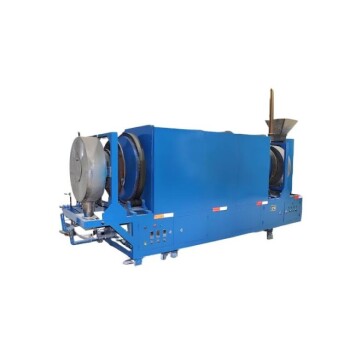
Electric Rotary Kiln Continuous Working Small Rotary Furnace Heating Pyrolysis Plant

Electric Rotary Kiln Continuous Working Small Rotary Furnace Heating Pyrolysis Plant

Efficiently calcine and dry bulk powder and lump fluid materials with an electric heating rotary furnace. Ideal for processing lithium ion battery materials and more.

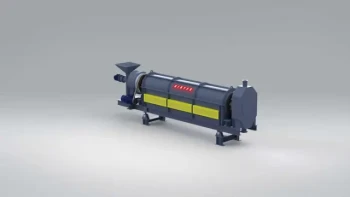
Electric Rotary Kiln Pyrolysis Furnace Plant Machine Calciner Small Rotary Kiln Rotating Furnace

Electric Rotary Kiln Pyrolysis Furnace Plant Machine Calciner Small Rotary Kiln Rotating Furnace

Electric rotary kiln - precisely controlled, it's ideal for calcination and drying of materials like lithium cobalate, rare earths, and non-ferrous metals.

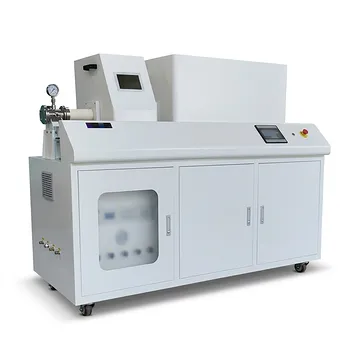
Vacuum Sealed Continuous Working Rotary Tube Furnace Rotating Tube Furnace

Vacuum Sealed Continuous Working Rotary Tube Furnace Rotating Tube Furnace

Experience efficient material processing with our vacuum-sealed rotary tube furnace. Perfect for experiments or industrial production, equipped with optional features for controlled feeding and optimized results. Order now.

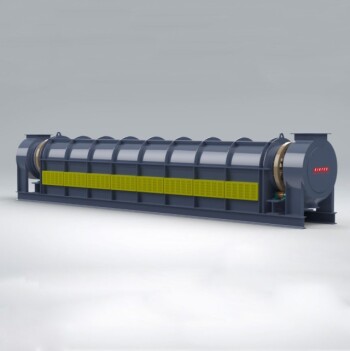
Electric Rotary Kiln Small Rotary Furnace Biomass Pyrolysis Plant

Electric Rotary Kiln Small Rotary Furnace Biomass Pyrolysis Plant

Learn about Rotary Biomass Pyrolysis Furnaces & how they decompose organic material at high temps without oxygen. Use for biofuels, waste processing, chemicals & more.

Rotary Tube Furnace Split Multi Heating Zone Rotating Tube Furnace

Rotary Tube Furnace Split Multi Heating Zone Rotating Tube Furnace

Multi zone rotary furnace for high-precision temperature control with 2-8 independent heating zones. Ideal for lithium ion battery electrode materials and high-temperature reactions. Can work under vacuum and controlled atmosphere.

Laboratory Vacuum Tilt Rotary Tube Furnace Rotating Tube Furnace

Laboratory Vacuum Tilt Rotary Tube Furnace Rotating Tube Furnace

Discover the versatility of Laboratory Rotary Furnace: Ideal for calcination, drying, sintering, and high-temperature reactions. Adjustable rotating and tilting functions for optimal heating. Suitable for vacuum and controlled atmosphere environments. Learn more now!

RRDE rotating disk (ring disk) electrode / compatible with PINE, Japanese ALS, Swiss Metrohm glassy carbon platinum

RRDE rotating disk (ring disk) electrode / compatible with PINE, Japanese ALS, Swiss Metrohm glassy carbon platinum

Elevate your electrochemical research with our Rotating Disk and Ring Electrodes. Corrosion resistant and customizable to your specific needs, with complete specifications.

Graphite Vacuum Furnace IGBT Experimental Graphitization Furnace

Graphite Vacuum Furnace IGBT Experimental Graphitization Furnace

IGBT experimental graphitization furnace, a tailored solution for universities and research institutions, with high heating efficiency, user-friendliness, and precise temperature control.

Graphite Vacuum Furnace Negative Material Graphitization Furnace

Graphite Vacuum Furnace Negative Material Graphitization Furnace

Graphitization furnace for battery production has uniform temperature and low energy consumption. Graphitization furnace for negative electrode materials: an efficient graphitization solution for battery production and advanced functions to enhance battery performance.

Vacuum Hot Press Furnace Machine for Lamination and Heating

Vacuum Hot Press Furnace Machine for Lamination and Heating

Experience clean and precise lamination with Vacuum Lamination Press. Perfect for wafer bonding, thin-film transformations, and LCP lamination. Order now!

Horizontal High Temperature Graphite Vacuum Graphitization Furnace

Horizontal High Temperature Graphite Vacuum Graphitization Furnace

Horizontal Graphitization Furnace: This type of furnace is designed with the heating elements placed horizontally, allowing for uniform heating of the sample. It's well-suited for graphitizing large or bulky samples that require precise temperature control and uniformity.

Laboratory Disc Rotary Mixer for Efficient Sample Mixing and Homogenization

Laboratory Disc Rotary Mixer for Efficient Sample Mixing and Homogenization

Efficient Laboratory Disc Rotary Mixer for Precise Sample Mixing, Versatile for Various Applications, DC Motor and Microcomputer Control, Adjustable Speed and Angle.

Ultra-High Temperature Graphite Vacuum Graphitization Furnace

Ultra-High Temperature Graphite Vacuum Graphitization Furnace

The ultra-high temperature graphitization furnace utilizes medium frequency induction heating in a vacuum or inert gas environment. The induction coil generates an alternating magnetic field, inducing eddy currents in the graphite crucible, which heats up and radiates heat to the workpiece, bringing it to the desired temperature. This furnace is primarily used for graphitization and sintering of carbon materials, carbon fiber materials, and other composite materials.

Small Vacuum Heat Treat and Tungsten Wire Sintering Furnace

Small Vacuum Heat Treat and Tungsten Wire Sintering Furnace

The small vacuum tungsten wire sintering furnace is a compact experimental vacuum furnace specially designed for universities and scientific research institutes. The furnace features a CNC welded shell and vacuum piping to ensure leak-free operation. Quick-connect electrical connections facilitate relocation and debugging, and the standard electrical control cabinet is safe and convenient to operate.

Platinum Sheet Electrode for Battery Lab Applications

Platinum Sheet Electrode for Battery Lab Applications

Platinum sheet is composed of platinum, which is also one of the refractory metals. It is soft and can be forged, rolled and drawn into rod, wire, plate, tube and wire.

Platinum Sheet Electrode for Laboratory and Industrial Applications

Platinum Sheet Electrode for Laboratory and Industrial Applications

Elevate your experiments with our Platinum Sheet Electrode. Crafted with quality materials, our safe and durable models can be tailored to fit your needs.


Leave Your Message