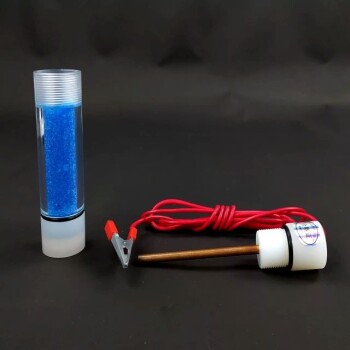
A stainless steel electrode serves as the cathode in the electrochemical synthesis of chlorates. Its primary function is to facilitate the reduction of water, a reaction that releases hydrogen gas and generates hydroxyl ions ($OH^-$). This generation of hydroxyl ions is not merely a byproduct; it is the fundamental mechanism for creating the alkaline environment required for the synthesis to proceed.
The stainless steel cathode acts as a chemical facilitator. By generating hydroxide ions, it creates the specific pH conditions necessary for chlorine gas to undergo disproportionation, transforming it into hypochlorite and eventually chlorate.
The Mechanism of Action
Reduction of Water molecules
At the surface of the stainless steel cathode, electrical current drives a reduction reaction. Water molecules ($H_2O$) accept electrons and split apart.
Release of Hydrogen Gas
This splitting process releases hydrogen gas ($H_2$) as bubbles. This is the visible physical output of the cathode's operation.
Generation of Hydroxyl Ions
Simultaneously, the reaction leaves behind hydroxyl ions ($OH^-$). The accumulation of these ions directly increases the pH in the immediate vicinity of the electrode.
The Critical Role of Alkalinity
Enabling Chemical Conversion
The synthesis of chlorate is not purely electrochemical; it relies heavily on chemical reactions in the bulk solution. The chlorine gas present in the system requires an alkaline environment to react effectively.
Driving Disproportionation
The hydroxyl ions produced by the stainless steel cathode react with chlorine. This causes the chlorine to "disproportionate," meaning it splits into different compounds.
Forming the Final Product
This reaction first forms hypochlorite, which serves as the intermediate precursor. Through further reaction steps in this alkaline medium, the hypochlorite is ultimately converted into the desired chlorate product.
Understanding the Trade-offs
Material Compatibility
Stainless steel is chosen specifically for its durability in alkaline electrolytes. While it is highly resistant to corrosion in the high-pH environment it creates, it performs poorly in acidic conditions.
The Importance of Polarity
Because stainless steel relies on the alkaline "shield" generated during operation, it must remain the cathode. If the polarity were reversed, or if the electrolyte became highly acidic, the material would rapidly degrade.
Making the Right Choice for Your Goal
To maximize the efficiency of your electrochemical cell, consider the following regarding your electrode selection:
- If your primary focus is longevity: Ensure the cell maintains continuous operation or proper alkaline storage conditions to protect the stainless steel from acidic corrosion.
- If your primary focus is reaction efficiency: Verify that your cathode surface area is sufficient to generate the high concentration of hydroxyl ions needed to fully convert the available chlorine.
The stainless steel cathode is the essential driver of alkalinity, bridging the gap between raw electrical input and the chemical formation of chlorates.
Summary Table:
| Feature | Role/Impact in Chlorate Synthesis |
|---|---|
| Primary Reaction | Reduction of water molecules to $H_2$ gas and $OH^-$ |
| pH Regulation | Increases local alkalinity to enable chlorine disproportionation |
| Chemical Driver | Converts chlorine into hypochlorite and eventually chlorates |
| Material Durability | Highly resistant to corrosion in the alkaline electrolytes produced |
| Operational Limit | Must remain the cathode; sensitive to acidic environments |
Maximize Your Electrochemical Efficiency with KINTEK
Precision in electrochemical synthesis requires more than just high-quality electrodes. At KINTEK, we empower laboratory researchers and industrial engineers with a comprehensive range of electrolytic cells, electrodes, and high-performance consumables designed for durability and reaction accuracy.
Whether you are refining chlorate production or exploring advanced battery research, our expert-grade equipment—including high-temperature reactors, vacuum furnaces, and specialized ceramics—is engineered to withstand the most demanding chemical environments.
Ready to optimize your lab’s output? Contact KINTEK today to discover how our tailored laboratory solutions and high-pressure systems can elevate your research results.
References
- Mayra Kerolly Sales Monteiro, Manuel A. Rodrigo. Towards the production of chlorine dioxide from electrochemically <scp><i>in‐situ</i></scp> produced solutions of chlorate. DOI: 10.1002/jctb.7073
This article is also based on technical information from Kintek Solution Knowledge Base .
Related Products
- Reference Electrode Calomel Silver Chloride Mercury Sulfate for Laboratory Use
- Copper Sulfate Reference Electrode for Laboratory Use
People Also Ask
- What is the function of a reference electrode? Master Precision in Three-Electrode Reactor Reconstruction
- What is the recommended maintenance for the filling solution of a reference electrode? A Guide to Stable & Accurate Readings
- Which electrode is used as a ground reference? Master the Key to Accurate Electrochemical Measurements
- What is the reference electrode in potentiometry? The Key to Stable & Accurate Measurements
- Which electrode is used as a reference? A Guide to Accurate Electrochemical Measurements