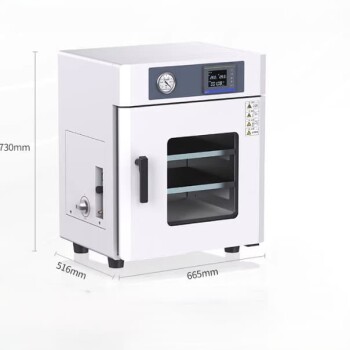
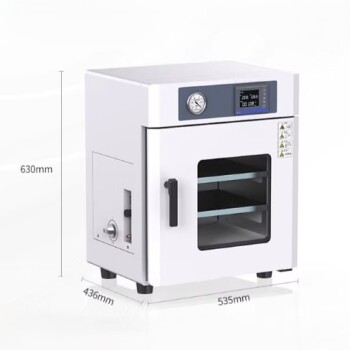
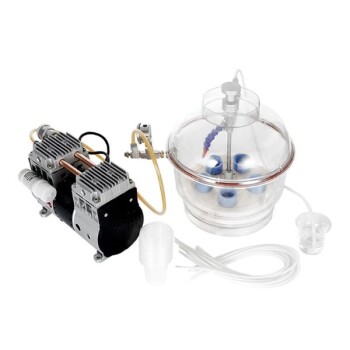
The vacuum drying oven serves as a critical purification and preservation stage for ball-milled LLZTO-polymer slurries. Its primary function is to thoroughly remove residual solvents, such as isopropanol, following centrifugal separation, ensuring the material is completely dry without subjecting it to damaging thermal stress.
By operating under negative pressure, the vacuum oven lowers the solvent's boiling point to facilitate rapid evaporation at controlled temperatures. This process isolates the sensitive slurry from the atmosphere, preventing oxidation and moisture absorption to preserve the electrochemical purity of the final powder.
The Mechanics of Solvent Removal
Lowering the Boiling Point
The fundamental advantage of this process is the ability to dry materials at significantly lower temperatures.
By creating a vacuum environment, the oven reduces the atmospheric pressure surrounding the slurry. This physics principle allows solvents like isopropanol to boil and evaporate at temperatures well below their standard boiling points, often around 60°C.
Accelerating Evaporation
Speed is essential in processing to prevent component segregation.
The vacuum environment creates a pressure differential that pulls solvent vapors away from the material surface. This accelerates the drying rate compared to standard atmospheric heating, ensuring the LLZTO-polymer slurry dries efficiently and uniformly.
Protecting the Electrolyte Chemistry
Preventing Oxidation
Standard heating methods expose materials to oxygen, which can degrade sensitive components.
The vacuum drying oven removes air from the chamber, creating an inert environment. This effectively prevents the LLZTO powder from oxidizing during the heating process, maintaining the chemical stability required for high-performance solid-state electrolytes.
Eliminating Moisture Absorption
LLZTO materials are often sensitive to environmental humidity.
The vacuum process strictly isolates the slurry from atmospheric moisture. This is critical for ensuring the dryness and purity of the final electrolyte powder, as absorbed moisture can lead to detrimental side reactions or reduced ionic conductivity in the final battery cell.
Understanding the Trade-offs
Process Speed vs. Material Integrity
While vacuum drying is faster than air drying at the same temperature, it is generally slower than high-temperature calcination.
The trade-off here is accepting a slightly longer processing time to guarantee material preservation. Rushing this step with higher heat could compromise the polymer structure or degrade the ceramic phase.
Operational Complexity
Vacuum drying requires precise control over pressure and temperature variables.
Unlike a simple convection oven, operators must monitor the vacuum levels to ensure they remain consistent. A failure in the vacuum seal not only halts drying but can immediately re-introduce moisture and oxygen to the sensitive LLZTO slurry.
Making the Right Choice for Your Goal
To maximize the effectiveness of vacuum drying for your specific electrolyte processing needs, consider these priorities:
- If your primary focus is Material Purity: Prioritize checking vacuum integrity to ensure zero exposure to atmospheric moisture, which is the primary contaminant for LLZTO.
- If your primary focus is Process Efficiency: Optimize the temperature setpoint (e.g., strictly at 60°C) to balance the fastest possible solvent evaporation without approaching the thermal degradation limit of the polymer.
The vacuum drying oven is not just a drying tool; it is an active protection barrier that guarantees the chemical viability of your solid-state electrolyte.
Summary Table:
| Feature | Role in LLZTO-Polymer Processing | Benefit for Solid-State Electrolytes |
|---|---|---|
| Vacuum Environment | Lowers solvent boiling points (e.g., Isopropanol) | Enables rapid drying at low temperatures (60°C) |
| Inert Atmosphere | Eliminates oxygen exposure during heating | Prevents chemical oxidation of the ceramic phase |
| Moisture Isolation | Removes atmospheric humidity from the chamber | Ensures high ionic conductivity and electrochemical purity |
| Pressure Differential | Pulls solvent vapors away from material surface | Accelerates evaporation and prevents component segregation |
Elevate Your Battery Research with KINTEK Precision
Precise control over material purity is the cornerstone of high-performance solid-state electrolyte development. KINTEK specializes in advanced laboratory equipment designed to meet the rigorous demands of battery research. From our high-performance vacuum drying ovens that ensure the chemical viability of your LLZTO slurries to our industry-leading crushing and milling systems and isostatic hydraulic presses, we provide the end-to-end solutions your lab requires.
Whether you are optimizing high-temperature furnaces, refining materials with our ball-milled systems, or sourcing essential PTFE and ceramic consumables, KINTEK delivers the reliability and innovation needed to accelerate your results.
Ready to enhance your lab's efficiency and material integrity?
Contact our specialists today to find the perfect solution for your research!
Related Products
- 56L Vertical Laboratory Vacuum Drying Oven
- 23L Laboratory Vacuum Drying Oven
- Laboratory Scientific Electric Heating Blast Drying Oven
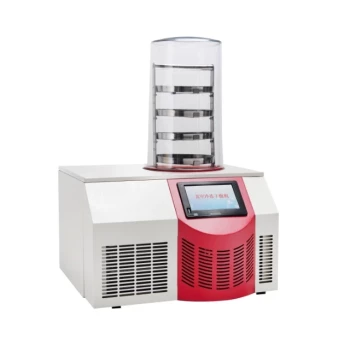
- Benchtop Laboratory Vacuum Freeze Dryer
- Dental Porcelain Zirconia Sintering Ceramic Vacuum Press Furnace
People Also Ask
- Why is a laboratory vacuum drying oven recommended for rice straw residues? Protect Your Biomass Integrity
- What role does a laboratory vacuum drying oven play in the preparation of modified multi-walled carbon nanotubes?
- What is the importance of using a laboratory vacuum drying oven? Preserving Slow-Release Microcapsule Integrity
- Why is a Laboratory Vacuum Drying Oven recommended for PBAT microspheres? Protect Sensitive Polymer Integrity
- What role does a laboratory vacuum drying oven play in processing nanoparticle powder samples? Protect Sample Integrity