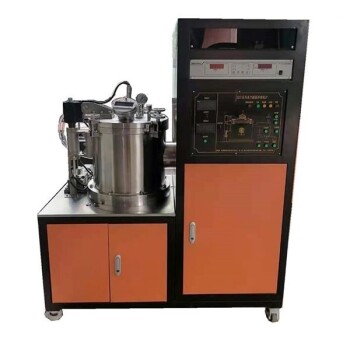
The induction melting furnace serves as the critical starting point for creating high-purity baseline materials in nuclear research. Its primary role is to melt and precisely control the composition of refractory metals—specifically niobium, tantalum, and iron-based alloys—to ensure exceptional uniformity. By minimizing impurities and crystal defects during the melting process, this technology removes the variables that typically distort the study of hydrogen diffusion in radiation-resistant materials.
Core Takeaway The study of hydrogen behavior in nuclear materials requires a "clean slate" because microscopic imperfections significantly alter diffusion patterns. The induction melting furnace provides this by producing alloys with high uniformity, allowing researchers to accurately isolate and analyze the specific degradation mechanisms caused by hydrogen atoms.
Achieving Material Uniformity
Processing Refractory Metals
The development of radiation-resistant materials often relies on refractory metals and their alloys.
The induction melting furnace is specifically utilized for processing high-melting-point materials such as niobium, tantalum, and iron-based alloys. These materials are candidates for nuclear applications but require precise thermal processing to maintain their integrity.
Controlling Composition
In nuclear fusion technology, the exact chemical makeup of a material dictates its performance.
Induction melting allows for precise composition control. This ensures that the final alloy matches the exact theoretical specifications required for testing, without the accidental introduction of foreign elements that often occurs in less controlled melting environments.
Minimizing Crystal Defects
The internal structure of the metal is just as important as its chemical makeup.
Impurity atoms and crystal defects act as traps or barriers. The high uniformity achieved through induction melting minimizes these structural flaws, ensuring the material is consistent throughout its volume.
The Critical Link to Hydrogen Diffusion
Removing Interference
Hydrogen atoms are incredibly small and mobile.
Because of this, their movement (diffusion) is easily disrupted by irregularities in the metal's lattice. If a material has random impurities or defects, they will interfere with hydrogen diffusion patterns, making it impossible to distinguish between the material's intrinsic properties and the effects of poor manufacturing.
Studying Ultra-High Mobility
To develop better materials, scientists must observe how hydrogen moves at high speeds.
The furnace enables the creation of samples suitable for studying the ultra-high diffusion mobility of hydrogen atoms. By starting with a defect-free base, researchers can gather accurate data on how hydrogen permeates the metal under fusion conditions.
Analyzing Degradation Mechanisms
Hydrogen is a primary cause of material failure in nuclear environments.
By using high-purity alloys produced in these furnaces, scientists can isolate the degradation mechanisms driven by hydrogen. This clarity is fundamental to engineering new alloys that can withstand the harsh environment of a nuclear reactor without becoming brittle or failing.
Operational Considerations and Trade-offs
The Necessity of Precision
While induction melting is powerful, it is not a "set it and forget it" solution.
The process requires rigorous control. If the melting parameters are not perfectly tuned, even an induction furnace can introduce inconsistencies. In the context of hydrogen diffusion, even marginal lack of uniformity can render the resulting data scientifically invalid.
Material Specificity
This technology is optimized for specific material classes.
The primary reference highlights its utility for refractory metals and iron alloys. Attempting to apply the same melting protocols to materials with vastly different thermal properties or reactivity profiles may not yield the same level of uniformity required for nuclear-grade research.
Strategic Application in Material Science
To effectively utilize induction melting in the development of fusion materials, you must align the output with your specific research objectives.
- If your primary focus is fundamental research: Prioritize the elimination of crystal defects to study the intrinsic ultra-high diffusion mobility of hydrogen without interference.
- If your primary focus is alloy engineering: Use the furnace's precise composition control to iteratively test how slight adjustments in niobium or tantalum ratios affect resistance to degradation.
The induction melting furnace transforms the chaotic variables of metal production into a controlled constant, enabling the precise science required for nuclear fusion innovation.
Summary Table:
| Key Role | Impact on Nuclear Material Development |
|---|---|
| Composition Control | Ensures exact ratios of niobium, tantalum, and iron-based alloys. |
| Impurity Reduction | Minimizes crystal defects that act as traps for hydrogen atoms. |
| Uniformity | Creates a 'clean slate' to accurately measure ultra-high diffusion mobility. |
| Degradation Analysis | Enables isolation of specific failure mechanisms under fusion conditions. |
Elevate Your Nuclear Material Research with KINTEK
Precise material synthesis is the foundation of innovation in nuclear fusion and hydrogen diffusion studies. At KINTEK, we specialize in high-performance laboratory equipment designed to meet the rigorous demands of material science. Our range of induction melting systems and high-temperature furnaces (vacuum, atmosphere, and tube) provides the exceptional composition control and uniformity required to eliminate variables in your research.
From advanced crushing and milling systems to precision hydraulic presses and high-purity ceramic crucibles, KINTEK delivers the comprehensive tools researchers need to develop the next generation of radiation-resistant materials.
Ready to achieve superior material purity and research accuracy?
Contact KINTEK Today to discuss your specific laboratory needs with our experts!
References
- S. V. Bobyr. Theoretical Methods of Hydrogen Diffusion Calculation in Metals Review. DOI: 10.19080/jojms.2023.07.555725
This article is also based on technical information from Kintek Solution Knowledge Base .
Related Products
- Lab-Scale Vacuum Induction Melting Furnace
- Vacuum Heat Treat Furnace and Levitation Induction Melting Furnace
- Non Consumable Vacuum Arc Induction Melting Furnace
- Vacuum Arc Induction Melting Furnace
- 600T Vacuum Induction Hot Press Furnace for Heat Treat and Sintering
People Also Ask
- How do vacuum induction or arc melting furnaces facilitate the synthesis of U-Al-C MAX phases? Precision Heat & Purity
- Why use VIM for rare earth steel? Essential Precision for Melting Reactive Lanthanum and Cerium
- What is the primary function of a vacuum induction melting furnace in Ni-Mo-Cr-Fe master alloy prep? Ensure High Purity
- What types of metals are typically processed in a vacuum induction melting furnace? High-Purity Alloys for Critical Applications
- What are the advantages of a vacuum induction melting furnace? Achieve High-Purity Alloys with Precision VIM