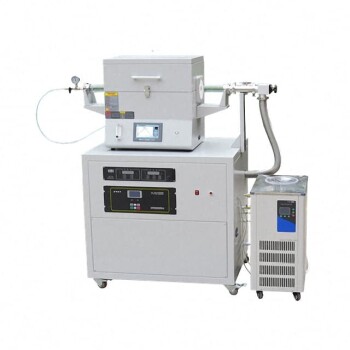
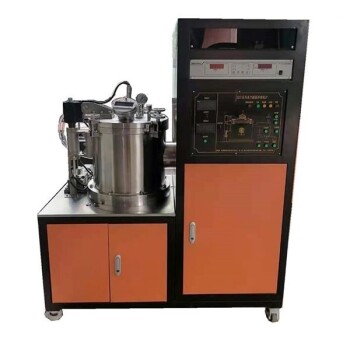
A vacuum tube furnace establishes a high-vacuum or negative-pressure environment. This specific atmospheric condition is mandatory during the high-temperature phase of cold-press sintering to isolate reactive materials from oxygen and contaminants.
The vacuum environment serves a dual purpose: it prevents the oxidation of copper and rare earth elements while actively removing trapped internal gases from the green compact to ensure material purity.
Preserving Chemical Composition
The primary challenge in sintering copper is its reactivity with oxygen. The vacuum tube furnace addresses this by altering the fundamental atmosphere of the processing chamber.
Preventing Copper Oxidation
Copper powder oxidizes rapidly when exposed to high temperatures in standard air.
The vacuum furnace eliminates oxygen from the chamber. This ensures the copper remains in its pure metallic state throughout the thermal cycle.
Protecting Rare Earth Elements
Advanced copper-based materials often incorporate rare earth elements to enhance performance.
These elements are exceptionally sensitive to oxidation, even more so than copper. A high-vacuum environment is critical to prevent these additives from degrading and losing their functional properties.
Enhancing Physical Structure
Beyond chemical protection, the pressure conditions within the furnace play a structural role in the sintering process.
Degassing the Green Compact
The "green compact"—the pressed powder shape before sintering—inevitably contains trapped air and volatiles within its pores.
A negative-pressure environment actively draws these internal gases out of the material. This process is essential for closing voids that would otherwise weaken the structure.
Ensuring Final Material Purity
By removing both external oxygen and internal trapped gases, the furnace maximizes the density of the final product.
This results in a sintered material with superior mechanical and electrical performance, free from the defects caused by gas inclusions.
Operational Considerations and Trade-offs
While a vacuum environment is superior for copper sintering, it introduces specific processing constraints that must be managed.
The Requirement for Seal Integrity
The effectiveness of this process relies entirely on maintaining a negative pressure.
Any leak in the tube furnace or vacuum system will immediately introduce oxygen. This compromises the entire batch, leading to oxidation and part rejection.
Processing Complexity
Creating a high-vacuum environment requires specialized pumping systems and longer cycle setup times compared to atmospheric furnaces.
This adds complexity to the workflow but is a non-negotiable trade-off to achieve the required material properties for copper-based applications.
Making the Right Choice for Your Project
The decision to use a vacuum tube furnace is driven by the strict chemical requirements of your materials.
- If your primary focus is material purity: The vacuum environment is essential to actively extract trapped gases from the green compact to prevent porosity.
- If your primary focus is alloy stability: You must use high vacuum to protect reactive rare earth elements that would otherwise degrade immediately upon heating.
Success in cold-press sintering of copper relies on the absolute exclusion of oxygen to ensure high performance.
Summary Table:
| Feature | Environmental Condition | Impact on Copper Sintering |
|---|---|---|
| Atmosphere | High Vacuum / Negative Pressure | Prevents oxidation of copper and rare earth elements |
| Gas Content | Oxygen-Free | Preserves chemical composition and material functional properties |
| Porosity Control | Active Degassing | Removes trapped gases from green compacts to increase density |
| Structural Integrity | Low Contaminant | Eliminates internal voids for superior mechanical performance |
Elevate Your Material Purity with KINTEK
Precision in sintering requires absolute control over your thermal environment. At KINTEK, we specialize in advanced vacuum tube furnaces, CVD systems, and high-pressure reactors designed to meet the rigorous demands of copper-based research and production. Whether you are protecting sensitive rare earth elements or aiming for maximum material density, our laboratory equipment ensures the oxygen-free conditions essential for success.
Why choose KINTEK?
- Unmatched Reliability: High-integrity sealing systems for consistent negative pressure.
- Comprehensive Solutions: From crushing and milling systems to isostatic presses and high-temperature furnaces, we provide the full workflow.
- Expert Support: Tailored consumables including high-purity ceramics and crucibles to prevent batch contamination.
Contact our laboratory specialists today to optimize your sintering process!
Related Products
- Vacuum Sealed Continuous Working Rotary Tube Furnace Rotating Tube Furnace
- Laboratory High Pressure Vacuum Tube Furnace
- Laboratory Vacuum Tilt Rotary Tube Furnace Rotating Tube Furnace
- Split Chamber CVD Tube Furnace with Vacuum Station Chemical Vapor Deposition System Equipment Machine
- 1200℃ Controlled Atmosphere Furnace Nitrogen Inert Atmosphere Furnace
People Also Ask
- What are the advantages of using a rotary tube furnace for MoVOx catalysts? Elevate Uniformity and Crystallinity
- What are the process advantages of using a rotary tube furnace for WS2 powder? Achieve Superior Material Crystallinity
- Why is a vacuum tube furnace with argon protection required for RGO/Cu? Ensure Conductivity and Material Purity
- Why is a rotary tube furnace preferred over a fixed tube furnace for the carbonization of asphaltenes? Superior Quality
- What is a rotary tube furnace? Achieve Superior Uniformity for Powders and Granules