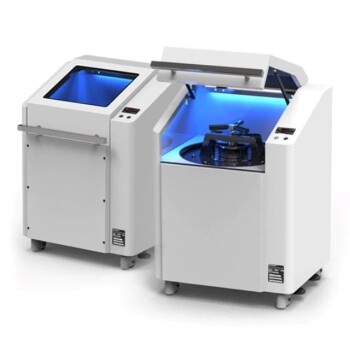
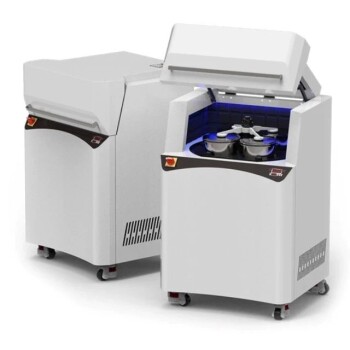
The industrial-grade dry vibration mill functions as the critical mechanism for high-energy milling in the creation of Oxide Dispersion Strengthened (ODS) iron-based alloys. Specifically, it processes yttria and iron oxide composite powders through continuous mechanical impact and friction. This mechanical action is necessary to reduce particle size and ensure a uniform distribution of components, creating the essential powder foundation required for subsequent sintering.
Core Takeaway The dry vibration mill is not merely a mixing device; it is a high-energy processing tool that forces the structural homogenization of raw materials. By subjecting powders to extended impact and friction, it creates the uniform, reactive precursor required to achieve the high-temperature strength and radiation resistance characteristic of ODS alloys.
The Mechanics of Preparation
High-Energy Impact and Friction
The primary function of the vibration mill is to deliver continuous mechanical impact and friction to the powder mixture.
Unlike simple stirring, this high-energy environment forces the materials to interact physically at a microscopic level. The process is rigorous and sustained, often requiring extended durations, such as 20 hours, to achieve the necessary state.
Particle Size Reduction
One of the most immediate measurable outcomes of this milling process is the significant reduction of powder particle size.
By breaking down the yttria and iron oxide particles, the mill increases the specific surface area of the material. This physical refinement is a prerequisite for the advanced material properties desired in the final alloy.
Homogenization of Components
The mill ensures a uniform distribution of the yttria and iron oxide components throughout the mixture.
This macroscopic and microscopic uniformity prevents segregation. It ensures that the strengthening oxide phases will be evenly dispersed across the matrix in the final solid metal.
Establishing the Foundation for Densification
Increasing Powder Reactivity
While the primary reference focuses on size and distribution, the mechanical action establishes a highly reactive state for the powder.
The high-energy input introduces microscopic defects and fresh surfaces. This effectively activates the powder, making it more receptive to bonding during the later stages of consolidation.
Preparing for Subsequent Alloying
The vibration mill output serves as a high-quality "master mix" for downstream processing.
Once this foundation is established, other elements, such as titanium powder, can be introduced. The uniform nature of the milled powder ensures that these subsequent additions are integrated effectively.
Enabling Advanced Sintering
The ultimate goal of this milling stage is to prepare the material for high-temperature consolidation, such as Spark Plasma Sintering (SPS).
The quality of the milled powder directly influences the success of sintering. A properly milled powder inhibits unwanted grain growth and facilitates the nano-scale dispersed phases that give ODS alloys their extreme durability.
Understanding the Trade-offs
Processing Time vs. Quality
The dry vibration milling process is time-intensive, necessitating cycle times that can span roughly 20 hours.
Shortcutting this duration risks incomplete homogenization or insufficient particle size reduction. This would lead to weak points in the final alloy, compromising its radiation resistance and high-temperature strength.
Energy Intensity
This method relies on high-intensity mechanical energy to achieve results.
It is an energy-demanding process compared to standard blending. However, this energy is not wasted; it is stored within the powder as internal strain and surface energy, which drives the densification process during final sintering.
Making the Right Choice for Your Goal
To maximize the performance of your ODS alloy production, consider how the milling stage aligns with your specific objectives:
- If your primary focus is Alloy Strength: Ensure the milling duration is sufficient to achieve maximum particle reduction and uniform dispersion, as this dictates the final mechanical properties.
- If your primary focus is Process Consistency: Standardize the specific impact energy and time (e.g., 20 hours) to maintain a repeatable "powder foundation" for the sintering phase.
- If your primary focus is Sintering Efficiency: Verify that the vibration mill has achieved sufficient "activation" of the powder, which will facilitate rapid densification during Spark Plasma Sintering.
The vibration mill is the gatekeeper of quality in ODS alloy production; without the uniformity it provides, advanced sintering techniques cannot recover the material's potential.
Summary Table:
| Key Role | Mechanical Action | Primary Outcome |
|---|---|---|
| Structural Homogenization | High-energy impact and friction | Uniform distribution of yttria and iron oxide |
| Particle Refinement | Continuous mechanical stress | Significant reduction in particle size |
| Powder Activation | Introduction of microscopic defects | Increased surface energy for better sintering |
| Pre-Alloying Foundation | Sustained milling (e.g., 20 hours) | Reactive precursor for Spark Plasma Sintering (SPS) |
Elevate Your Material Research with KINTEK
Precision in ODS alloy preparation starts with the right equipment. KINTEK specializes in advanced laboratory solutions designed to meet the rigorous demands of high-energy milling and sintering.
Our extensive portfolio includes:
- High-Performance Crushing & Milling Systems: Achieve superior homogenization and particle reduction.
- Sintering & High-Temperature Furnaces: Including Vacuum, CVD, and Atmosphere furnaces for advanced alloy consolidation.
- Hydraulic Presses: Pellet, hot, and isostatic presses for high-density material preparation.
- High-Pressure Reactors & Autoclaves: For specialized chemical and material synthesis.
Whether you are refining oxide dispersions or advancing battery research, our technical experts are ready to help you select the ideal tools for your workflow.
Contact KINTEK Today to Optimize Your Lab's Efficiency
References
- Fang Yang. Effects of Y2O3, Ti and Forming Processes on ODS-Iron Based Alloy. DOI: 10.4172/2157-7439.1000158
This article is also based on technical information from Kintek Solution Knowledge Base .
Related Products
- High Energy Vibratory Laboratory Ball Mill Grinding Mill Single Tank Type
- Vibratory Sieve Shaker Machine Dry Three-Dimensional Vibrating Sieve
- Laboratory Vibratory Sieve Shaker Machine for Dry and Wet Three-Dimensional Sieving
- Vibrating Disc Mill Small Laboratory Grinding Machine
- Low-Temperature Water-Cooled Touchscreen Vibratory Ultrafine Pulverizer
People Also Ask
- What is the function of a high-energy ball mill in the preparation of nanoparticle-reinforced steel? | KINTEK
- Why is a high-energy ball mill used in the preparation of NTP electrode slurries? Maximize Conductivity & Performance
- What is the role of a high-energy ball mill in Al/Si/Al2O3/SiO2/MWCNTs nanocomposites? Master Powder Pretreatment
- How is a high-energy ball mill utilized in the dry-process preparation of composite electrolytes? | KINTEK
- What is the role of a high-energy ball mill in battery material prep? Optimize Nanostructuring for Li-ion Performance