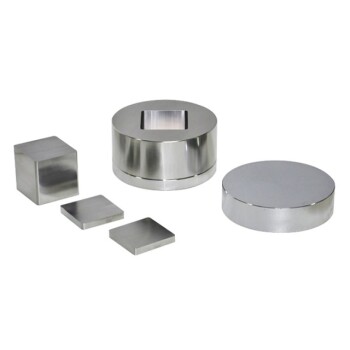
High-strength graphite molds serve as the critical processing interface during the vacuum hot pressing of Fe-ZTA (Iron-Zirconia Toughened Alumina) cermets. They function primarily as shaping containers that define the material's geometry while simultaneously transmitting axial pressures of up to 12 MPa at sintering temperatures reaching 1000°C.
The mold is not merely a passive vessel; it is an active mechanical and thermal component that enables the simultaneous application of heat and pressure necessary to densify loose powder into a structural composite.
The Mechanics of Densification
Transmitting Axial Force
The primary mechanical role of the graphite mold is to act as a transmission medium for the hydraulic system.
It transfers significant axial pressure—specifically up to 12 MPa for Fe-ZTA cermets—directly to the powder mixture. This pressure is essential for eliminating voids and achieving a dense final product.
Withstanding High-Temperature Stress
The mold must maintain its structural integrity while subjected to extreme thermal and mechanical loads simultaneously.
During the process, the mold operates at temperatures up to 1000°C without fracturing or deforming. This high-temperature strength ensures the pressure is applied effectively throughout the entire sintering cycle.
Thermal Management Roles
Facilitating Heat Transfer
Graphite is selected for these molds largely due to its high thermal conductivity.
This property ensures that the heat generated within the vacuum chamber is transferred rapidly and efficiently to the Fe-ZTA powder.
Ensuring Uniform Sintering
Effective thermal conductivity prevents thermal gradients where the outside of the sample might sinter faster than the core.
By promoting uniform heat distribution, the mold helps ensure the cermet achieves a consistent microstructure and uniform density throughout the component.
Geometric Definition
Determining Final Shape
The mold acts as the physical boundary that confines the pre-alloyed powders.
Because the process involves turning loose powder into a solid, the internal cavity of the graphite mold dictates the precise geometry and dimensions of the final Fe-ZTA billet.
Maintaining Dimensional Stability
To produce accurate parts, the mold itself must not warp or distort under the processing conditions.
High-strength graphite provides the necessary rigidity to ensure the final cermet retains the intended shape after cooling.
Understanding the Constraints
Chemical Compatibility Risks
While graphite is generally chosen for its stability, it must remain chemically inert relative to the specific composite materials being processed.
For Fe-ZTA cermets, the mold must contain the iron and ceramic phases without triggering harmful chemical reactions that could degrade the material's purity or make demolding difficult.
Service Life and Oxidation
Although vacuum environments minimize degradation, graphite molds are still subject to wear and potential oxidative loss over repeated cycles.
This gradual degradation can eventually affect dimensional tolerances, making the monitoring of mold condition a critical part of process control.
Making the Right Choice for Your Goal
When selecting or designing molds for Fe-ZTA vacuum hot pressing, prioritize the following based on your specific requirements:
- If your primary focus is Maximum Density: Ensure the graphite grade chosen has sufficient mechanical strength to withstand pressures exceeding 12 MPa without cracking.
- If your primary focus is Geometric Precision: Select high-density graphite with superior thermal stability to minimize expansion or warping at 1000°C.
By balancing thermal conductivity with mechanical robustness, you ensure the mold acts as an effective enabler of the Fe-ZTA cermet's final performance properties.
Summary Table:
| Functional Role | Key Contribution to Fe-ZTA Processing |
|---|---|
| Pressure Transmission | Delivers up to 12 MPa of axial force to eliminate voids and achieve density. |
| Thermal Conductivity | Enables rapid, uniform heat distribution at 1000°C for consistent microstructure. |
| Structural Stability | Withstands extreme thermo-mechanical stress without warping or fracturing. |
| Geometric Precision | Defines the final dimensions and shape of the solid cermet billet. |
| Chemical Containment | Provides a stable interface for iron and ceramic phases under vacuum. |
Elevate Your Material Research with KINTEK Precision
Achieving the perfect Fe-ZTA cermet requires more than just high temperatures; it demands the right equipment and precision tooling. KINTEK specializes in advanced laboratory solutions, providing the high-strength graphite molds and vacuum hot pressing systems (including hydraulic presses and high-temperature furnaces) essential for superior densification and geometric accuracy.
From high-temperature high-pressure reactors to specialized crushing and milling systems, we empower researchers and manufacturers with the tools needed for cutting-edge material science.
Ready to optimize your sintering process? Contact our technical experts today to discover how KINTEK’s comprehensive range of equipment and consumables can enhance your lab's efficiency and results.
Related Products
- Anti-Cracking Press Mold for Lab Use
- Special Shape Press Mold for Lab
- Ball Press Mold for Lab
- Double Plate Heating Press Mold for Lab
- Horizontal High Temperature Graphite Vacuum Graphitization Furnace
People Also Ask
- What is the press mould method? A Guide to Consistent, Detailed Ceramic Forms
- How to use a press mold? Master the Art of Creating Consistent Ceramic Forms
- What is the function of press molds during the preparation of SiCf/Ti-43Al-9V composites? Achieve Structural Precision
- What is a press mold used for? Achieve Repeatable Precision and Efficiency
- What is the purpose of specialized pressure devices in sulfide solid-state batteries? Ensure Chemo-Mechanical Stability