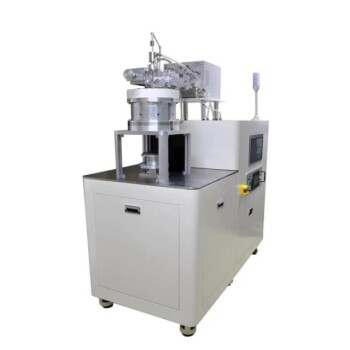
The sealing cone and safety weep hole design serves as a critical, intrinsic fail-safe mechanism within Supercritical Water Gasification (SCWG) reactors. This system utilizes a metal-to-metal seal that, in the event of component displacement caused by thermal stress or pressure overload, deliberately directs high-pressure media through pre-drilled safety weep holes to prevent catastrophic structural failure.
This design philosophy prioritizes "leak before break," ensuring that if the system's integrity is compromised, the failure manifests as a predictable, controlled vent rather than a dangerous, uncontrolled rupture.
The Mechanics of the Safety Design
The Metal-to-Metal Seal
SCWG reactors operate under extreme conditions that render many standard gaskets ineffective. To address this, the system relies on a metal-to-metal sealing cone.
This robust design provides the necessary structural integrity to maintain a reliable seal during normal high-pressure operations.
Reaction to System Stress
In high-pressure environments, reactors are subject to significant forces, including thermal stress and pressure overload.
These forces can cause minor displacement of reactor components. The sealing cone design acknowledges this possibility and is engineered to handle such shifts without causing a structural explosion.
The Function of Safety Weep Holes
Controlled Pressure Release
If the sealing cone is displaced, the system does not attempt to contain the pressure indefinitely, which could lead to a burst vessel.
Instead, the design allows the seal to "fail" safely. The high-pressure media is channeled specifically toward pre-drilled safety weep holes.
Localizing the Hazard
By directing the escaping media through these weep holes, the system limits the risk to a predictable area.
This prevents the random, violent release of hot gases or fluids. It protects both the physical laboratory environment and, most importantly, the operating personnel from unexpected blasts.
Understanding the Operational Trade-offs
Controlled Leak vs. Operation Continuity
While this design prevents catastrophic explosions, a "safety event" still results in a loss of containment.
When the weep holes are engaged, the reactor is effectively venting its contents. This necessitates an immediate shutdown of the process and likely requires maintenance to reseal the connection.
Sensitivity to Displacement
The safety mechanism is triggered by component displacement.
While this protects the vessel, it implies that the system is sensitive to mechanical shifts. Operators must be aware that significant thermal cycling or pressure spikes may trigger this safety venting, potentially interrupting experiments or production runs.
Ensuring Operational Safety in SCWG
To maximize the safety and efficiency of your high-pressure reactor operations, consider how this mechanism aligns with your safety protocols.
- If your primary focus is Operator Safety: Trust that the weep holes will direct dangerous media away from personnel, but ensure the venting area remains clear of obstructions.
- If your primary focus is System Longevity: Monitor thermal stress levels to avoid unnecessary displacement of the sealing cone, preserving the seal's integrity for longer durations.
The sealing cone design transforms the unpredictable danger of high-pressure failure into a manageable, localized event.
Summary Table:
| Safety Component | Primary Function | Failure Mode Response |
|---|---|---|
| Metal-to-Metal Seal | Maintains integrity under extreme SCWG conditions | Shifts to allow controlled venting during overload |
| Safety Weep Holes | Directs escaping media to a localized area | Prevents vessel rupture by releasing pressure safely |
| Sealing Cone | Provides structural high-pressure containment | Protects personnel by prioritizing 'leak before break' |
Secure Your High-Pressure Research with KINTEK
Operating Supercritical Water Gasification (SCWG) systems requires precision engineering where safety is non-negotiable. KINTEK specializes in advanced laboratory equipment, including high-temperature high-pressure reactors and autoclaves designed with sophisticated fail-safe mechanisms like sealing cones and weep holes.
Our comprehensive portfolio supports every stage of your research, from crushing and milling systems to battery research tools and high-temperature furnaces. Partner with KINTEK to benefit from:
- Enhanced Operator Safety: Equipment engineered to prevent catastrophic structural failure.
- Process Reliability: Robust seals designed for extreme thermal and pressure cycling.
- Expert Technical Support: Guidance on selecting the right reactors and consumables for your specific applications.
Don't compromise on safety or performance. Contact KINTEK today to discuss your reactor needs!
References
- Cataldo De Blasio, Andrea Magnano. Implications on Feedstock Processing and Safety Issues for Semi-Batch Operations in Supercritical Water Gasification of Biomass. DOI: 10.3390/en14102863
This article is also based on technical information from Kintek Solution Knowledge Base .
Related Products
- Customizable High Pressure Reactors for Advanced Scientific and Industrial Applications
- Customizable Laboratory High Temperature High Pressure Reactors for Diverse Scientific Applications
- Visual High-Pressure Reactor for In-Situ Observation
- Horizontal High Temperature Graphite Vacuum Graphitization Furnace
- High Pressure Laboratory Autoclave Reactor for Hydrothermal Synthesis
People Also Ask
- What is the function of high-pressure reactors in the synthesis of MFI-type zeolites? Master Dry Gel Conversion.
- Graphene Fiber Synthesis: Key High-Pressure Reactor Processing Conditions Explained
- What reactor is used for high pressure reactions? Select the Right Autoclave for Your Lab
- What is the primary function of a high-pressure reactor in NiMoO4 preparation? Optimize Hydrothermal Catalyst Synthesis
- What are the hazards of high pressure reactors? A Guide to Managing Explosive Risks