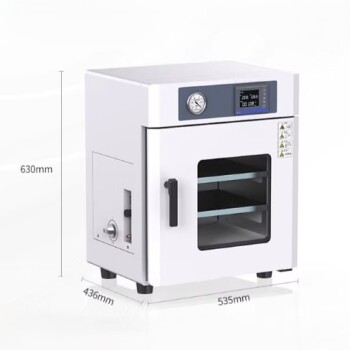
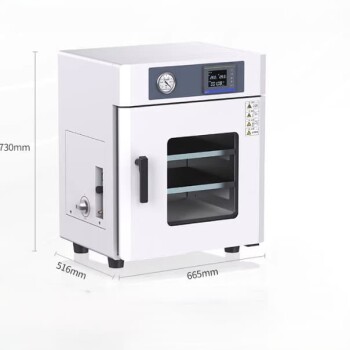
In the context of coal gangue acid leaching experiments, the laboratory electric constant temperature drying oven functions as a precise thermal reactor chamber rather than a simple moisture-removal tool. It houses high-pressure reactors containing coal gangue and hydrochloric acid solutions, maintaining them at specific, sustained temperatures between 120°C and 200°C to drive the chemical leaching process.
The oven’s primary value lies in its ability to maintain a strictly controlled thermal environment for long-duration static soaking. This temperature stability is the governing factor for reaction kinetics, directly dictating the extraction rates of aluminum and iron and determining the final silica-to-alumina ratio of the synthesized material.
The Critical Role of Thermal Control
Facilitating High-Pressure Reactions
While the equipment is named a "drying oven," its function here is to serve as a heating vessel for high-pressure reactors.
Inside the oven, the reactors containing the coal gangue and acid mixture undergo "static soaking."
The oven provides the external energy required to elevate the internal pressure and temperature of the reactors to the necessary reaction threshold.
Stabilizing Reaction Kinetics
The chemical breakdown of coal gangue requires a highly stable environment to proceed efficiently.
The drying oven ensures that the temperature remains constant throughout the long-duration soaking period.
This stability eliminates thermal gradients that could cause inconsistent reaction rates within the solution.
Determining Chemical Composition
The precise temperature maintained by the oven directly influences the quality of the final product.
Specifically, the thermal conditions control the leaching rates of aluminum and iron from the gangue.
Furthermore, accurate heat regulation is essential for achieving the targeted silica-to-alumina ratio in the synthesized sample.
Understanding the Trade-offs
The Necessity of "Static" Heating
Unlike stirred reactors, this method relies on static soaking within the oven.
The trade-off is that mass transfer relies heavily on diffusion and the consistent application of heat, rather than mechanical agitation.
If the oven fails to maintain uniform heat distribution, the lack of mixing can lead to uneven leaching results across the sample batch.
Temperature Sensitivity
The process operates within a specific window of 120°C to 200°C.
Operating at the lower end may result in incomplete leaching or insufficient reaction kinetics.
Conversely, aggressive heating without precise control can alter the silica-to-alumina ratio unpredictably, deviating from the target material specifications.
Optimizing Your Experimental Setup
If your primary focus is maximizing extraction yields:
- Ensure the oven is calibrated to maintain the higher end of the temperature spectrum (near 200°C) to accelerate reaction kinetics for Aluminum and Iron leaching.
If your primary focus is material synthesis precision:
- Prioritize thermal stability over speed, verifying that the oven temperature remains constant to guarantee a specific silica-to-alumina ratio.
By treating the drying oven as a precision reactor rather than a utility device, you ensure the reproducibility and chemical integrity of your leaching experiments.
Summary Table:
| Feature | Function in Acid Leaching | Impact on Experiment |
|---|---|---|
| Temperature Range | 120°C to 200°C | Drives chemical leaching and extraction rates |
| Thermal Stability | Long-duration static soaking | Eliminates thermal gradients for consistent kinetics |
| Energy Source | External heating for reactors | Facilitates high-pressure reaction thresholds |
| Composition Control | Regulated heat application | Determines final silica-to-alumina ratios |
Elevate Your Chemical Research with KINTEK Precision
Achieve uncompromising thermal stability and chemical integrity in your acid leaching experiments. KINTEK specializes in high-performance laboratory equipment, offering a robust selection of high-temperature drying ovens, high-pressure reactors, and PTFE consumables specifically designed for demanding material synthesis.
Whether you are optimizing aluminum extraction or refining silica-to-alumina ratios, our advanced thermal solutions ensure reproducible results every time. Contact us today to find the perfect equipment for your laboratory and see how our expertise in high-temperature furnaces and reactor systems can accelerate your research.
References
- Yunsheng Zheng, Guping Tang. Preparation of a High-Silicon ZSM-5 Molecular Sieve Using Only Coal Gangue as the Silicon and Aluminum Sources. DOI: 10.3390/ma16124338
This article is also based on technical information from Kintek Solution Knowledge Base .
Related Products
- Laboratory Scientific Electric Heating Blast Drying Oven
- 23L Laboratory Vacuum Drying Oven
- 56L Vertical Laboratory Vacuum Drying Oven
- 1700℃ Muffle Oven Furnace for Laboratory
- 1400℃ Muffle Oven Furnace for Laboratory
People Also Ask
- How does a laboratory electric drying oven contribute to the formation of the initial coating? Expert Insights
- What role does a precision laboratory drying oven play in the synthesis of GO-PANI nanocomposites? Protect Material Integrity
- What role does a laboratory drying oven play in the preparation of zinc oxide nanoparticle precursors?
- What is the necessity of using a laboratory drying oven when processing MoO3/GO composite nanopowders? Find out here.
- What is the role of a laboratory drying oven in cellulose citrate production? Ensure Material Stability & Purity