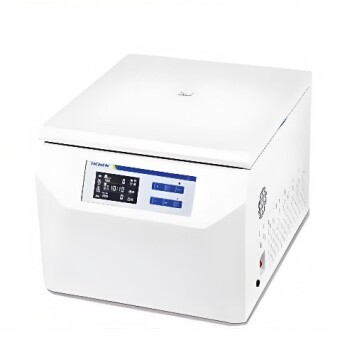
A high-pressure reactor creates a sealed, solvothermal environment characterized by elevated temperatures and pressures, typically reaching 180°C for this specific synthesis. By preventing evaporation, this setup forces solvents—such as hydrochloric acid mixtures—to remain in the liquid phase well beyond their atmospheric boiling points.
Core Takeaway: The primary function of this environment is to "supercharge" the solvent, dramatically increasing the solubility and reactivity of precursors like SnCl4 and TeO2. This controlled aggression is essential for growing perovskite micro-crystals with high crystallinity and uniform morphology that cannot be achieved under standard atmospheric conditions.
The Physics of the Solvothermal Environment
The "Autoclave Effect"
The reactor, effectively acting as an autoclave, creates a closed system where matter cannot escape.
As the temperature rises to 180°C, the vapor pressure inside the vessel increases significantly.
Superheated Liquid Phase
Under normal atmospheric conditions, hydrochloric acid mixtures would boil off long before reaching the target reaction temperature.
The high internal pressure suppresses this boiling.
This maintains the solvent in a superheated liquid state, allowing it to facilitate reactions at energy levels otherwise impossible in open vessels.
Chemical Implications for Precursors
Enhanced Solubility
The key challenge in synthesizing Te4+:Cs2SnCl6 phosphors is dissolving the necessary precursors effectively.
The high-pressure environment significantly boosts the solubility of SnCl4 and TeO2.
This ensures a homogeneous mixture where reactants are fully available for chemical bonding.
Increased Reactivity
Beyond simple dissolution, the environment promotes higher kinetic energy among molecules.
This accelerates the reaction rates between the dissolved precursors.
It facilitates the precise chemical substitution required to dope the structure with Te4+ ions.
Impact on Crystal Formation
Nucleation Control
The sealed environment provides a stable thermodynamic space for crystal nuclei to form.
Because the temperature and pressure are uniform throughout the vessel, nucleation occurs consistently.
Morphology and Crystallinity
This method is specifically chosen to produce perovskite micro-crystals.
The slow, pressurized growth phase encourages high crystallinity, reducing defects in the crystal lattice.
The result is a powder characterized by regular, uniform morphology, which is critical for consistent optical performance in phosphors.
Understanding the Trade-offs
Process Visibility
A major limitation of high-pressure steel reactors is the "black box" nature of the synthesis.
Unlike open-glassware reactions, you cannot visually monitor the color change or precipitation in real-time.
You must rely entirely on precise temperature and time programming to control the outcome.
Safety and Complexity
Operating at 180°C under autogenous pressure introduces safety hazards requiring rated equipment (autoclaves).
The process is strictly a batch operation.
Scaling up requires significantly more expensive equipment compared to ambient-pressure methods.
Making the Right Choice for Your Goal
If you are deciding whether to utilize a solvothermal route for your phosphor synthesis, consider these specific outcomes:
- If your primary focus is Optical Quality: Use this high-pressure method; the high crystallinity directly translates to better emission efficiency.
- If your primary focus is Morphology Control: Use this method to ensure regular, uniform micro-crystals rather than irregular aggregates.
- If your primary focus is Process Speed: Consider alternative methods, as the heating and cooling cycles of massive steel autoclaves are inherently slow.
The high-pressure reactor is not just a vessel; it is a thermodynamic tool that forces difficult-to-dissolve materials to yield high-quality crystalline structures.
Summary Table:
| Feature | Solvothermal Environment Effect |
|---|---|
| Temperature | Maintains superheated liquid state up to 180°C |
| Pressure | High autogenous pressure prevents solvent evaporation |
| Solubility | Dramatically increases precursor (SnCl4/TeO2) dissolution |
| Crystallinity | Promotes uniform perovskite micro-crystals with low defects |
| Reaction Mode | Controlled batch processing for high-performance optical materials |
Elevate Your Material Synthesis with KINTEK Precision
Unlock the full potential of your research with KINTEK’s premium high-temperature high-pressure reactors and autoclaves. Whether you are synthesizing advanced phosphors or developing next-generation perovskites, our specialized laboratory equipment provides the stable, high-energy environments necessary for superior crystallinity and morphology.
Why choose KINTEK?
- Comprehensive Reactor Solutions: From stainless steel autoclaves to custom high-pressure vessels.
- Total Lab Support: We provide everything from muffle and tube furnaces to hydraulic presses, cooling solutions, and essential ceramic consumables.
- Expert Reliability: Our equipment is engineered to handle the rigorous demands of solvothermal and hydrothermal synthesis safely and effectively.
Ready to achieve high-purity results in your lab? Contact our technical experts today to find the perfect reactor for your application!
Related Products
- Customizable Laboratory High Temperature High Pressure Reactors for Diverse Scientific Applications
- Customizable High Pressure Reactors for Advanced Scientific and Industrial Applications
- Stainless High Pressure Autoclave Reactor Laboratory Pressure Reactor
- Mini SS High Pressure Autoclave Reactor for Laboratory Use
- High Pressure Laboratory Autoclave Reactor for Hydrothermal Synthesis
People Also Ask
- How do high-pressure and high-temperature reactors ensure the effective treatment of lignocellulosic wastewater in WAO?
- What equipment is required for high-pressure high-temperature reactions? Master Extreme Chemistry Safely
- How do you control high pressure in a reactor? A Guide to Safe & Stable Operation
- How does initial oxygen pressure affect the wet oxidation of pharmaceutical sludge? Master Your Oxidation Depth
- Why is argon better than nitrogen for inert atmosphere? Ensure Absolute Reactivity & Stability