Knowledge What types of electrodes are used in the H-type electrolytic cell? Expert Guide to Three-Electrode Systems
Author avatar

Tech Team · Kintek Solution

Updated 2 days ago

What types of electrodes are used in the H-type electrolytic cell? Expert Guide to Three-Electrode Systems


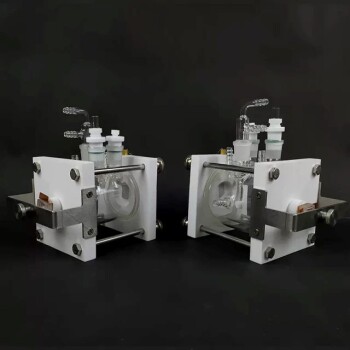
The H-type electrolytic cell utilizes a specific three-electrode configuration. To function correctly, the design accommodates a working electrode, a counter electrode, and a reference electrode. These three components are essential for creating the precise electrical environment required for electrochemical experiments.

Core Takeaway The H-type cell distinguishes itself by using a three-electrode system rather than a simple two-electrode setup. This configuration separates the current-carrying role from the voltage-measuring role, allowing for significantly higher accuracy in experimental data.

The Three-Electrode System

The architecture of the H-type cell is built around three distinct types of electrodes. Understanding the specific function of each is critical for successful operation.

The Working Electrode

This is the core component where the primary chemical reaction of interest occurs. In a standard setup, the working electrode facilitates the specific reduction or oxidation process you are studying.

The Counter Electrode

The counter electrode acts as the partner to the working electrode. Its primary function is to complete the electrical circuit, allowing current to flow through the electrolyte.

The Reference Electrode

The reference electrode is unique because it provides a stable voltage benchmark. It does not carry high current; instead, it maintains a constant potential against which the working electrode is measured.

Material Composition and Chemistry

Beyond their functional roles, the physical composition of these electrodes is vital for the cell's integrity.

Inert Materials

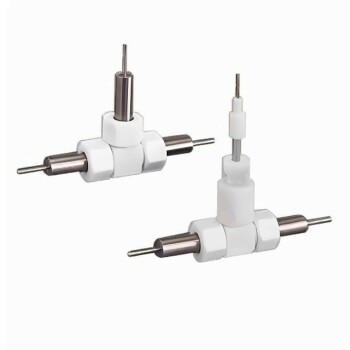
To prevent the electrodes themselves from reacting chemically and skewing results, they are typically made from inert materials. Common choices include graphite (carbon rods) or platinum wire.

Anode and Cathode Roles

While the system is defined by the "working" and "counter" designations, the electrodes also take on the traditional roles of anode (positive) and cathode (negative). Positively charged ions flow toward the cathode, while negatively charged ions flow toward the anode.

Operational Considerations and Trade-offs

While the three-electrode system offers precision, it introduces specific maintenance challenges that must be managed to ensure data integrity.

Degradation and Corrosion

Electrodes are not permanent fixtures; they gradually wear and corrode during use. This physical degradation directly impacts their electrical conductivity and the accuracy of your results.

Mandatory Maintenance

To mitigate degradation, electrodes require regular maintenance. This includes cleaning, polishing, and calibrating the surfaces to restore performance. Neglecting this step often leads to experimental drift.

Handling Fragility

The physical installation and removal of these electrodes require extreme care. They are precise instruments, and rough handling can damage the contact surfaces or the structural integrity of the rod or wire.

Making the Right Choice for Your Goal

The selection and care of your electrodes depend heavily on your specific experimental requirements.

  • If your primary focus is data precision: Ensure you use high-purity chemical reagents for your electrolyte and calibrate your reference electrode frequently to prevent voltage drift.
  • If your primary focus is equipment longevity: Establish a strict protocol for cleaning and polishing the working and counter electrodes after every cycle to minimize corrosion.

The success of an H-type cell experiment relies not just on having the right electrodes, but on maintaining their surface condition to ensure the circuit remains stable and conductive.

Summary Table:

Electrode Type Primary Function Common Materials
Working Electrode Facilitates the main chemical reaction (redox) Platinum, Gold, Glassy Carbon
Counter Electrode Completes the circuit for current flow Platinum Wire, Graphite Rod
Reference Electrode Provides a stable voltage benchmark Ag/AgCl, Saturated Calomel (SCE)
Anode/Cathode Ionic migration targets (positive/negative) Varies by experimental setup

Elevate Your Electrochemical Research with KINTEK

Precision in the lab starts with high-quality components. At KINTEK, we specialize in providing researchers with the robust tools needed for accurate data, from advanced H-type electrolytic cells and high-purity electrodes to specialized battery research consumables and electrolytic cell accessories.

Whether you are performing complex redox studies or standardizing chemical benchmarks, our portfolio of laboratory equipment—including high-temperature furnaces, hydraulic presses, and cooling solutions—is designed to meet the most demanding scientific standards.

Ready to optimize your experimental setup? Contact our technical experts today to find the perfect electrode and cell configuration for your specific laboratory needs.

Related Products

People Also Ask

Related Products

Electrode Polishing Material for Electrochemical Experiments

Electrode Polishing Material for Electrochemical Experiments

Looking for a way to polish your electrodes for electrochemical experiments? Our polishing materials are here to help! Follow our easy instructions for best results.

Conductive Carbon Cloth Carbon Paper Carbon Felt for Electrodes and Batteries

Conductive Carbon Cloth Carbon Paper Carbon Felt for Electrodes and Batteries

Conductive carbon cloth, paper, and felt for electrochemical experiments. High-quality materials for reliable and accurate results. Order now for customization options.

Glassy Carbon Sheet RVC for Electrochemical Experiments

Glassy Carbon Sheet RVC for Electrochemical Experiments

Discover our Glassy Carbon Sheet - RVC. Perfect for your experiments, this high-quality material will elevate your research to the next level.

Graphite Vacuum Furnace Negative Material Graphitization Furnace

Graphite Vacuum Furnace Negative Material Graphitization Furnace

Graphitization furnace for battery production has uniform temperature and low energy consumption. Graphitization furnace for negative electrode materials: an efficient graphitization solution for battery production and advanced functions to enhance battery performance.

Conductive Boron Nitride BN Ceramics Composite for Advanced Applications

Conductive Boron Nitride BN Ceramics Composite for Advanced Applications

Due to the characteristics of boron nitride itself, the dielectric constant and dielectric loss are very small, so it is an ideal electrical insulating material.

Ultra-Vacuum Electrode Feedthrough Connector Flange Power Electrode Lead for High-Precision Applications

Ultra-Vacuum Electrode Feedthrough Connector Flange Power Electrode Lead for High-Precision Applications

Discover the Ultra-Vacuum Electrode Feedthrough Connector Flange, perfect for high-precision applications. Ensure reliable connections in ultra-vacuum environments with advanced sealing and conductive technology.

Manual button battery sealing machine

Manual button battery sealing machine

The manual button battery sealing machine is a high-precision packaging device designed specifically for small button batteries (such as CR2032, LR44 and other models). It is suitable for laboratory research and development, small batch production and teaching demonstrations.

Laboratory Multifunctional Small Speed-Adjustable Horizontal Mechanical Shaker for Lab

Laboratory Multifunctional Small Speed-Adjustable Horizontal Mechanical Shaker for Lab

The laboratory multifunctional speed-regulating oscillator is a constant-speed experimental equipment specially developed for modern bioengineering production units.

Electric Split Lab Cold Isostatic Press CIP Machine for Cold Isostatic Pressing

Electric Split Lab Cold Isostatic Press CIP Machine for Cold Isostatic Pressing

Split cold isostatic presses are capable of providing higher pressures, making them suitable for testing applications that require high pressure levels.

Custom PTFE Teflon Parts Manufacturer for PTFE Ball Valve Seat

Custom PTFE Teflon Parts Manufacturer for PTFE Ball Valve Seat

Seats and inserts are vital components in the valve industry. As a key component, polytetrafluoroethylene is usually selected as the raw material.

Aluminum-Plastic Flexible Packaging Film for Lithium Battery Packaging

Aluminum-Plastic Flexible Packaging Film for Lithium Battery Packaging

Aluminum-plastic film has excellent electrolyte properties and is an important safe material for soft-pack lithium batteries. Unlike metal case batteries, pouch batteries wrapped in this film are safer.

Small Lab Rubber Calendering Machine

Small Lab Rubber Calendering Machine

Small lab rubber calendering machine is used for producing thin, continuous sheets of plastic or rubber materials. It is commonly employed in laboratories, small-scale production facilities, and prototyping environments to create films, coatings, and laminates with precise thickness and surface finish.

Copper Foam

Copper Foam

Copper foam has good thermal conductivity and can be widely used for heat conduction and heat dissipation of motors/electrical appliances and electronic components.

Lab Blown Film Extrusion Three Layer Co-Extrusion Film Blowing Machine

Lab Blown Film Extrusion Three Layer Co-Extrusion Film Blowing Machine

Lab blown film extrusion is mainly used to detect the feasibility of film blowing of polymer materials and the colloid condition in the materials, as well as the dispersion of colored dispersions, controlled mixtures, and extrudates;

Laboratory Vibratory Sieve Shaker Machine Slap Vibrating Sieve

Laboratory Vibratory Sieve Shaker Machine Slap Vibrating Sieve

KT-T200TAP is a slapping and oscillating sieving instrument for laboratory desktop use, with 300 rpm horizontal circular motion and 300 vertical slapping motions to simulate manual sieving to help sample particles pass through better.

Heated Hydraulic Press Machine with Integrated Manual Heated Plates for Lab Use

Heated Hydraulic Press Machine with Integrated Manual Heated Plates for Lab Use

Efficiently process heat-pressing samples with our Integrated Manual Heated Lab Press. With a heating range up to 500°C, it's perfect for various industries.

Laboratory Vibratory Sieve Shaker Machine for Dry and Wet Three-Dimensional Sieving

Laboratory Vibratory Sieve Shaker Machine for Dry and Wet Three-Dimensional Sieving

KT-VD200 can be used for sieving tasks of dry and wet samples in the laboratory. The screening quality is 20g-3kg. The product is designed with a unique mechanical structure and an electromagnetic vibrating body with a vibration frequency of 3000 times per minute.

Laboratory Sterilizer Lab Autoclave Herbal Powder Sterilization Machine for Plant

Laboratory Sterilizer Lab Autoclave Herbal Powder Sterilization Machine for Plant

The herbal powder sterilization autoclave machine for Chinese medicine uses saturated steam for effective sterilization. It utilizes the heat and penetrative properties of steam, achieves sterilization after heat preservation, and maintains a good drying effect with a dedicated drying system.

Laboratory Test Sieves and Vibratory Sieve Shaker Machine

Laboratory Test Sieves and Vibratory Sieve Shaker Machine

Efficiently process powders, granules, and small blocks with a high-frequency vibration sieve. Control vibration frequency, screen continuously or intermittently, and achieve accurate particle size determination, separation, and classification.

Small Injection Molding Machine for Lab Use

Small Injection Molding Machine for Lab Use

The small injection molding machinehas fast and stable movements; good controllability and repeatability, super energy saving; the product can be automatically dropped and formed; the machine body is low, convenient for feeding, easy to maintain, and no height restrictions on the installation site.


Leave Your Message