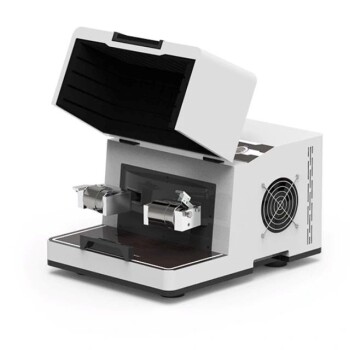
High-energy ball mills are the primary equipment used for the mechanochemical treatment of zeolites. These devices generate intense mechanical energy through impact forces, allowing for the physical modification of zeolite crystals without the need for traditional solvent-based processes.
The ball mill functions as a mechanical reactor where kinetic energy drives structural change. By manipulating the milling environment, you can induce controlled fragmentation and amorphization, effectively tailoring the particle size, pore architecture, and active sites of the zeolite.
The Mechanics of Modification
Generating High-Energy Impact
The core mechanism involves the collision of grinding balls within a moving jar.
These collisions generate high-energy impact forces that transfer mechanical energy directly to the zeolite precursors. This energy is sufficient to break chemical bonds and induce structural transformations.
Solvent-Free Environments
Unlike traditional synthesis methods, ball milling often operates in solvent-free or solvent-deficient conditions.
This allows for a "cleaner" process where the mechanical force itself acts as the driving agent for modification, rather than chemical solvating agents.
Critical Control Parameters
Regulating Rotation Speed
The rotation speed of the grinding jars is a fundamental variable.
Higher speeds increase the kinetic energy of the grinding balls, resulting in more intense impact forces. Precise regulation here determines whether the zeolite undergoes minor surface modification or significant structural change.
Grinding Ball Size
The size of the grinding media dictates the nature of the impact.
Larger balls generally provide higher impact energy, useful for crushing and coarse fragmentation. Smaller balls offer more frequent contact points, which can be better for fine-tuning particle properties.
Processing Time
The duration of the milling process correlates directly with the cumulative energy input.
Controlling the time allows you to stop the process at a specific stage of "partial structural change," preventing total destruction of the crystal lattice while achieving the desired modification.
Structural and Physical Outcomes
Particle Fragmentation and Aggregation
The primary physical effect is the alteration of particle size.
The impact forces induce fragmentation, breaking down larger crystal aggregates into smaller, more discrete units. This directly influences the crystal aggregation state of the final material.
Modification of Pore Properties
Mechanochemical treatment physically alters the pore properties of the zeolite.
By restructuring the material, you can change the accessibility of the internal surface area. This is critical for applications where diffusion into the zeolite structure is a limiting factor.
Controlled Amorphization
The process induces a state of controlled amorphization in the zeolite crystals.
This partial loss of crystallinity is not necessarily a defect; it influences the type and density of active sites. This pre-treatment can enable the synthesis of specific structures, such as MFI and BEA, at lower temperatures during subsequent heating steps.
Understanding the Trade-offs
The Risk of Over-Processing
The key phrase in successful modification is "precisely regulating."
If the impact forces are too high or the processing time is too long, the "partial" structural changes can become total amorphization. This destroys the zeolitic framework entirely, rendering the material useless for its intended catalytic purpose.
Energy Management
While this method reduces the need for solvents, it shifts the energy cost to mechanical generation.
You must balance the intensity of the ball milling with the desired outcome. Excessive mechanical energy can generate unwanted heat, which may inadvertently alter the material's properties in uncontrolled ways.
Making the Right Choice for Your Goal
To maximize the efficacy of mechanochemical treatment, align your operational parameters with your specific material objectives:
- If your primary focus is Physical Morphology: Prioritize the selection of grinding ball size to control fragmentation and break up crystal aggregates effectively.
- If your primary focus is Catalytic Activity: Focus on optimizing processing time to induce controlled amorphization, thereby enhancing the accessibility and density of active sites without destroying the framework.
Mastering the variables of the ball mill allows you to dictate the architecture of the zeolite at a fundamental level.
Summary Table:
| Parameter | Influence on Zeolite Modification | Key Outcome |
|---|---|---|
| Equipment | High-Energy Ball Mill | Intense mechanical energy for bond breaking |
| Rotation Speed | Kinetic Energy Level | Determines intensity of structural transformation |
| Ball Size | Impact Nature | Controls fragmentation vs. fine-tuning properties |
| Processing Time | Cumulative Energy Input | Balances amorphization with framework preservation |
| Environment | Solvent-Free/Deficient | Cleaner, mechanical-driven chemical reaction |
Revolutionize Your Material Synthesis with KINTEK Precision
Unlock the full potential of your zeolite research with KINTEK’s advanced crushing and milling systems. Whether you are aiming for controlled amorphization or precise particle fragmentation, our high-energy ball mills provide the reliability and control needed for superior mechanochemical treatment.
As experts in laboratory equipment, KINTEK offers a comprehensive range of solutions for researchers and industrial labs, including:
- High-Temperature Furnaces (Muffle, Vacuum, CVD/PECVD) for post-milling heating.
- Hydraulic Presses (Pellet, Hot, Isostatic) for material consolidation.
- Specialized Consumables including high-purity ceramics and crucibles.
Ready to optimize your zeolite modification process? Contact us today to consult with our technical team and find the perfect equipment for your specific application.
References
- Ângela Martins, Luísa M. D. R. S. Martins. Zeolites and Related Materials as Catalyst Supports for Hydrocarbon Oxidation Reactions. DOI: 10.3390/catal12020154
This article is also based on technical information from Kintek Solution Knowledge Base .
Related Products
- High Energy Planetary Ball Mill Milling Machine for Laboratory
- High Energy Planetary Ball Mill for Laboratory Horizontal Tank Type Milling Machine
- High-Energy Omnidirectional Planetary Ball Mill Milling Machine for Laboratory
- High Energy Planetary Ball Mill Milling Machine for Laboratory
- High Energy Planetary Ball Mill Machine for Laboratory Horizontal Tank Type
People Also Ask
- What role do planetary ball mills and zirconia media play in LLZT preparation? Optimize Your Solid Electrolyte Research
- What is the primary function of a planetary ball mill? Mastering SiC/Al Composite Mixing for Homogeneity
- What is the primary purpose of using a planetary ball mill for LAGP? Achieve High-Purity Solid-State Electrolytes
- What role does a planetary ball mill play in the preparation of LGVO powders? Precision Refinement for Aerosol Deposition
- What is the function of a planetary ball mill in the preparation of high-entropy rare earth silicate multi-phase ceramics?