Knowledge Why are alumina grinding balls preferred for Al/B4C mixing? Ensure High Purity and Efficient Homogenization
Author avatar

Tech Team · Kintek Solution

Updated 3 days ago

Why are alumina grinding balls preferred for Al/B4C mixing? Ensure High Purity and Efficient Homogenization


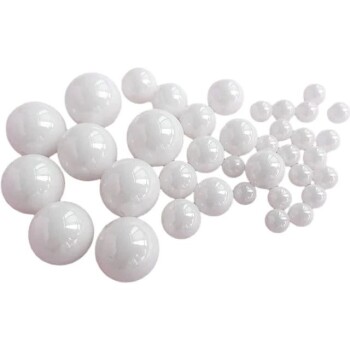
Alumina grinding balls are preferred for mixing Al/B4C composites primarily because they prevent metallic contamination while delivering high mechanical efficiency. By utilizing alumina, manufacturers ensure that the aluminum matrix remains chemically pure while achieving a homogenous mix of soft metal and hard ceramic powders.

Core Insight: The selection of grinding media is a trade-off between kinetic energy and chemical inertness. Alumina is the specific solution for Al/B4C composites because it provides the necessary hardness to blend disparate particles without the "penalty" of introducing metallic impurities that would degrade the final material's performance.

The Mechanics of Efficient Mixing

Bridging the Hardness Gap

Mixing Aluminum (a soft metal) and Boron Carbide (a hard ceramic) presents a significant mechanical challenge.

Alumina grinding balls possess the high hardness required to bridge this gap. This physical property allows them to effectively transfer grinding energy into the mixture, forcing the disparate particle sizes to blend uniformly.

Superior Wear Resistance

Effectiveness in ball milling is not just about initial impact; it is about sustained performance.

Alumina offers superior wear resistance, ensuring the media retains its shape and size throughout the process. This consistency is vital for maintaining a predictable energy transfer rate during the mixing cycle.

The Criticality of Material Purity

Avoiding Metallic Impurities

The most distinct advantage of alumina over alternative media is its chemical composition.

Using metallic grinding balls (such as steel) creates a high risk of introducing metallic impurities into the powder due to wear. These impurities can negatively react with or weaken the aluminum matrix.

Preserving Chemical Integrity

For a composite to perform as intended, the raw materials must remain chemically pure.

Alumina acts as a chemically compatible medium. By minimizing the introduction of foreign metallic elements, it ensures the final Al/B4C composite retains the specific chemical and structural properties intended by the design.

Understanding the Trade-offs

Impact Energy vs. Purity

While metallic balls generally offer higher density and impact energy, they are unsuitable for this specific application due to contamination risks.

You are effectively trading the raw impact force of a metallic ball for the cleanliness of a ceramic ball. In the context of Al/B4C composites, purity is the dominant requirement, making the lower density of alumina (compared to steel or zirconia) an acceptable compromise to avoid destroying the matrix chemistry.

Making the Right Choice for Your Goal

When selecting grinding media for metal-matrix composites, consider your specific performance targets:

  • If your primary focus is Chemical Purity: Select Alumina grinding balls to eliminate the risk of metallic cross-contamination that could degrade the aluminum matrix.
  • If your primary focus is Mixing Efficiency of Dissimilar Powders: Rely on Alumina's high hardness to ensure sufficient energy transfer between soft metallic and hard ceramic particles.

Ultimately, Alumina is the definitive choice for Al/B4C mixing because it safeguards the material's chemical identity without sacrificing the mechanical force needed for homogenization.

Summary Table:

Feature Alumina Grinding Balls Metallic Media (e.g., Steel) Benefit to Al/B4C Process
Contamination Risk Extremely Low (Ceramic) High (Metallic Impurities) Maintains aluminum matrix integrity
Hardness Very High High Efficiently blends soft Al and hard B4C
Wear Resistance Superior Variable Ensures consistent energy transfer
Chemical Compatibility High Low Prevents unwanted chemical reactions
Primary Application Purity-sensitive composites General industrial grinding Optimal for high-performance composites

Elevate Your Material Purity with KINTEK Solutions

Don't let metallic contamination compromise the integrity of your Al/B4C composites. KINTEK specializes in high-performance laboratory equipment and consumables designed for precision material science. From our superior alumina grinding balls and milling systems to our advanced crushing, sieving, and hydraulic press solutions, we provide the tools necessary to achieve a perfect, homogenous mix every time.

Whether you are conducting battery research, developing high-temperature ceramics, or perfecting metal-matrix composites, our comprehensive portfolio—including high-temperature furnaces, vacuum systems, and specialized PTFE and ceramic consumables—is engineered to meet the strictest industry standards.

Ready to optimize your mixing process? Contact our technical experts today to find the right equipment for your lab's unique requirements!

Related Products

People Also Ask

Related Products

Laboratory Ball Mill Jar Mill with Metal Alloy Grinding Jar and Balls

Laboratory Ball Mill Jar Mill with Metal Alloy Grinding Jar and Balls

Grind and mill with ease using metal alloy grinding jars with balls. Choose from 304/316L stainless steel or tungsten carbide and optional liner materials. Compatible with various mills and features optional functions.

Laboratory Single Horizontal Jar Mill

Laboratory Single Horizontal Jar Mill

KT-JM3000 is a mixing and grinding instrument for placing a ball milling tank with a volume of 3000ml or less. It adopts frequency conversion control to realize timing, constant speed, direction change, overload protection and other functions.

High Energy Planetary Ball Mill for Laboratory Horizontal Tank Type Milling Machine

High Energy Planetary Ball Mill for Laboratory Horizontal Tank Type Milling Machine

KT-P4000H uses the unique Y-axis planetary motion trajectory, and utilizes the collision, friction and gravity between the sample and the grinding ball to have a certain anti-sinking ability, which can obtain better grinding or mixing effects and further improve the sample output.

Laboratory Horizontal Planetary Ball Mill Milling Machine

Laboratory Horizontal Planetary Ball Mill Milling Machine

Improve sample uniformity with our Horizontal Planetary Ball Mills. KT-P400H reduces sample deposition and KT-P400E has multi-directional capabilities. Safe, convenient and efficient with overload protection.

High Energy Planetary Ball Mill Milling Machine for Laboratory

High Energy Planetary Ball Mill Milling Machine for Laboratory

Experience fast and effective sample processing with the F-P2000 high-energy planetary ball mill. This versatile equipment offers precise control and excellent grinding capabilities. Perfect for laboratories, it features multiple grinding bowls for simultaneous testing and high output. Achieve optimal results with its ergonomic design, compact structure, and advanced features. Ideal for a wide range of materials, it ensures consistent particle size reduction and low maintenance.

High Energy Planetary Ball Mill Milling Machine for Laboratory

High Energy Planetary Ball Mill Milling Machine for Laboratory

The biggest feature is that the high energy planetary ball mill can not only perform fast and effective grinding, but also has good crushing ability

Laboratory Planetary Ball Mill Rotating Ball Milling Machine

Laboratory Planetary Ball Mill Rotating Ball Milling Machine

KT-P400E is a desktop multi-directional planetary ball mill with unique grinding and mixing capabilities. It offers continuous and intermittent operation, timing, and overload protection, making it ideal for various applications.

Laboratory Ten-Body Horizontal Jar Mill for Lab Use

Laboratory Ten-Body Horizontal Jar Mill for Lab Use

The Ten-body horizontal jar mill is for 10 ball mill pots (3000ml or less). It has frequency conversion control, rubber roller movement, and PE protective cover.

High-Energy Omnidirectional Planetary Ball Mill Milling Machine for Laboratory

High-Energy Omnidirectional Planetary Ball Mill Milling Machine for Laboratory

The KT-P4000E is a new product derived from the vertical high-energy planetary ball mill with a 360° swivel function. Experience faster, uniform, and smaller sample output results with 4 ≤1000ml ball mill jars.

Laboratory Planetary Ball Mill Cabinet Planetary Ball Milling Machine

Laboratory Planetary Ball Mill Cabinet Planetary Ball Milling Machine

The vertical cabinet structure combined with ergonomic design enables users to obtain the best comfortable experience in standing operation. The maximum processing capacity is 2000ml, and the speed is 1200 revolutions per minute.

High Energy Vibratory Laboratory Ball Mill Double Tank Type

High Energy Vibratory Laboratory Ball Mill Double Tank Type

High-energy vibration ball mill is a small desktop laboratory grinding instrument. It uses 1700r/min high-frequency three-dimensional vibration to make the sample achieve the result of grinding or mixing.

Lab Vibration Mill

Lab Vibration Mill

Vibration Mill for Efficient Sample Preparation, Suitable for Crushing and Grinding a Variety of Materials with Analytical Precision. Supports Dry / Wet / Cryogenic Grinding and Vacuum/Inert Gas Protection.

Hybrid High Energy Vibratory Ball Mill for Lab Use

Hybrid High Energy Vibratory Ball Mill for Lab Use

KT-BM400 is used for rapid grinding or mixing of dry, wet and frozen small amount of samples in the laboratory. It can be configured with two 50ml ball mill jars

High Energy Vibratory Laboratory Ball Mill Grinding Mill Single Tank Type

High Energy Vibratory Laboratory Ball Mill Grinding Mill Single Tank Type

High-energy vibration ball mill is a small desktop laboratory grinding instrument.It can be ball-milled or mixed with different particle sizes and materials by dry and wet methods.

Vibrating Disc Mill Small Laboratory Grinding Machine

Vibrating Disc Mill Small Laboratory Grinding Machine

Discover the versatile Vibrating Disc Mill for efficient laboratory grinding. Ideal for geology, metallurgy, biology, and more. Explore now!

High Energy Vibratory Ball Mill for Lab Use

High Energy Vibratory Ball Mill for Lab Use

The high-energy vibrating ball mill is a high-energy oscillating and impacting multifunctional laboratory ball mill. The table-top type is easy to operate, small in size, comfortable and safe.

Liquid Nitrogen Cryogenic Grinder Mill Cryomill with Screw Feeder

Liquid Nitrogen Cryogenic Grinder Mill Cryomill with Screw Feeder

Discover the Liquid Nitrogen Cryogenic Pulverizer with Screw Feeder, perfect for fine material processing. Ideal for plastics, rubber, and more. Boost your lab efficiency now!

Disc Cup Vibrating Mill Multi-Platform for Lab

Disc Cup Vibrating Mill Multi-Platform for Lab

The multi-platform vibrating disc mill is suitable for non-destructive crushing and fine grinding of samples with large particle sizes. It is suitable for crushing and grinding applications of medium-hard, high-hard, brittle, fibrous, and elastic materials.

Dental Porcelain Zirconia Sintering Ceramic Vacuum Press Furnace

Dental Porcelain Zirconia Sintering Ceramic Vacuum Press Furnace

Get precise dental results with Dental Vacuum Press Furnace. Automatic temperature calibration, low noise tray, and touch screen operation. Order now!

Vacuum Heat Treat and Sintering Furnace with 9MPa Air Pressure

Vacuum Heat Treat and Sintering Furnace with 9MPa Air Pressure

The air pressure sintering furnace is a high-tech equipment commonly used for the sintering of advanced ceramic materials. It combines vacuum sintering and pressure sintering techniques to achieve high-density and high-strength ceramics.


Leave Your Message