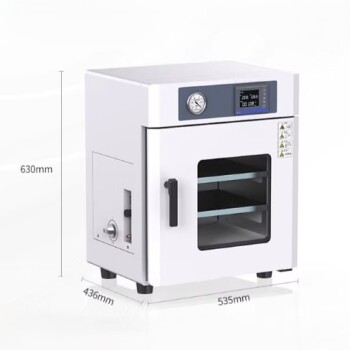
Knowledge Why are biopalladium samples processed in a vacuum drying oven? Ensuring Sample Integrity for SEM Analysis
Author avatar

Tech Team · Kintek Solution

Updated 2 days ago

Why are biopalladium samples processed in a vacuum drying oven? Ensuring Sample Integrity for SEM Analysis


Vacuum drying is the definitive preparation method for biopalladium samples because it reconciles two conflicting requirements: the need for complete dehydration and the need to preserve delicate biological structures. By removing moisture at low temperatures, this process prevents thermal degradation of the microbial carrier and inhibits the oxidation of palladium nanoparticles, rendering the sample safe for the high-vacuum environment of a scanning electron microscope (SEM).

Core Takeaway Processing biopalladium in a vacuum drying oven is essential to remove moisture without using destructive high heat. This ensures the structural integrity of the microbial carrier and the chemical purity of the nanoparticles, allowing for clear, artifact-free imaging within the SEM’s high-vacuum chamber.

Preserving Sample Integrity

Protecting the Microbial Structure

Biopalladium consists of metallic nanoparticles supported by a biological carrier, typically microbial cells. These biological structures are highly sensitive to heat.

Standard drying methods often require high temperatures that can collapse or distort the cell structure. Vacuum drying lowers the boiling point of water, allowing moisture to evaporate efficiently at low temperatures, preserving the original morphology of the microbial carrier.

Preventing Nanoparticle Oxidation

Palladium nanoparticles are reactive, and their surface properties are critical for characterization. Exposure to high heat in the presence of air can lead to rapid oxidation.

The vacuum environment removes oxygen during the drying process. This ensures that the palladium remains in its metallic state, allowing for an accurate assessment of the nanoparticles as they exist on the cell surface.

Ensuring Microscope Compatibility

The Necessity of Dehydration

Scanning electron microscopes operate under a high-vacuum. Introducing a wet sample into this environment causes rapid evaporation, which can destabilize the microscope's electron beam and damage the vacuum system.

The vacuum drying oven ensures the sample is completely dehydrated before insertion. This eliminates the risk of outgassing inside the SEM chamber.

Achieving Image Clarity

Moisture in a sample creates interference that blurs surface details. To obtain clear surface morphology images, the sample must be bone-dry.

Proper vacuum drying allows the electron beam to interact precisely with the sample surface. This provides high-resolution data regarding the specific distribution and arrangement of nanoparticles on the cells.

Common Pitfalls to Avoid

The Risk of Incomplete Drying

If the vacuum drying cycle is terminated too early, residual moisture will remain deep within the biological material.

This residual moisture will likely vaporize once inside the SEM. This results in poor image resolution and potential contamination of the microscope's column.

Thermal Damage from Alternatives

Attempting to speed up the process by using standard ovens is a common error.

While this removes water, it often destroys the biological scaffold. This leads to misleading data where the nanoparticles appear aggregated or displaced simply because the cell structure underneath them has collapsed.

Making the Right Choice for Your Goal

To ensure your SEM characterization yields valid data, align your preparation with your specific analytical focus:

  • If your primary focus is surface morphology: Prioritize complete dehydration time in the vacuum oven to ensure crisp, high-contrast imaging of the cell surface.
  • If your primary focus is nanoparticle chemistry: Ensure the vacuum seal is robust to minimize oxygen exposure, preventing oxidation artifacts that could skew compositional analysis.

Precise sample preparation is the invisible foundation of accurate nanoscale imaging.

Summary Table:

Feature Vacuum Drying Oven Conventional Thermal Oven
Temperature Low (protects heat-sensitive microbes) High (risks structural collapse)
Environment Oxygen-free (prevents Pd oxidation) Atmospheric (risk of surface oxidation)
Structural Integrity Preserves original cell morphology Causes shrinkage and distortion
SEM Compatibility Eliminates outgassing risks Residual moisture may blur images
Efficiency Faster evaporation at low boiling points Slower, less uniform dehydration

Elevate Your Nanoscale Characterization with KINTEK

Precise sample preparation is the foundation of breakthrough research. At KINTEK, we specialize in high-performance laboratory equipment designed to protect your most sensitive samples. Our advanced vacuum drying ovens and freeze dryers ensure complete dehydration without compromising biological scaffolds or chemical purity.

Whether you are characterizing biopalladium or developing advanced materials, KINTEK offers a comprehensive range of solutions, including:

  • High-Temperature Furnaces (Muffle, Vacuum, CVD/PECVD)
  • Sample Preparation Tools (Hydraulic presses, crushing and milling systems)
  • Cooling Solutions (ULT freezers, freeze dryers)
  • Reactors & Consumables (Autoclaves, ceramic crucibles, PTFE products)

Ready to achieve artifact-free SEM imaging? Contact our laboratory specialists today to find the perfect equipment for your research workflow.

References

  1. Peipei He, Pengfei Zhang. Enhanced reductive removal of ciprofloxacin in pharmaceutical wastewater using biogenic palladium nanoparticles by bubbling H<sub>2</sub>. DOI: 10.1039/d0ra03783d

This article is also based on technical information from Kintek Solution Knowledge Base .

Related Products

People Also Ask

Related Products

Small Vacuum Heat Treat and Tungsten Wire Sintering Furnace

Small Vacuum Heat Treat and Tungsten Wire Sintering Furnace

The small vacuum tungsten wire sintering furnace is a compact experimental vacuum furnace specially designed for universities and scientific research institutes. The furnace features a CNC welded shell and vacuum piping to ensure leak-free operation. Quick-connect electrical connections facilitate relocation and debugging, and the standard electrical control cabinet is safe and convenient to operate.

Lab-Scale Vacuum Induction Melting Furnace

Lab-Scale Vacuum Induction Melting Furnace

Get precise alloy composition with our Vacuum Induction Melting Furnace. Ideal for aerospace, nuclear energy, and electronic industries. Order now for effective smelting and casting of metals and alloys.

Vacuum Heat Treat Furnace with Ceramic Fiber Liner

Vacuum Heat Treat Furnace with Ceramic Fiber Liner

Vacuum furnace with polycrystalline ceramic fiber insulation liner for excellent heat insulation and uniform temperature field. Choose from 1200℃ or 1700℃ max. working temperature with high vacuum performance and precise temperature control.

Vacuum Hot Press Furnace Machine for Lamination and Heating

Vacuum Hot Press Furnace Machine for Lamination and Heating

Experience clean and precise lamination with Vacuum Lamination Press. Perfect for wafer bonding, thin-film transformations, and LCP lamination. Order now!

Graphite Vacuum Furnace High Thermal Conductivity Film Graphitization Furnace

Graphite Vacuum Furnace High Thermal Conductivity Film Graphitization Furnace

The high thermal conductivity film graphitization furnace has uniform temperature, low energy consumption and can operate continuously.

2200 ℃ Graphite Vacuum Heat Treat Furnace

2200 ℃ Graphite Vacuum Heat Treat Furnace

Discover the power of the KT-VG Graphite Vacuum Furnace - with a maximum working temperature of 2200℃, it's perfect for vacuum sintering of various materials. Learn more now.

Horizontal High Temperature Graphite Vacuum Graphitization Furnace

Horizontal High Temperature Graphite Vacuum Graphitization Furnace

Horizontal Graphitization Furnace: This type of furnace is designed with the heating elements placed horizontally, allowing for uniform heating of the sample. It's well-suited for graphitizing large or bulky samples that require precise temperature control and uniformity.

Oil Free Diaphragm Vacuum Pump for Laboratory and Industrial Use

Oil Free Diaphragm Vacuum Pump for Laboratory and Industrial Use

Oil-free diaphragm vacuum pump for labs: clean, reliable, chemical-resistant. Ideal for filtration, SPE, and rotary evaporation. Maintenance-free operation.

Vertical High Temperature Graphite Vacuum Graphitization Furnace

Vertical High Temperature Graphite Vacuum Graphitization Furnace

Vertical high temperature graphitization furnace for carbonization and graphitization of carbon materials up to 3100℃.Suitable for shaped graphitization of carbon fiber filaments and other materials sintered in a carbon environment.Applications in metallurgy, electronics, and aerospace for producing high-quality graphite products like electrodes and crucibles.

Laboratory Sterilizer Lab Autoclave Pulsating Vacuum Desktop Steam Sterilizer

Laboratory Sterilizer Lab Autoclave Pulsating Vacuum Desktop Steam Sterilizer

The pulsating vacuum desktop steam sterilizer is a compact and reliable device used for rapid sterilization of medical, pharmaceutical, and research items.

Molybdenum Vacuum Heat Treat Furnace

Molybdenum Vacuum Heat Treat Furnace

Discover the benefits of a high-configuration molybdenum vacuum furnace with heat shield insulation. Ideal for high-purity, vacuum environments like sapphire crystal growth and heat treatment.

Vacuum Sealed Continuous Working Rotary Tube Furnace Rotating Tube Furnace

Vacuum Sealed Continuous Working Rotary Tube Furnace Rotating Tube Furnace

Experience efficient material processing with our vacuum-sealed rotary tube furnace. Perfect for experiments or industrial production, equipped with optional features for controlled feeding and optimized results. Order now.

Laboratory Rotary Vane Vacuum Pump for Lab Use

Laboratory Rotary Vane Vacuum Pump for Lab Use

Experience high vacuum pumping speed and stability with our UL-certified Rotary Vane Vacuum Pump. Two-shift gas ballast valve and dual oil protection. Easy maintenance and repair.

Circulating Water Vacuum Pump for Laboratory and Industrial Use

Circulating Water Vacuum Pump for Laboratory and Industrial Use

Efficient circulating water vacuum pump for labs - oil-free, corrosion-resistant, quiet operation. Multiple models available. Get yours now!

Graphite Vacuum Continuous Graphitization Furnace

Graphite Vacuum Continuous Graphitization Furnace

High-temperature graphitization furnace is a professional equipment for graphitization treatment of carbon materials. It is a key equipment for the production of high-quality graphite products. It has high temperature, high efficiency and uniform heating. It is suitable for various high-temperature treatments and graphitization treatments. It is widely used in metallurgy, electronics, aerospace, etc. industry.

30T 40T Split Automatic Heated Hydraulic Press Machine with Heated Plates for Laboratory Hot Press

30T 40T Split Automatic Heated Hydraulic Press Machine with Heated Plates for Laboratory Hot Press

Discover our split automatic heated lab press 30T/40T for precise sample preparation in material research, pharmacy, ceramics, and electronics industries. With a small footprint and heating up to 300°C, it's perfect for processing under vacuum environment.

Vacuum Cold Trap Chiller Indirect Cold Trap Chiller

Vacuum Cold Trap Chiller Indirect Cold Trap Chiller

Boost vacuum system efficiency and prolong pump life with our Indirect Cold Trap. Built-in chilling system with no need for fluid or dry ice. Compact design and easy to use.

Laboratory Sterilizer Lab Autoclave Pulse Vacuum Lifting Sterilizer

Laboratory Sterilizer Lab Autoclave Pulse Vacuum Lifting Sterilizer

The pulse vacuum lifting sterilizer is a state-of-the-art equipment for efficient and precise sterilization. It uses pulsating vacuum technology, customizable cycles, and a user-friendly design for easy operation and safety.

Graphite Vacuum Furnace Bottom Discharge Graphitization Furnace for Carbon Materials

Graphite Vacuum Furnace Bottom Discharge Graphitization Furnace for Carbon Materials

Bottom-out graphitization furnace for carbon materials, ultra-high temperature furnace up to 3100°C, suitable for graphitization and sintering of carbon rods and carbon blocks. Vertical design, bottom discharging, convenient feeding and discharging, high temperature uniformity, low energy consumption, good stability, hydraulic lifting system, convenient loading and unloading.

304 316 Stainless Steel Vacuum Ball Valve Stop Valve for High Vacuum Systems

304 316 Stainless Steel Vacuum Ball Valve Stop Valve for High Vacuum Systems

Discover 304/316 stainless steel vacuum ball valves, Ideal for high vacuum systems, Ensure precise control and durability. Explore now!


Leave Your Message