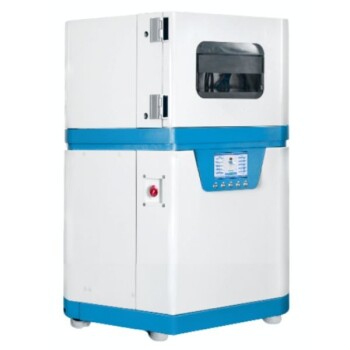
Crushing and secondary pressing are critical mechanical interventions required to rectify compositional inconsistencies inherent in the first stage of vacuum thermal reduction. These systems function to physically break down intermediate reaction products, forcing unreacted materials back into close contact to enable a complete chemical reaction in the subsequent stage.
The first thermal stage often leaves reactants isolated and unreacted. Intermediate mechanical processing eliminates this inhomogeneity, ensuring that phases like $Ti_2O_3$ and Carbon are sufficiently mixed to convert into a uniform $TiC_{0.5}O_{0.5}$ structure.
The Problem: Compositional Inhomogeneity
Incomplete First-Stage Reactions
The initial thermal reduction stage rarely results in a perfectly uniform product. Instead, it frequently yields a material with significant compositional inhomogeneity.
The Barrier of Separation
Within this intermediate product, specific unreacted phases—notably $Ti_2O_3$ and Carbon—often remain physically separated.
If these components are not in direct contact, the chemical reaction stalls. Continuing to heat the material without mechanical intervention will not drive the reaction forward effectively.
The Solution: Mechanical Intervention
Re-grinding for Redistribution
The crushing process acts as a "reset" for the material's distribution. By re-grinding the intermediate products, you break up the segregated clusters of material.
This ensures that the unreacted $Ti_2O_3$ and Carbon are redistributed evenly throughout the mixture, rather than remaining in isolated pockets.
Secondary Pressing for Contact
Once the material is re-ground, secondary pressing is employed to compact the powder. This step is vital for establishing thorough physical contact between the particles.
By minimizing the distance between the reactants, you create the necessary conditions for diffusion and chemical conversion during the second thermal stage.
The Goal: Structural Uniformity
Achieving the $TiC_{0.5}O_{0.5}$ Structure
The ultimate objective of these mechanical steps is to facilitate the synthesis of a specific, uniform structure: $TiC_{0.5}O_{0.5}$.
Ensuring Complete Conversion
Without the intermediate steps of crushing and pressing, the second thermal reduction stage would likely result in a defective product containing residual unreacted phases.
The mechanical processing ensures the "complete conversion" required to meet strict stoichiometric specifications.
Understanding the Trade-offs
Increased Process Complexity
Introducing crushing and pressing steps between thermal stages significantly increases the complexity of the manufacturing line.
It requires the integration of mechanical systems capable of handling reactive intermediate materials, often demanding strict environmental controls to prevent contamination.
Cycle Time vs. Quality
While these steps lengthen the overall production cycle and consume additional energy, they are a necessary trade-off.
Attempting to bypass these steps to save time will almost invariably result in a lower-quality product with inconsistent material properties.
Making the Right Choice for Your Goal
To maximize the efficacy of your vacuum thermal reduction process, you must treat the mechanical stages with the same precision as the thermal stages.
- If your primary focus is product purity: Ensure the re-grinding process is aggressive enough to eliminate all agglomerates of unreacted $Ti_2O_3$.
- If your primary focus is reaction efficiency: Optimize the secondary pressing pressure to maximize surface contact between Carbon and the oxide phases without causing lamination.
Mastering the mechanical transition between thermal stages is the key to transforming a heterogeneous mixture into a high-quality, uniform material.
Summary Table:
| Process Stage | Action Taken | Primary Objective |
|---|---|---|
| First Thermal Stage | Initial reduction | Initial reaction, results in $Ti_2O_3$ and Carbon |
| Crushing / Re-grinding | Mechanical breakdown | Eliminates inhomogeneity & redistributes unreacted phases |
| Secondary Pressing | Powder compaction | Maximizes physical contact for diffusion |
| Second Thermal Stage | Final reduction | Achieves complete conversion to uniform $TiC_{0.5}O_{0.5}$ |
Optimize Your Material Synthesis with KINTEK Precision
Achieving stoichiometric perfection in vacuum thermal reduction requires more than just heat—it demands superior mechanical intervention. KINTEK specializes in high-performance crushing and milling systems, sieving equipment, and hydraulic pellet presses designed to handle reactive intermediate materials with precision.
Whether you are producing advanced ceramics or conducting battery research, our comprehensive range of vacuum and atmosphere furnaces, alongside our specialized milling solutions, ensures your production cycle achieves maximum uniformity and purity.
Don't let compositional inhomogeneity compromise your results. Contact our laboratory equipment experts today to find the perfect crushing and pressing solution for your material science needs.
References
- Tianzhu Mu, Bin Deng. Dissolution Characteristic of Titanium Oxycarbide Electrolysis. DOI: 10.2320/matertrans.mk201616
This article is also based on technical information from Kintek Solution Knowledge Base .
Related Products
- Vacuum Induction Melting Spinning System Arc Melting Furnace
- Vacuum Heat Treat and Pressure Sintering Furnace for High Temperature Applications
- Electric Heated Hydraulic Vacuum Heat Press for Lab
- Vacuum Hot Press Furnace Machine for Lamination and Heating
- Touchscreen Automatic Vacuum Heat Press
People Also Ask
- What are the advantages of a vacuum induction melting furnace? Achieve High-Purity Alloys with Precision VIM
- Why use VIM for rare earth steel? Essential Precision for Melting Reactive Lanthanum and Cerium
- What is the primary function of a vacuum induction melting furnace in Ni-Mo-Cr-Fe master alloy prep? Ensure High Purity
- What is the function of a vacuum induction melting furnace? Essential Guide for High-Purity FeCrAl Alloy Production
- What types of metals are typically processed in a vacuum induction melting furnace? High-Purity Alloys for Critical Applications