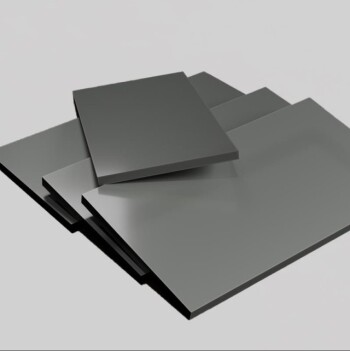
Graphite molds are the linchpin of the sintering process because they offer a unique combination of thermal conductivity, mechanical strength at high temperatures, and chemical inertness that other materials cannot match. Specifically for Copper-Carbon Nanotube (Cu-CNT) composites, these molds act as the primary containment vessel, translating the vacuum hot press's extreme heat and pressure into the powder mixture to ensure uniform densification without chemically contaminating the copper matrix.
The core value of a graphite mold lies in its ability to withstand the mechanical stress of densification while ensuring the composite material remains chemically pure and dimensionally accurate.
The Role of Thermal and Mechanical Integrity
Withstanding Extreme Process Conditions
Vacuum hot pressing subjects materials to intense environments. Graphite is essential because it maintains superior high-temperature strength, serving as a robust container for powder shaping.
While other materials might deform or soften, graphite retains its structural integrity, ensuring the powder stays confined within a specific geometry under mechanical pressures (often reaching 25 MPa or higher during Cu-CNT processing).
Ensuring Uniform Densification
Achieving a homogenous composite requires consistent heat and pressure. Graphite possesses excellent thermal conductivity, which allows it to transfer heat from the furnace elements to the Cu-CNT powder efficiently.
Simultaneously, the mold acts as the medium for pressure transmission. It ensures that the axial force from the hydraulic press is distributed uniformly throughout the powder, preventing density gradients in the final product.
Chemical Stability and Production Efficiency
Preventing Matrix Contamination
Copper is reactive at high temperatures, making the choice of mold material critical. Graphite is chemically stable in reducing atmospheres, which are standard in vacuum hot pressing.
Crucially, graphite does not react with the copper matrix. This inertness prevents the formation of unwanted intermetallic compounds or surface defects that could compromise the electrical or mechanical properties of the Cu-CNT composite.
Facilitating Easy Demolding
Efficiency in manufacturing relies on removing the part without damage. Graphite offers natural self-lubricating properties, acting as a built-in release agent.
Because the copper matrix does not adhere to the carbon structure of the mold, the finished sample can be easily demolded. This preserves the dimensional precision of the sample and reduces post-processing cleanup.
Understanding the Trade-offs
The Consumable Nature of Graphite
While graphite is mechanically strong at high temperatures, it is generally softer and more brittle than metals at room temperature. This makes the molds susceptible to mechanical wear and abrasion over repeated cycles of loading and unloading powder.
Oxidation Sensitivity
Graphite's chemical stability is highly dependent on the environment. While excellent in a vacuum or inert atmosphere, it oxidizes rapidly in air at high temperatures. Therefore, maintaining a strict vacuum is not just for the sample's protection, but is required to prevent the mold itself from degrading.
Making the Right Choice for Your Goal
To maximize the quality of your Cu-CNT composites, consider how the mold's properties align with your specific sintering objectives:
- If your primary focus is Dimensional Precision: Rely on the high-temperature strength of the graphite to maintain rigid geometry, ensuring the applied pressure translates directly to densification rather than mold deformation.
- If your primary focus is Material Purity: Leverage the chemical inertness of the graphite to prevent surface reactions, ensuring the copper matrix remains uncontaminated during the high-heat cycle.
Graphite serves as the critical interface that allows extreme processing forces to shape delicate nanocomposites without compromising their integrity.
Summary Table:
| Feature | Benefit for Cu-CNT Sintering |
|---|---|
| High-Temp Strength | Resists deformation under pressures of 25+ MPa |
| Thermal Conductivity | Ensures uniform heat distribution for homogenous density |
| Chemical Inertness | Prevents copper matrix contamination and surface reactions |
| Self-Lubrication | Enables easy demolding and preserves dimensional accuracy |
| Reducing Stability | Operates reliably within vacuum or inert atmospheres |
Elevate Your Material Research with KINTEK Precision Solutions
Don't let subpar tooling compromise your Cu-CNT composites. KINTEK specializes in advanced laboratory equipment designed for extreme environments. Our high-performance vacuum hot press systems and isostatic presses are engineered for precision, while our high-purity graphite crucibles and consumables ensure your samples remain free from contamination.
Whether you are refining battery research, developing aerospace alloys, or exploring nanotechnology, KINTEK offers the complete workflow—from crushing and milling systems to high-temperature furnaces and ULT cooling solutions.
Ready to optimize your sintering process? Contact KINTEK experts today to discuss our range of laboratory equipment and high-purity consumables tailored to your specific application.
Related Products
- 2200 ℃ Graphite Vacuum Heat Treat Furnace
- Ultra-High Temperature Graphite Vacuum Graphitization Furnace
- Graphite Vacuum Continuous Graphitization Furnace
- Horizontal High Temperature Graphite Vacuum Graphitization Furnace
- Anti-Cracking Press Mold for Lab Use
People Also Ask
- How does heat transmit in a vacuum? Mastering Thermal Radiation for Purity & Precision
- What is the process of vacuum heat treating? Achieve Superior Hardening with a Clean, Bright Finish
- Why do you heat treat in a vacuum? Achieve Perfect Surface Finish and Material Integrity
- How does a vacuum heat treat furnace work? Achieve Pristine, Oxide-Free Metal Parts
- What is graphite heating? A Guide to Durable, High-Temp Industrial Furnace Solutions