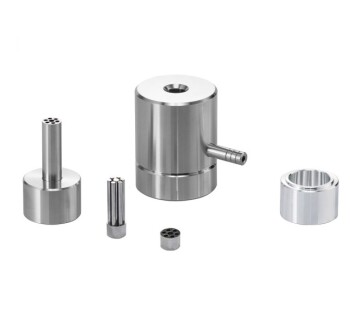
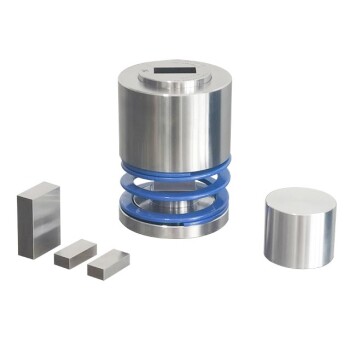
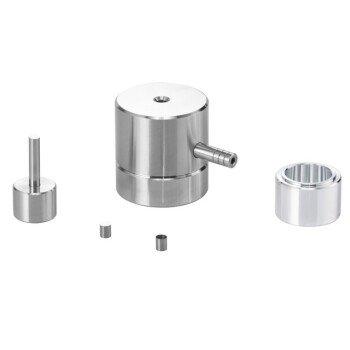
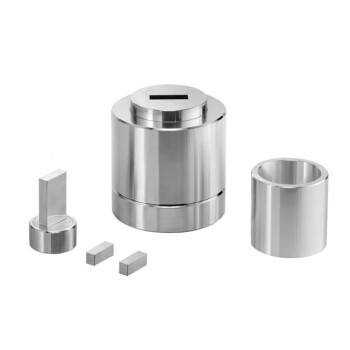
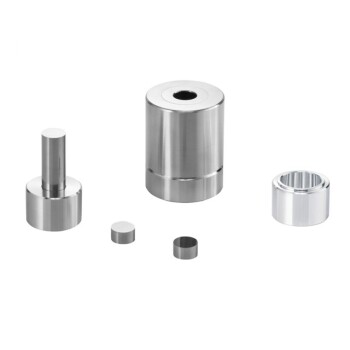
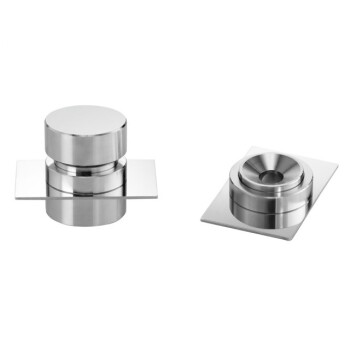
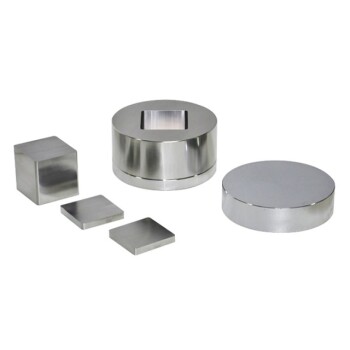
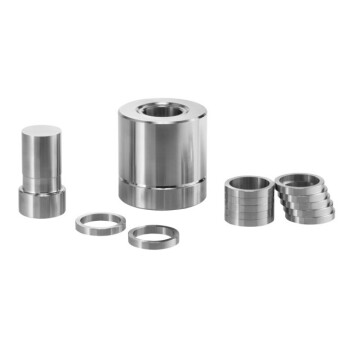
High-pressure resistant molds serve as the primary containment and force-transmission vessels used to convert loose powder into a dense, solid composite. During the vacuum hot pressing of Silicon Carbide (SiC) reinforced amorphous composites, these molds define the material's final geometry while transmitting extreme external pressures—up to 1.2 GPa—directly to the powder mixture.
Core Insight: The mold is not merely a container; it is an active tool for densification. Its ability to maintain dimensional stability under extreme pressure is the deciding factor in whether particles successfully rearrange and bond to form a defect-free bulk sample.
The Mechanics of Pressure Transmission
Withstanding Extreme Loads
The primary function of these molds is to withstand and transmit massive hydraulic forces. In the specific context of SiC reinforced amorphous composites, the molds must accommodate pressures as high as 1.2 GPa.
Converting External Force to Internal Density
The mold acts as the medium that transfers this external pressure to the loose powders inside. This transmission is critical for forcing the hard SiC particles and the amorphous matrix to interact intimately, eliminating voids that would otherwise weaken the material.
Geometric Definition and Stability
Defining Final Shape
The mold provides the precise geometric constraints for the composite. Because the starting material is loose powder, the internal walls of the mold dictate the final shape and surface finish of the bulk sample.
High-Temperature Dimensional Stability
These molds are typically constructed from high-strength alloys or specialized graphite to resist deformation at elevated temperatures. They must exhibit exceptional dimensional stability; any warping of the mold during the heating cycle would result in a distorted final product.
Facilitating Material Consolidation
Enabling Particle Rearrangement
The constraints provided by the mold allow for effective particle rearrangement. As pressure is applied, the mold prevents lateral expansion, forcing particles to slide past one another and fill interstitial gaps.
Preventing Macroscopic Defects
By maintaining structural integrity under load, the mold ensures uniform compression. This prevents the formation of macroscopic defects, such as cracks or uneven density gradients, which occur if the pressure transmission is non-uniform or if the mold yields under stress.
Understanding the Trade-offs
Material Limitations vs. Pressure Requirements
Selecting the mold material involves a critical trade-off between thermal resilience and mechanical yield strength. While graphite offers excellent thermal properties, the extreme pressure requirement (1.2 GPa) may necessitate the use of high-strength alloys to prevent the mold itself from shattering or deforming.
Thermal Expansion Mismatch
A common pitfall is ignoring the coefficient of thermal expansion (CTE) between the mold and the composite. If the mold expands or contracts at a significantly different rate than the SiC reinforced composite, it can lead to stress fractures in the sample during cooling or difficulty in extracting the final part.
Making the Right Choice for Your Project
To ensure the successful fabrication of SiC reinforced amorphous composites, prioritize your mold selection based on your specific processing parameters:
- If your primary focus is maximum density: Prioritize mold materials with the highest possible compressive yield strength to safely reach the 1.2 GPa pressure threshold without deformation.
- If your primary focus is geometric precision: Select mold materials known for high dimensional stability and low thermal expansion to ensure the final shape mirrors the design specifications exactly.
Success in vacuum hot pressing relies on a mold that is mechanically superior to the extreme forces it must transmit.
Summary Table:
| Function | Description | Key Metric/Requirement |
|---|---|---|
| Force Transmission | Converts hydraulic force into internal powder pressure | Up to 1.2 GPa |
| Geometric Definition | Defines final shape and surface finish of the bulk sample | High Dimensional Stability |
| Densification | Eliminates voids by forcing particle rearrangement | Voids Elimination |
| Structural Integrity | Prevents lateral expansion and macroscopic defects | High Compressive Strength |
| Thermal Resistance | Maintains mold shape and strength at elevated temperatures | Low CTE & High-Strength Alloys |
Elevate your material research with KINTEK’s precision engineering. From high-pressure resistant molds and hydraulic presses for SiC composite fabrication to vacuum hot pressing systems, we provide the robust equipment needed to achieve maximum density and geometric precision. Whether you are developing amorphous composites or advanced ceramics, our experts offer a comprehensive range of crushing and milling systems, high-temperature furnaces, and essential consumables tailored to your lab's needs. Contact KINTEK today to optimize your consolidation process and achieve defect-free results!
Related Products
- Anti-Cracking Press Mold for Lab Use
- Special Shape Press Mold for Lab
- Ball Press Mold for Lab
- Round Bidirectional Press Mold for Lab
- Square Bidirectional Pressure Mold for Lab Use
People Also Ask
- What is the press mould method? A Guide to Consistent, Detailed Ceramic Forms
- How to use a press mold? Master the Art of Creating Consistent Ceramic Forms
- What is the function of press molds during the preparation of SiCf/Ti-43Al-9V composites? Achieve Structural Precision
- What is a press mold used for? Achieve Repeatable Precision and Efficiency
- What is the purpose of specialized pressure devices in sulfide solid-state batteries? Ensure Chemo-Mechanical Stability