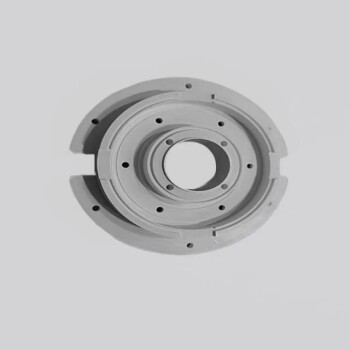
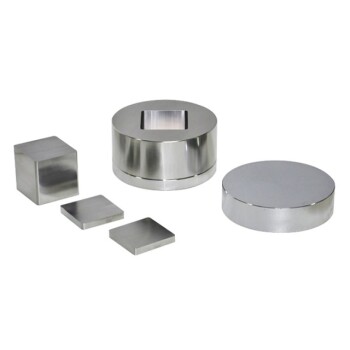
The primary functions of a graphite mold coated with Boron Nitride (BN) in vacuum hot-press sintering are to provide structural definition under extreme conditions while chemically isolating the sample material. The graphite substrate creates a high-strength cavity that withstands significant mechanical pressure (often exceeding 20 MPa) to shape the powder, while the BN coating acts as a non-reactive barrier to prevent chemical bonding and ensure the final part releases cleanly.
Core Takeaway Successful vacuum hot-press sintering relies on a dichotomy of functions: the graphite mold provides the necessary thermal and mechanical stability to densify the powder, while the Boron Nitride coating ensures chemical inertness. Without the coating, the high temperatures required for sintering would cause active alloys to react with the carbon mold, ruining both the sample properties and the mold itself.
The Role of the Graphite Substrate
Structural Integrity Under Load
The fundamental purpose of the graphite mold is to serve as a robust container that defines the geometry of the final sample. It must possess high mechanical strength to withstand the axial pressures exerted by hydraulic systems, which typically range from 10 to 30 MPa.
Effective Pressure Transmission
Beyond simply holding the powder, the mold functions as a transmission medium. It transfers the external mechanical force uniformly to the internal powder compact. This uniform pressure distribution is critical for promoting plastic flow and achieving high density in the final alloy block.
Thermal Stability and Conductivity
Graphite is selected for its ability to endure extreme thermal environments, ranging from 650°C to 1500°C, without softening or deforming. Its superior thermal conductivity ensures that heat is distributed evenly throughout the powder, preventing thermal gradients that could warp the sample.
Environmental Control
At high temperatures, graphite can generate a local reducing atmosphere. This helps protect sensitive alloy powders (such as CoCrCuFeNi) from oxidation during the sintering process, adding a layer of chemical protection beyond the vacuum environment itself.
The Function of the Boron Nitride (BN) Coating
Chemical Isolation
The most critical role of the BN coating is to act as a barrier layer between the metallic powder and the carbon-rich graphite. Without this layer, active alloy components (such as Titanium) would react with the graphite at high temperatures.
Prevention of Brittle Phases
These reactions often form harmful, brittle compounds (such as carbides or nitrides) at the interface. These compounds degrade the mechanical properties of the sample, specifically reducing bending strength and surface integrity.
Lubrication and Demolding
Boron Nitride possesses excellent lubricity, functioning effectively as a mold release agent. By preventing the sintered sample from adhering or chemically bonding to the mold walls, the coating ensures the sample can be successfully and smoothly demolded without damage.
Understanding the Trade-offs
The Risk of Reaction
The primary trade-off in this system is the chemical reactivity of graphite. While graphite is structurally ideal, it is chemically aggressive toward many metals at sintering temperatures. If the BN coating is applied unevenly or fails, the resulting reaction can fuse the part to the mold.
Dependence on Coating Integrity
The success of the process is entirely dependent on the quality of the isolation layer. A "perfect" graphite mold is useless for active alloys if the BN coating is compromised, as the resulting chemical interaction creates surface defects and renders the part unusable.
Making the Right Choice for Your Goal
To optimize your sintering process, you must balance the mechanical requirements of the mold with the chemical sensitivity of your powder.
- If your primary focus is Dimensional Accuracy: Prioritize high-quality graphite with high thermal strength to ensure the mold does not deform under the 20-30 MPa pressure load.
- If your primary focus is Surface Quality and Purity: Ensure the Boron Nitride coating is applied thoroughly to create a flawless barrier, preventing the formation of brittle reaction layers.
The graphite mold provides the muscle to shape the material, but the Boron Nitride coating provides the finesse required to preserve its integrity.
Summary Table:
| Component | Primary Function | Key Properties |
|---|---|---|
| Graphite Substrate | Structural definition & pressure transmission | High thermal conductivity, 10-30 MPa strength |
| BN Coating | Chemical isolation & mold release | Non-reactive barrier, high lubricity |
| The System | Densification & purity preservation | Operates from 650°C to 1500°C |
Elevate Your Material Research with KINTEK Precision Solutions
Don't let chemical reactions or mold failure compromise your sintering results. KINTEK specializes in high-performance laboratory equipment, including vacuum hot-press sintering systems, high-temperature furnaces, and premium consumables like graphite components and BN coatings.
Whether you are working with sensitive alloys or advanced ceramics, our expert team provides the structural and chemical tools necessary for high-density, defect-free results. Contact KINTEK today to optimize your laboratory workflow and explore our full range of hydraulic presses, milling systems, and cooling solutions tailored for your success.
Related Products
- Ultra-High Temperature Graphite Vacuum Graphitization Furnace
- 2200 ℃ Graphite Vacuum Heat Treat Furnace
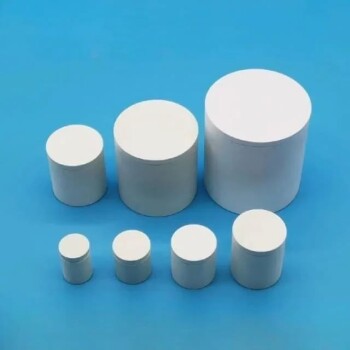
- Boron Nitride (BN) Crucible for Phosphorous Powder Sintered
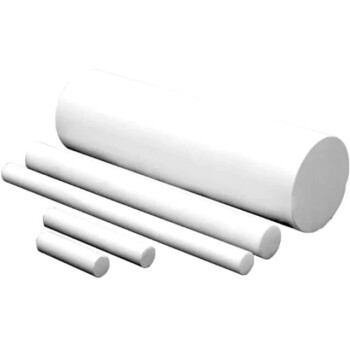
- Boron Nitride (BN) Ceramic Rod for High Temperature Applications
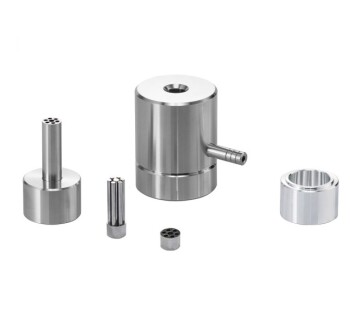
- Special Shape Press Mold for Lab
People Also Ask
- What is the disadvantage of graphite furnace? Managing Reactivity and Contamination Risks
- Is a graphite melting point high or low? Discover Its Extreme Thermal Resilience
- What are the advantages and disadvantages of graphite furnace? Unlock Extreme Heat Performance
- What are the disadvantages of graphite furnace? Key Limitations and Operational Costs
- What gas is used in graphite furnace? Maximize Accuracy with the Right Inert Gas