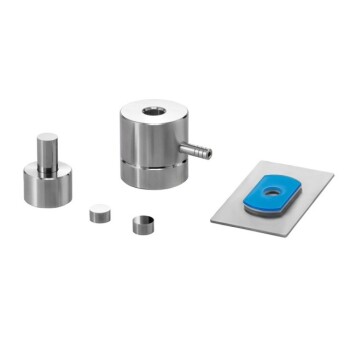
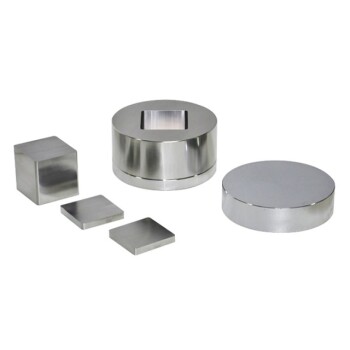
Graphite molds are the critical structural interface in the vacuum hot press sintering of Nb-Cr-Si alloys. They function simultaneously as the containment vessel for the metal powder and the primary medium for transferring mechanical pressure. Their widespread use is dictated by their ability to maintain structural rigidity and chemical inertness at extreme temperatures, ensuring the alloy is densified without deformation or contamination.
Core Insight: The success of sintering refractory alloys relies on applying immense pressure at temperatures where most materials fail. Graphite is utilized because it acts as a "thermal scaffold," remaining physically stable and chemically passive enough to force the metal powder into a dense, precise shape without reacting with it.
The Structural Role of Graphite
Withstanding Extreme Mechanical Load
The primary function of the graphite mold is to act as a pressure transfer medium. During vacuum hot pressing, the system applies significant uniaxial pressure (often ranging from 25 MPa to 49 MPa) to the powder compact.
Graphite is unique because it retains high-temperature strength. Unlike metals that soften as they heat, graphite remains rigid, allowing it to transmit this vertical force directly to the powder without buckling or deforming itself.
Defining Geometric Precision
Because the mold does not soften at sintering temperatures (which can reach upwards of 1700°C), it enforces strict geometric limits on the alloy.
The mold effectively restricts lateral expansion. As the hydraulic rams press down, the graphite walls prevent the powder from spreading outward, forcing the particles to rearrange and bond into a dense, dimensionally accurate block.
Chemical and Thermal Interactions
Chemical Inertness with Metal Powders
For alloys containing reactive elements like Niobium (Nb) or Silicon (Si), contamination is a major failure risk. Graphite is chosen because it exhibits excellent chemical stability.
It does not react significantly with the metal powders even under high heat. This ensures that the final sintered sample retains the precise chemical composition intended, without picking up unwanted carbon contaminants from the mold walls.
Uniform Thermal Conductivity
Graphite is an excellent conductor of heat. In a vacuum hot press, uniform heating is essential to prevent internal stresses or uneven densification in the alloy.
The mold absorbs heat and distributes it evenly around the powder compact. This ensures that the center of the sample reaches the same sintering temperature as the edges, promoting uniform grain growth and metallurgical bonding.
Understanding the Trade-offs
The "Micro-Atmosphere" Effect
While graphite is generally inert regarding the metal, it does interact with the environment in a specific, often beneficial way. At high temperatures, graphite can react with residual oxygen in the chamber to generate trace amounts of Carbon Monoxide (CO).
This creates a localized reducing atmosphere. While this technically contradicts "total inertness," it is often advantageous: this environment helps decompose oxide layers on the powder surfaces, facilitating better bonding between particles without chemically altering the bulk alloy.
Porosity and Gas Evacuation
Graphite is naturally porous. In a vacuum environment, this porosity assists in the removal of trapped gases.
As the mechanical pressure squeezes the powder, gases trapped between particles need an escape route. The vacuum environment, combined with the nature of the mold, allows these gases to be evacuated, preventing porosity and voids in the final Nb-Cr-Si alloy.
Making the Right Choice for Your Goal
When designing a sintering protocol for Nb-Cr-Si alloys, understand that the mold is an active participant in the process parameters.
- If your primary focus is Dimensional Accuracy: Rely on graphite’s high-temperature rigidity to prevent lateral deformation, but ensure your pressure parameters do not exceed the mold's fracture strength.
- If your primary focus is Microstructural Homogeneity: Leverage the high thermal conductivity of graphite by allowing sufficient soak times for heat to equalize throughout the powder compact.
- If your primary focus is Surface Purity: Recognize that while graphite is inert, the localized reducing atmosphere can help clean powder surfaces, improving particle-to-particle bonding.
Graphite molds provide the essential balance of thermal conductivity and mechanical rigidity required to transform loose refractory powders into high-performance, fully dense alloy blocks.
Summary Table:
| Feature | Benefit for Nb-Cr-Si Sintering |
|---|---|
| High-Temp Rigidity | Withstands 25-49 MPa pressure at 1700°C+ without deformation. |
| Thermal Conductivity | Ensures uniform heat distribution for consistent grain growth. |
| Chemical Inertness | Prevents contamination and maintains precise alloy composition. |
| Natural Porosity | Facilitates gas evacuation in a vacuum to eliminate internal voids. |
| Reducing Effect | Creates a micro-atmosphere that decomposes oxide layers on powders. |
Elevate Your Material Research with KINTEK
Achieving the perfect densification for refractory alloys like Nb-Cr-Si requires high-performance equipment and high-purity consumables. KINTEK specializes in advanced laboratory solutions designed for precision and durability. From our robust vacuum hot presses and high-temperature furnaces (vacuum, tube, atmosphere) to precision-engineered graphite molds and crucibles, we provide the tools necessary to ensure your sintering process is contamination-free and dimensionally accurate.
Whether you are focusing on battery research, metallurgical bonding, or advanced ceramics, our comprehensive portfolio—including high-pressure reactors, hydraulic presses, and specialized milling systems—is tailored to meet the demands of modern material science.
Ready to optimize your lab's performance? Contact us today to discuss your custom equipment needs!
Related Products
- Ultra-High Temperature Graphite Vacuum Graphitization Furnace
- 2200 ℃ Graphite Vacuum Heat Treat Furnace
- 600T Vacuum Induction Hot Press Furnace for Heat Treat and Sintering
- Vacuum Heat Treat and Pressure Sintering Furnace for High Temperature Applications
- Vacuum Hot Press Furnace Machine for Lamination and Heating
People Also Ask
- What is the disadvantage of graphite furnace? Managing Reactivity and Contamination Risks
- Is a graphite melting point high or low? Discover Its Extreme Thermal Resilience
- What are the advantages and disadvantages of graphite furnace? Unlock Extreme Heat Performance
- What is the temperature range of a graphite furnace? Unlock up to 3000°C for advanced materials processing.
- What gas is used in graphite furnace? Maximize Accuracy with the Right Inert Gas