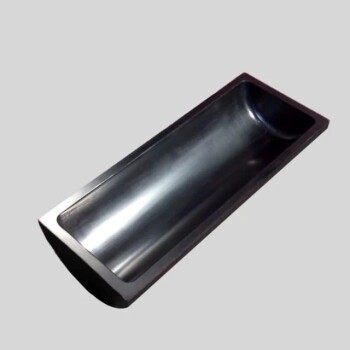
Graphite sample holders are chosen primarily for their superior thermal conductivity and robust chemical stability at high temperatures. These properties allow the holder to transfer heat rapidly and evenly from the furnace walls to the silicon substrate while resisting reactions with process gases, ensuring the integrity of the Al2TiO5 coating.
The success of Al2TiO5 deposition relies on maintaining a pristine chemical environment and a uniform temperature profile. Graphite achieves this by acting as an efficient thermal conduit that remains inert, preventing contamination even under intense heat.
Ensuring Thermal Uniformity
Efficient Heat Transfer
The deposition process requires the silicon substrate to reach specific temperatures efficiently. Graphite acts as a highly effective thermal bridge, rapidly conducting heat from the furnace walls directly to the substrate.
Consistent Temperature Distribution
Achieving a high-quality coating requires more than just reaching a target temperature; the heat must be spread evenly. Graphite ensures a consistent temperature distribution across the entire deposition surface of the silicon. This uniformity prevents hot spots or cool zones that could compromise the structure of the Al2TiO5 layer.
Maintaining Process Purity
High-Temperature Stability
Deposition environments are harsh, often involving extreme heat that degrades lesser materials. Graphite possesses high-temperature chemical stability, allowing it to maintain its structural integrity throughout the heating cycle without breaking down.
Resistance to Chemical Reaction
In the specific context of Al2TiO5 deposition, the process often utilizes reducing or inert atmospheres, such as argon. Graphite does not easily react with these process gases. This inertness is critical because it prevents the holder from releasing impurities or reacting with the environment, thereby eliminating the risk of chemical contamination on the silicon substrate.
Understanding the Operational Context
Dependency on Atmosphere
While graphite is chemically stable, the reference specifically notes its effectiveness in reducing or inert atmospheres. Using graphite relies on maintaining these specific environmental conditions (e.g., argon gas) to ensure it remains non-reactive.
The Source of Heat
It is important to note that the graphite holder is a passive thermal tool. It relies on the furnace walls as the primary heat source. The holder's effectiveness is derivative of its ability to transfer this external heat, rather than generating heat itself.
Making the Right Choice for Your Goal
When configuring your deposition setup, understanding why graphite is utilized helps you troubleshoot and optimize the process.
- If your primary focus is Coating Homogeneity: Rely on graphite’s high thermal conductivity to eliminate temperature gradients across the substrate surface.
- If your primary focus is Material Purity: Ensure your process atmosphere remains inert (e.g., using argon) to leverage graphite's resistance to chemical contamination.
By utilizing graphite, you ensure that the substrate is physically supported by a material that thermally aids the process without chemically interfering with it.
Summary Table:
| Feature | Benefit for Al2TiO5 Deposition |
|---|---|
| High Thermal Conductivity | Ensures rapid heat transfer and uniform temperature across the silicon substrate. |
| Chemical Stability | Maintains structural integrity at extreme temperatures without degrading. |
| Atmospheric Inertness | Resists reaction with argon or reducing gases to prevent coating contamination. |
| Thermal Uniformity | Eliminates hot spots to ensure a consistent and homogeneous material structure. |
Optimize Your Deposition Process with KINTEK
Achieve precision in every coating layer with KINTEK’s high-performance laboratory solutions. Whether you are conducting CVD, PECVD, or atmosphere-controlled deposition, our specialized equipment ensures thermal uniformity and material purity for your most demanding research projects.
KINTEK specializes in high-quality laboratory equipment and consumables, offering a comprehensive range of:
- High-Temperature Furnaces: Muffle, tube, rotary, vacuum, CVD, PECVD, and atmosphere-controlled systems.
- Material Processing: Crushing and milling systems, sieving equipment, and hydraulic presses (pellet, hot, isostatic).
- Specialized Reactors: High-temperature high-pressure reactors, autoclaves, and electrolytic cells.
- Advanced Consumables: PTFE products, ceramics, and high-purity crucibles.
Ready to enhance your lab's efficiency and ensure superior results for your silicon substrate coatings? Contact KINTEK today to discuss your specific requirements!
References
- Sebastian Öhman, Mats Boman. Selective kinetic growth and role of local coordination in forming Al<sub>2</sub>TiO<sub>5</sub>-based coatings at lower temperatures. DOI: 10.1039/d1ma00428j
This article is also based on technical information from Kintek Solution Knowledge Base .
Related Products
- Sample Support Body for Electrochemical Tests
- Customizable XRD Sample Holders for Diverse Research Applications
- Custom PTFE Wafer Holders for Lab and Semiconductor Processing
- Carbon Graphite Boat -Laboratory Tube Furnace with Cover
- XRD Sample Holder X-ray Diffractometer Powder Slide
People Also Ask
- Why is a dedicated electrochemical test cell necessary for carbon steel? Ensure Precise Geothermal Corrosion Data
- How does a standardized electrochemical test cell assist in MOx/CNTf electrode screening? Optimize Material Ratios
- Why must the electrochemical cell be continuously purged with nitrogen? Ensure Precision in Ni-Cr Corrosion Tests
- What is the difference between a voltaic cell and an electrochemical cell? Understand the Two Types of Energy Conversion
- How do the electrochemical cell and three-electrode testing system collaborate? Optimize Zinc Anode Deposition Control