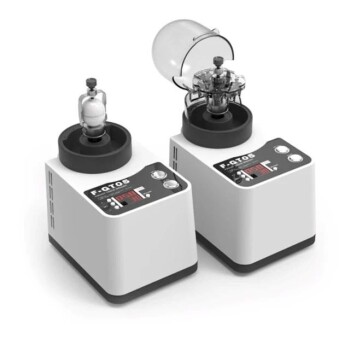
High-precision ball mills are the fundamental tools for transforming raw bulk materials into high-performance catalysts. They are necessary to physically refine coarse powders—such as natural minerals, shells, or eggshells—down to micron or even nanometer scales. This mechanical reduction is critical for maximizing specific surface area and enabling the precise chemical interactions required for effective catalysis.
The core function of these systems is to bridge the gap between bulk raw materials and molecular reactivity. By pulverizing materials to the micro- or nano-scale, grinding exposes the maximum number of active sites and ensures that different chemical components can mix uniformly, which is impossible to achieve with coarse particles.
The Physics of Catalytic Performance
Maximizing Specific Surface Area
The primary reason for using high-precision grinding is to drastically increase the specific surface area of the catalyst material.
Raw materials often start as bulk or coarse powders, which effectively "hide" the majority of their material inside the particle. By reducing these materials to micron or nanometer scales, you exponentially increase the total surface area available for chemical reactions.
Increasing Active Site Exposure
Catalysis occurs on the surface of the material, specifically at "active sites."
Fine grinding directly increases the exposure frequency of these active sites. Without this step, potential reactive zones remain trapped within the bulk of the particle, rendering them useless for the catalytic process.
Achieving Chemical Uniformity
Facilitating Molecular-Level Mixing
Modifying alkaline earth metal oxides often involves doping or co-precipitation processes where multiple components must interact.
High-precision grinding is not just about size reduction; it facilitates molecular-level uniform mixing of these multiple metal oxide components. If the particles are too large, the components segregate, leading to a heterogeneous mixture with poor performance.
Ensuring Consistency in Formulation
In advanced applications, such as automotive catalysts, uniformity is paramount.
Laboratory grinding equipment is used to slurry active components to a precise size, typically achieving a D50 of less than 15 µm. This precise control ensures a high degree of component uniformity within the catalyst particles, which is requisite for obtaining consistent, reliable activity results during screening.
Common Pitfalls to Avoid
The Risk of Inconsistent Particle Sizes
If the grinding system lacks precision, it produces a wide distribution of particle sizes rather than a tight tolerance.
This inconsistency leads to unpredictable catalytic behavior, as larger particles will react at different rates than smaller ones. This makes it impossible to standardize the activation process or accurately predict the catalyst's lifespan.
Impact on Downstream Processing
Grinding is rarely the final step; it is usually a precursor to drying, crushing, or sieving.
Failure to achieve the target particle size (e.g., < 15 µm) can cause bottlenecks or defects in these subsequent processing steps. Poorly ground material may not slurry correctly or may clog filtration systems, disrupting the entire production workflow.
Making the Right Choice for Your Goal
To optimize your catalyst modification process, align your grinding strategy with your specific objectives:
- If your primary focus is Reactivity: Prioritize equipment capable of reaching nanometer scales to maximize surface area and the exposure of active sites.
- If your primary focus is Doping/Complexity: Ensure your system supports high-energy milling to facilitate molecular-level mixing of multiple metal oxide components.
- If your primary focus is Reliability: Select high-precision equipment that guarantees a tight particle size distribution (e.g., D50 < 15 µm) to ensure consistent screening results.
The effectiveness of any alkaline earth metal oxide catalyst is ultimately defined by the precision of its physical preparation.
Summary Table:
| Feature | Impact on Catalyst Performance | Technical Requirement |
|---|---|---|
| Particle Size Reduction | Increases specific surface area and active site exposure | Nanometer to Micron scales |
| Mixing Precision | Ensures molecular-level uniformity for doped components | High-energy ball milling |
| Consistency | Guarantees predictable catalytic activity and screening | D50 < 15 µm |
| Material Integrity | Prevents segregation of metal oxide components | Controlled grinding parameters |
Elevate Your Catalyst Research with KINTEK Precision
Don't let inconsistent particle sizes compromise your catalytic performance. KINTEK specializes in providing high-precision crushing and milling systems designed to meet the rigorous demands of laboratory research and material modification.
Whether you are refining alkaline earth metal oxides or developing complex automotive catalysts, our equipment ensures you achieve the precise surface area and molecular uniformity required for breakthrough results. Beyond grinding, we offer a comprehensive suite of lab solutions, including high-temperature furnaces, high-pressure reactors, and sieving equipment to support your entire workflow.
Ready to achieve D50 < 15 µm consistency? Contact our technical experts today to find the perfect milling solution for your lab!
References
- Jesús Andrés Tavizón-Pozos, José A. Rodrı́guez. State of Art of Alkaline Earth Metal Oxides Catalysts Used in the Transesterification of Oils for Biodiesel Production. DOI: 10.3390/en14041031
This article is also based on technical information from Kintek Solution Knowledge Base .
Related Products
- Stainless Steel Laboratory Ball Mill for Dry Powder and Liquid with Ceramic Polyurethane Lining
- High-Energy Omnidirectional Planetary Ball Mill Milling Machine for Laboratory
- Laboratory Ball Mill Jar Mill with Metal Alloy Grinding Jar and Balls
- High-Energy Omnidirectional Planetary Ball Mill Machine for Laboratory
- Hybrid High Energy Vibratory Ball Mill for Lab Use
People Also Ask
- How do laboratory ball mills facilitate the mechanochemical synthesis of ZIF-8? Solvent-Free Synthesis Explained
- What is the primary function of a laboratory ball mill in the modification of sulfide-based solid electrolytes with LiPO2F2?
- How does a laboratory ball mill ensure the mixing quality of Mn3Zn0.8Sn0.2N and Ti? Achieve Perfect Homogeneity
- What is the function of a laboratory ball mill in the preparation of AMMCs? Optimize Dispersion & Grain Refinement
- In what way does a laboratory ball mill affect material properties when modifying PHBV/pulp fiber composites?