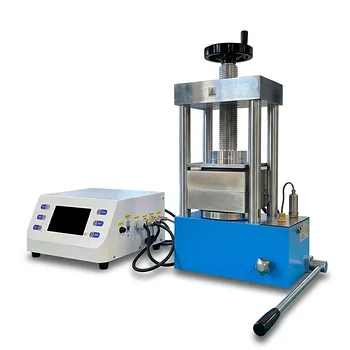
High-pressure stainless steel laboratory reactors are strictly required for the hydrothermal liquefaction of waste tires because the process necessitates extreme subcritical or supercritical water conditions. Specifically, these vessels must safely withstand temperatures up to 400°C and internal pressures reaching 30 MPa, limits that standard laboratory glassware or low-grade vessels cannot survive.
Core Insight: The reactor is not merely a container; it is a process enabler that forces water into a unique physical state where it acts as both a powerful solvent and a reactant. High-grade stainless steel is the only material that offers the necessary "triad" of resistance: mechanical strength against bursting, chemical resistance against corrosion, and thermal stability for heat transfer.
The Critical Role of Pressure and Temperature
To liquefy waste tires effectively, the reactor must alter the fundamental physical properties of water.
Achieving Subcritical and Supercritical States
Hydrothermal liquefaction (HTL) does not occur at standard atmospheric pressure. To process waste tires, the reactor must maintain conditions up to 400°C and 30 MPa. The reactor's primary function is to create a sealed environment that prevents water from vaporizing, keeping it in a dense, reactive subcritical or supercritical state.
Transforming Water into a Reactant
In this high-pressure environment, the polarity and solvent properties of water change drastically. It behaves less like standard water and more like an organic solvent, capable of dissolving hydrophobic organic components found in tires. This state allows water to actively break carbon-carbon bonds and facilitate complex reactions like dechlorination.
Why Industrial-Grade Stainless Steel is Non-Negotiable
The material construction of the reactor is as critical as its pressure rating.
Withstanding Extreme Mechanical Stress
The internal pressure of 30 MPa represents a massive amount of potential energy. Reactors must be constructed from industrial-grade stainless steel, such as S30408, to handle this stress without catastrophic structural failure.
Resisting Chemical Corrosion
The breakdown of waste tires releases various inorganic elements and organic compounds that can be highly corrosive at high temperatures. Stainless steel provides the essential corrosion resistance needed to prevent the reactor walls from degrading or contaminating the chemical reaction.
Ensuring Thermal Conductivity
HTL requires precise thermal management to maintain a stable environment. Stainless steel offers the thermal conductivity necessary to transfer heat efficiently and uniformly throughout the reactor, ensuring the water environment remains consistent.
Understanding the Trade-offs
While high-pressure stainless steel reactors are essential, they introduce specific operational challenges that must be managed.
Safety vs. Accessibility
The sealed, high-pressure nature of these reactors makes them inherently dangerous if not monitored correctly. Unlike open systems, you cannot easily sample or adjust the contents mid-process without depressurizing, which stops the reaction.
Material Limits
While grades like S30408 are robust, they are not invincible. Operating continuously at the upper limits of the reactor's temperature (400°C) and pressure (30 MPa) ratings can fatigue the metal over time, requiring rigorous inspection schedules.
Making the Right Choice for Your Goal
Selecting the correct reactor configuration depends on the specific phase of waste tire processing you are targeting.
- If your primary focus is rapid decomposition: Prioritize a reactor rated for pressures exceeding 30 MPa to ensure you can safely reach supercritical water conditions for maximum breakdown speed.
- If your primary focus is chemical analysis and purity: Ensure the reactor is lined or constructed of high-grade, corrosion-resistant stainless steel (like S30408) to prevent leached metals from skewing your results.
Success in hydrothermal liquefaction relies on a vessel that acts as an unyielding physical barrier against extreme thermodynamic forces.
Summary Table:
| Feature | Requirement for Tire HTL | Benefit of Stainless Steel Reactors |
|---|---|---|
| Pressure Rating | Up to 30 MPa | Prevents catastrophic structural failure under extreme stress. |
| Temperature Limit | Up to 400°C | Enables subcritical and supercritical water states for reaction. |
| Corrosion Resistance | High (against tire byproducts) | Prevents vessel degradation and sample contamination. |
| Solvent Action | Phase Transformation | Maintains high-density water to act as an organic solvent. |
| Material Safety | Industrial Grade (e.g., S30408) | Ensures mechanical integrity and efficient thermal conductivity. |
Scale Your Waste-to-Energy Research with KINTEK
Hydrothermal liquefaction requires equipment that never compromises on safety or precision. At KINTEK, we specialize in providing high-performance laboratory solutions tailored for extreme environments. Our high-temperature high-pressure reactors and autoclaves are engineered to withstand the rigorous demands of tire liquefaction, ensuring stable supercritical conditions and superior corrosion resistance.
From high-pressure reactors to crushing and milling systems for feedstock preparation, KINTEK offers the complete infrastructure your lab needs to achieve breakthrough results. Our expertise in laboratory equipment and consumables ensures your research is backed by industrial-grade durability and expert support.
Ready to optimize your HTL process? Contact our technical team today to find the perfect reactor configuration for your specific research goals.
References
- Rongjie Chen, Yanguo Zhang. Hydrothermal Liquefaction of Scrap Tires: Optimization of Reaction Conditions and Recovery of High Value-Added Products. DOI: 10.3389/fenrg.2022.841752
This article is also based on technical information from Kintek Solution Knowledge Base .
Related Products
- Stainless High Pressure Autoclave Reactor Laboratory Pressure Reactor
- Customizable Laboratory High Temperature High Pressure Reactors for Diverse Scientific Applications
- High Pressure Laboratory Autoclave Reactor for Hydrothermal Synthesis
- Mini SS High Pressure Autoclave Reactor for Laboratory Use
- Customizable High Pressure Reactors for Advanced Scientific and Industrial Applications
People Also Ask
- Why is a laboratory high-pressure reactor used in the hydrothermal synthesis of hydroxyapatite catalysts?
- Why is a laboratory high-pressure reactor necessary for synthesizing fly ash-based zeolite? Achieve Pure Crystallization
- What role does a laboratory high-pressure reactor play in the leaching process of spent cathode materials? Optimize Recovery
- What conditions do laboratory high-pressure reactors provide for HTC? Optimize Your Biochar Production Processes
- How are high-pressure reactors used to prepare metaphosphate electrocatalysts? Master In-Situ Precursor Growth