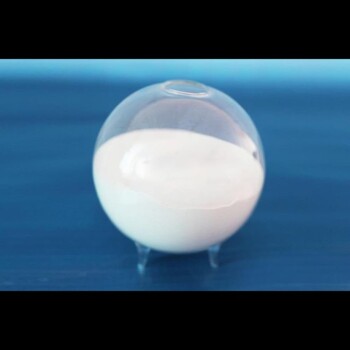
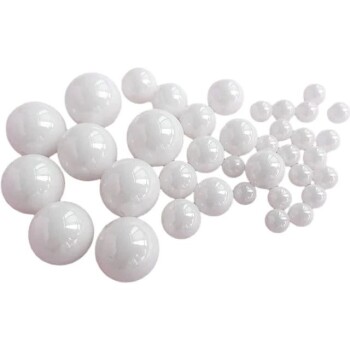
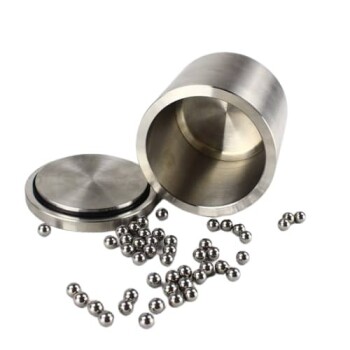
The selection of high-purity alumina ($Al_2O_3$) balls for friction testing is a strategic choice driven by their mechanical and chemical superiority.
These balls serve as a standardized, extremely hard counter-material that ensures wear occurs primarily on the Ni-W alloy coating rather than the abrasive itself. By providing a consistent and stable interface, alumina allows researchers to isolate the coating's performance and accurately measure friction coefficients under extreme stress or high-temperature conditions.
Core Takeaway: High-purity alumina is utilized because its extreme hardness and chemical inertness create a stable "friction pair" that reliably simulates mechanical wear. This allows for an objective assessment of how Ni-W coatings respond to varying heat treatments and environmental loads without interference from the testing media.
The Critical Role of Mechanical Superiority
Hardness as a Benchmark for Wear
High-purity alumina is significantly harder than most metallic alloys, including Ni-W coatings. This extreme hardness ensures that the ball acts as a "hard counter-material," effectively challenging the coating's integrity.
Using a harder abrasive ensures that the observed volume loss and wear tracks are a direct reflection of the coating’s resistance. This setup is essential for determining how different heat treatment temperatures affect the mechanical durability of the Ni-W matrix.
Maintaining Constant Contact Geometry
Alumina’s superior wear resistance prevents the ball from deforming or wearing down significantly during the test. If the abrasive ball were to flatten, the contact area would increase, inadvertently lowering the contact pressure and skewing the results.
By maintaining its spherical shape, the alumina ball ensures that the load distribution remains constant throughout the experiment. This consistency is vital for calculating an accurate and repeatable friction coefficient.
Chemical and Thermal Integrity
Preventing Tribo-Chemical Interference
Alumina is known for its excellent chemical stability and inertness, meaning it does not easily react with the nickel or tungsten in the coating. In many friction tests, "material transfer" or chemical bonding between the two surfaces can lead to false readings.
By using a chemically stable ceramic, researchers ensure that the friction measured is purely mechanical. This eliminates the "noise" of chemical adhesion, allowing for a cleaner analysis of the alloy's intrinsic properties.
Reliability at High Temperatures
Ni-W alloy coatings are often tested at elevated temperatures to simulate industrial environments. Alumina maintains its structural integrity and thermal stability even at temperatures exceeding $1000^\circ C$.
This makes it the ideal candidate for ball-on-disk dry sliding experiments where frictional heat or external heating is applied. The material will not soften or lose its abrasive qualities, ensuring the test remains valid under thermal stress.
Understanding the Trade-offs
The Risk of Non-Representative Wear
While alumina provides a clear baseline for material strength, it may not perfectly simulate real-world applications where Ni-W rubs against other metals. Ceramic-on-metal friction behaves differently than metal-on-metal friction due to the lack of metallic bonding.
Brittleness Under Extreme Loads
Despite its hardness, alumina is a ceramic and is inherently brittle. Under exceptionally high impact loads, the ball may experience micro-fracturing or "chipping" rather than gradual wear.
Researchers must balance the applied load to ensure the alumina ball provides consistent abrasion without catastrophic failure. If the ball fractures, the debris acts as a third-body abrasive, which can lead to overestimating the wear rate of the coating.
How to Apply This to Your Research
Making the Right Choice for Your Goal
When designing friction and wear protocols for Ni-W or similar alloy coatings, the choice of counter-material should align with your primary analytical objective.
- If your primary focus is benchmark wear resistance: Use high-purity alumina balls to ensure the coating is the "weak link" in the friction pair, providing a clear measure of its durability.
- If your primary focus is high-temperature stability: Alumina is the preferred choice as it will not oxidize or deform at the temperatures required to test heat-treated Ni-W alloys.
- If your primary focus is simulating specific industrial hardware: Consider substituting alumina with a material that matches the actual counterface used in the field, such as hardened steel or another alloy.
Utilizing alumina as a standardized abrasive ensures that your data is both scientifically rigorous and comparable to established industry benchmarks.
Summary Table:
| Key Property | Benefit to Wear Testing | Impact on Results |
|---|---|---|
| Extreme Hardness | Acts as a rigid counter-material | Ensures wear occurs on the coating, not the abrasive. |
| Geometric Stability | Resists deformation under load | Maintains constant contact pressure and friction coefficients. |
| Chemical Inertness | Prevents tribo-chemical bonding | Isolates mechanical wear from chemical adhesion "noise." |
| Thermal Resistance | Stable at $1000^\circ C+$ | Reliable for testing heat-treated alloys in high-heat environments. |
Optimize Your Material Testing with KINTEK
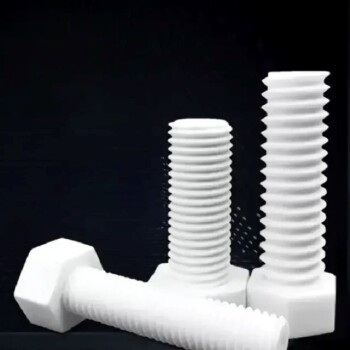
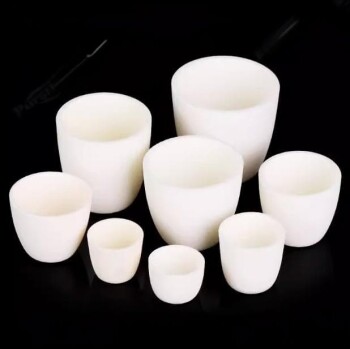
Precision in friction and wear analysis starts with the right equipment and high-quality consumables. KINTEK specializes in providing the tools researchers need to push the boundaries of material science. From high-temperature furnaces (muffle, vacuum, and CVD) for critical heat treatments to hydraulic presses and premium ceramic consumables like high-purity alumina and crucibles, our solutions ensure your data is rigorous and repeatable.
Whether you are testing Ni-W alloy coatings or developing next-generation materials, our team is here to support your laboratory's efficiency and accuracy.
Contact KINTEK today to discuss your project requirements!
References
- Yingjun Xu, Shaoyan Hu. The Effect of Heat Treatment on Phase Structure and Mechanical and Corrosion Resistance Properties of High Tungsten Ni-W Alloy Coating. DOI: 10.3390/coatings13091651
This article is also based on technical information from Kintek Solution Knowledge Base .
Related Products
- High Purity Alumina Granulated Powder for Engineering Advanced Fine Ceramics
- Advanced Engineering Fine Ceramics Low Temperature Alumina Granulation Powder
- High Temperature Wear-Resistant Alumina Al2O3 Plate for Engineering Advanced Fine Ceramics
- Custom-Made Alumina Zirconia Special-Shaped Ceramic Plates for Engineering Advanced Fine Ceramics Processing
- High Quality Alumina Ceramic Screw for Engineering Advanced Fine Ceramics with High Temperature Resistance and Insulation
People Also Ask
- What is the function of high-purity alumina powder in pack cementation? Ensure Uniform Aerospace Blade Coatings
- How should alumina powder be selected for polishing a disc electrode, and what is the procedure for removing scratches? Achieve a Perfect Mirror Finish
- What are the properties and handling precautions for alumina powder as a polishing material? Achieve a Flawless Finish with Precision
- Why is it necessary to apply alumina powder to graphite molds for TiC10/Cu-Al2O3? Ensure Smooth Release.
- What measures should be taken to prevent cross-contamination when using different sizes of alumina powder?