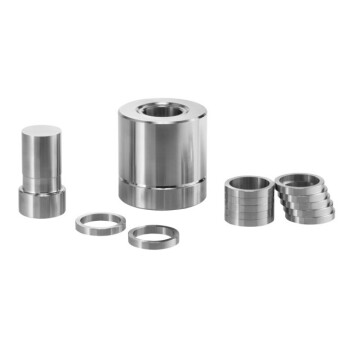
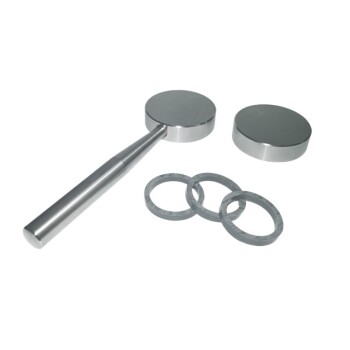
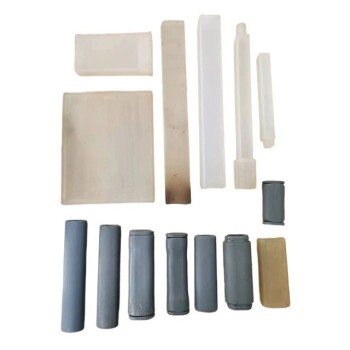
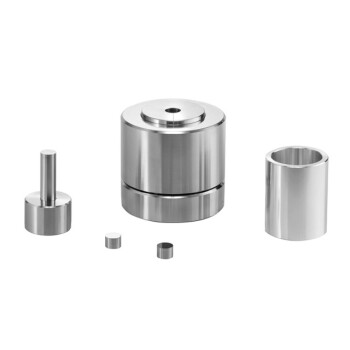
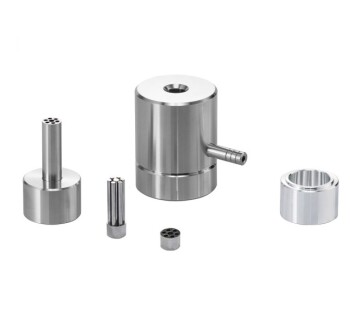
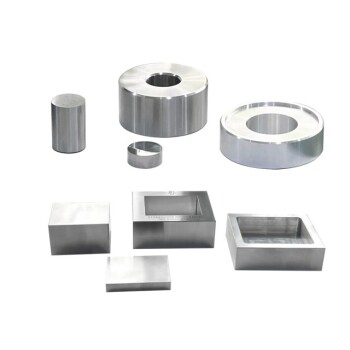
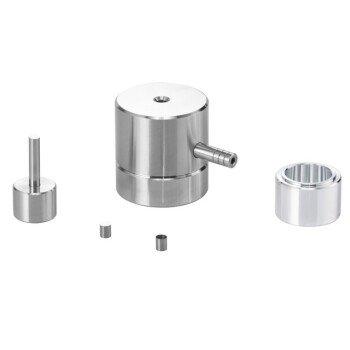
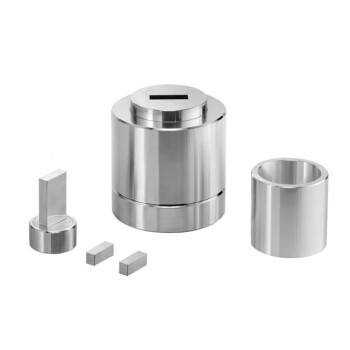
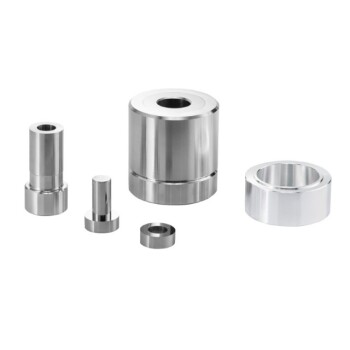
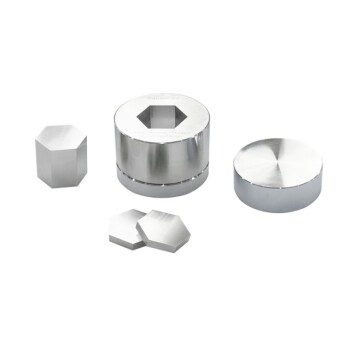
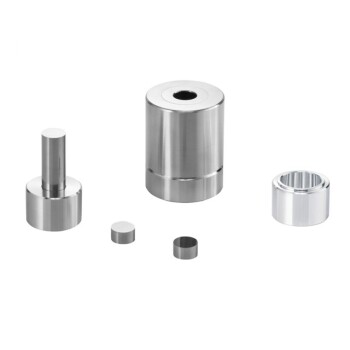
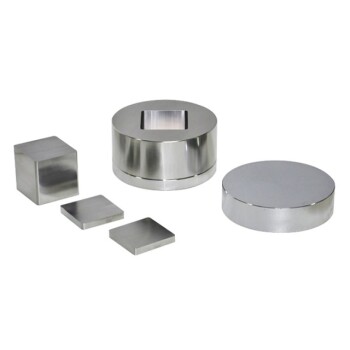
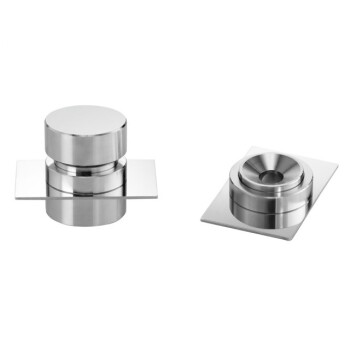
D2 steel molds are the industry standard for pressing titanium alloy green bodies because they provide the necessary compressive strength and dimensional stability to withstand extreme forming pressures. During the powder metallurgy process, these molds endure pressures starting at 500 MPa and reaching as high as 1500 MPa without undergoing permanent deformation. This resistance is critical for forcing titanium powder particles to rearrange and plastically deform, resulting in a high-density green body with the structural integrity required for sintering.
High-strength D2 steel acts as a rigid containment system that facilitates the transition of loose titanium powder into a dense, geometrically precise "green" state. By resisting mechanical stress and minimizing internal friction, these molds ensure the production of components that are both dimensionally accurate and structurally sound.
Handling the Mechanics of High-Pressure Compaction
Resisting Permanent Deformation
The primary role of D2 steel is to maintain its shape under extreme mechanical stress. During the pressing phase, the mold must withstand forces that would cause lesser materials to warp or crack.
By avoiding permanent deformation, the D2 mold ensures that every green body produced is identical in size and shape. This consistency is vital for mass production where tight tolerances are non-negotiable.
Facilitating Particle Rearrangement
To achieve high density, titanium powder particles must be forced into the smallest possible volume. The rigidity of D2 steel allows the press to apply enough force to cause plastic deformation of the powder itself.
This process creates a stable structural foundation for the green body. Without this high-pressure environment, the powder would lack the "green strength" necessary to be handled or moved to a sintering furnace.
Impact on Green Body Quality and Integrity
Ensuring Dimensional Accuracy
The high hardness of D2 steel ensures that the inner dimensions of the mold cavity remain constant throughout thousands of cycles. This leads to high dimensional accuracy in the final powder compact.
Precise green bodies reduce the amount of post-sintering machining required. This is a significant cost-saving factor, as titanium alloys are notoriously difficult and expensive to machine.
Optimizing Surface Quality and Demolding
Supplementary to its strength, D2 steel can be polished to a high surface finish on its inner walls. This smooth surface significantly reduces the friction between the titanium powder and the die wall.
Lower friction ensures smooth demolding, preventing the green body from cracking or sticking as it is ejected. This results in superior surface quality and reduces the rate of rejected parts.
Understanding the Trade-offs
Wear and Abrasive Stress
While D2 steel is exceptionally strong, titanium powder is highly abrasive. Over time, the constant friction can lead to surface wear, even on hardened steel.
To mitigate this, molds must be monitored for dimensional drift. Regular maintenance and specialized coatings are often used to extend the life of the D2 die in high-volume environments.
Balancing Hardness and Toughness
D2 steel is chosen for its hardness, but increasing hardness often comes at the expense of fracture toughness. If the pressing cycle is not perfectly aligned, the mold can be susceptible to brittle failure.
Proper heat treatment of the D2 steel is essential to find the "sweet spot" between being hard enough to resist wear and tough enough to handle the shock of rapid compression.
Selecting the Right Approach for Your Project
How to Apply This to Your Production
When integrating D2 steel molds into your powder metallurgy workflow, your specific goals will dictate your maintenance and design strategy.
- If your primary focus is Dimensional Precision: Prioritize the use of D2 steel with a vacuum heat treatment to ensure maximum stability and minimal distortion during the mold-making process.
- If your primary focus is High-Volume Throughput: Implement a regular polishing schedule for the inner die walls to maintain a high surface finish and prevent friction-induced cracking during ejection.
- If your primary focus is Complex Geometries: Ensure the D2 mold design accounts for uniform pressure distribution to avoid localized stress points that could lead to mold failure at 1500 MPa.
The selection of high-strength D2 steel is the fundamental decision that bridges the gap between loose metallic powder and a high-performance titanium component.
Summary Table:
| Feature | Advantage for Titanium Pressing | Technical Impact |
|---|---|---|
| Compressive Strength | Withstands extreme forming pressures | Resists loads up to 1500 MPa |
| Dimensional Stability | Ensures identical size and shape | Minimal deformation under stress |
| Surface Finish | Reduces friction and prevents sticking | High polish for smooth demolding |
| High Hardness | Maintains mold cavity dimensions | Long-term wear resistance |
| Structural Rigidity | Facilitates plastic powder deformation | Creates high-density green bodies |
Elevate Your Powder Metallurgy Precision with KINTEK
Achieving a high-performance titanium component starts with the right equipment. KINTEK provides a comprehensive range of laboratory solutions designed to handle the extreme stresses of material science research and industrial production.
From high-pressure compaction to final sintering, our portfolio supports your entire workflow:
- Hydraulic Presses & Molds: High-precision pellet, hot, and isostatic presses for superior green body density.
- High-Temperature Furnaces: A complete selection of vacuum, muffle, and sintering furnaces for critical heat treatments.
- Material Preparation: Advanced crushing, milling, and sieving systems to ensure powder consistency.
- Specialized Reactors: High-temperature high-pressure reactors, autoclaves, and electrolytic cells for diverse chemical applications.
Whether you are a researcher or a high-volume manufacturer, KINTEK delivers the durability and precision you need to reduce costs and improve product quality. Contact our technical experts today to find the perfect solution for your lab!
References
- Ambreen Azmat, Sandhanasamy Devanesan. Comparative Study of Biocompatible Titanium Alloys Containing Non-Toxic Elements for Orthopedic Implants. DOI: 10.3390/cryst13030467
This article is also based on technical information from Kintek Solution Knowledge Base .
Related Products
- XRF & KBR steel ring lab Powder Pellet Pressing Mold for FTIR
- Round Bidirectional Press Mold for Lab
- XRF & KBR plastic ring lab Powder Pellet Pressing Mold for FTIR
- Isostatic Molding Pressing Molds for Lab
- Double Plate Heating Press Mold for Lab
People Also Ask
- What is the purpose of using a mold for pellet pressing when preparing catalyst test samples? Ensure Data Consistency
- What are the advantages of using the pressed pellet method for XRF sample preparation? Optimize Your XRF Analysis
- What is the pressed powder pellet method? A Guide to Accurate FTIR Sample Preparation
- How does the selection of a pressure mold affect the performance of all-solid-state batteries? Expert Pelletizing Guide
- What are the different types of XRF samples? A Guide to Solid, Powder, and Liquid Prep