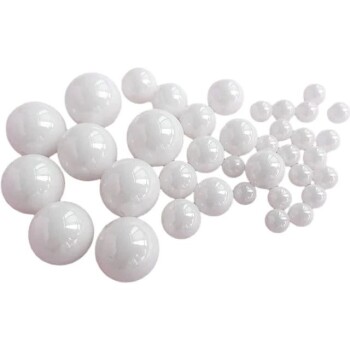
The prevention of metallic contamination is the single most critical factor. When milling Boron Carbide (B4C), polyurethane grinding jars and agate grinding balls are selected primarily to maintain the chemical purity of the powder. Because B4C is exceptionally hard, it causes rapid wear on conventional metal media, which would introduce detrimental metallic impurities into the final product.
The extreme hardness of Boron Carbide causes significant abrasion to grinding media. Polyurethane and agate are preferred because they are chemically inert and wear-resistant relative to standard metals, effectively eliminating the risk of metallic contamination that compromises the mechanical properties of the final composite.
The Challenge of Milling Boron Carbide
The Hardness Factor
Boron Carbide is one of the hardest materials known. When milled with conventional steel or metal media, the B4C particles act as an abrasive, stripping material from the jar and balls.
The Risk of Contamination
This abrasive action creates a high volume of metallic wear debris (such as iron). This debris mixes with the B4C powder, resulting in an impure feedstock that can severely hamper downstream processing.
Why Polyurethane and Agate are Superior
Chemical Inertness
Polyurethane and agate are chemically inert materials. Unlike metals, they do not react aggressively with the powder during the high-energy milling process.
Eliminating Metallic Impurities
The primary reference highlights that using these specific materials ensures the high purity of B4C/Al composite raw materials. By removing metal from the grinding equation, you avoid introducing conductive or chemically reactive elements that don't belong in the matrix.
Optimized Wear Resistance
While B4C is harder than agate, the text notes that this combination offers excellent wear resistance compared to the rapid degradation of conventional metals. This stability is essential for long-term grinding operations where maintaining consistent powder quality is paramount.
The Impact on Material Performance
Preserving Interfacial Reactions
In composite materials, such as B4C reinforced Aluminum, the interface between the ceramic and the metal matrix is critical. Impurities introduced during milling can alter these chemical reactions, leading to weak bonding.
Ensuring Mechanical Integrity
The ultimate goal of using B4C is to achieve high hardness and strength. Contaminants act as defects within the material structure; avoiding them ensures the final product retains the intended mechanical properties.
Understanding the Trade-offs
Milling Efficiency vs. Purity
While agate is excellent for purity, it is generally less dense than metallic media like steel or tungsten carbide. This means the kinetic energy of the impact may be lower, potentially requiring longer milling times to achieve the same particle size reduction.
Material Compatibility
Agate (Silicon Dioxide) is distinct from Boron Carbide. While it prevents metallic contamination, some minor wear is inevitable in any milling process. The choice implies that any trace silica wear is preferred or chemically more tolerable than iron or other metallic contaminants.
Making the Right Choice for Your Goal
Select your milling media based on the strictness of your purity requirements and the final application of the powder.
- If your primary focus is Chemical Purity: Choose polyurethane jars and agate balls to eliminate the introduction of heavy metals and iron, which is critical for high-performance electronic or structural ceramics.
- If your primary focus is Composite Strength: Stick to inert media to prevent impurities that would otherwise degrade the interfacial bonding and mechanical strength of the final composite.
By prioritizing inert milling media, you ensure that the exceptional properties of Boron Carbide are not compromised by the processing equipment itself.
Summary Table:
| Feature | Polyurethane & Agate Media | Conventional Metal Media |
|---|---|---|
| Contamination Risk | Extremely Low (Inert) | High (Metallic debris) |
| Purity Maintenance | Excellent for B4C/Al composites | Poor (Introduces iron/impurities) |
| Wear Mechanism | Gradual, non-metallic wear | Rapid abrasion by B4C particles |
| Impact on Strength | Preserves mechanical integrity | Creates defects in final product |
| Best Use Case | High-purity electronic/structural ceramics | General milling where purity is non-critical |
Ensure the highest purity for your advanced material research with KINTEK's premium milling solutions. From ultra-durable polyurethane jars and agate grinding balls to our high-precision crushing and milling systems, we provide the specialized tools needed to prevent contamination in hard-material processing. Whether you are developing B4C composites or exploring battery technologies, KINTEK offers a comprehensive range of high-temperature furnaces, planetary ball mills, and ceramic crucibles designed for excellence. Contact our experts today to optimize your lab's performance!
References
- Yao Liu, Y.X. Leng. Influence of B4C Particle Size on the Microstructure and Mechanical Properties of B4C/Al Composites Fabricated by Pressureless Infiltration. DOI: 10.3390/met13081358
This article is also based on technical information from Kintek Solution Knowledge Base .
Related Products
- Laboratory Ball Mill Jar Mill with Metal Alloy Grinding Jar and Balls
- Laboratory Jar Mill with Agate Grinding Jar and Balls
- Laboratory Jar Ball Mill with Alumina Zirconia Grinding Jar and Balls
- Laboratory Single Horizontal Jar Mill
- Laboratory Four-Body Horizontal Jar Mill
People Also Ask
- What is the function of a laboratory ball mill in the preparation of AMMCs? Optimize Dispersion & Grain Refinement
- What is the primary function of a laboratory ball mill in the modification of sulfide-based solid electrolytes with LiPO2F2?
- What is the function of a laboratory ball mill in the pretreatment of waste tire char (WTC)? Optimize Material Reactivity
- What is the primary function of a laboratory ball mill in Rice Husk Ash (RHA) modification? Achieve Peak Densification
- How do laboratory ball mills facilitate the mechanochemical synthesis of ZIF-8? Solvent-Free Synthesis Explained