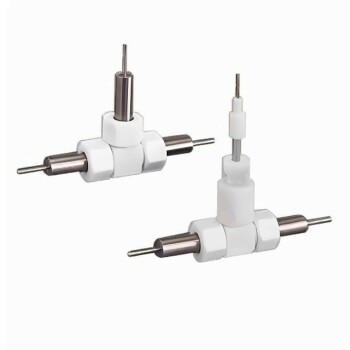
Silicone sealing gaskets serve as the critical definition boundary in traditional Electrochemical Droplet Cell (EDC) experiments. Installed at the tip of the micro-droplet cell, these components provide a soft, chemically resistant seal that strictly confines the electrolyte to the intended measurement zone, preventing the droplet from spreading or leaking across the sample surface.
By strictly defining the effective contact area between the electrolyte and the sample, silicone gaskets are the single most important variable for ensuring the accuracy of current density calculations and surface area normalization.
The Mechanics of Electrolyte Confinement
Preventing Uncontrolled Spreading
Without a physical barrier, an electrolyte droplet on a metal surface is subject to varying surface tension.
The silicone gasket acts as a dam, forcing the liquid to remain within a specific geometric zone. This prevents the droplet from wandering or spreading unpredictably during the measurement.
Eliminating Surface Leakage
EDC experiments require isolation of a specific microscopic area.
The gasket creates a tight seal that prevents the electrolyte from leaking out across the metal surface. This ensures that the electrochemical reactions are restricted solely to the target area, protecting the surrounding material from unwanted exposure.
Ensuring Calculation Accuracy
Defining the Effective Contact Area
In electrochemistry, raw current data is often meaningless without normalization. To calculate current density, you must know the exact surface area participating in the reaction.
The silicone gasket defines this effective contact area with precision. Any variation in this area would render downstream calculations inaccurate.
Maintaining Data Consistency
If a seal fails or shifts, the wetted area changes in real-time.
By using a fresh, high-quality gasket, researchers ensure the contact area remains constant throughout the experiment. This eliminates geometric fluctuations as a source of experimental error.
Material Advantages of Silicone
Soft Surface Compliance
The "consumable" nature of these gaskets is tied to their material properties.
Silicone is sufficiently soft to compress against the metal sample, creating a hermetic seal. This compliance allows it to conform to slight surface irregularities without damaging the sample itself.
Chemical Resistance
EDC setups often utilize various electrolyte solutions.
Silicone provides a chemically resistant barrier that withstands exposure to many standard electrolytes. This prevents the gasket material from degrading and contaminating the test solution.
Recognizing the Trade-offs
The Risk of Deformation
Because silicone is soft, it is susceptible to mechanical deformation over time.
Repeated use or excessive pressure can permanently flatten the gasket. A deformed gasket alters the defined contact area, leading to silent errors in your calculations even if no visible leak occurs.
Consumable Lifespan
These gaskets are not designed for indefinite use.
Treating them as permanent fixtures is a common pitfall. To maintain the integrity of the "soft seal," they must be viewed as consumables and replaced regularly to ensure the material retains its elasticity and shape.
Making the Right Choice for Your Experiment
To ensure the highest fidelity in your EDC data, apply the following guidelines regarding your sealing gaskets:
- If your primary focus is calculation accuracy: Inspect the gasket before every run; if the shape appears flattened or distorted, replace it immediately to preserve the defined contact area.
- If your primary focus is experimental reproducibility: Standardize the pressure applied to the gasket to ensure the effective area remains identical across different samples.
The reliability of your electrochemical data is directly proportional to the integrity of the seal at the droplet interface.
Summary Table:
| Feature | Benefit in EDC Experiments |
|---|---|
| Boundary Definition | Precisely defines the effective contact area for accurate current density calculations. |
| Leak Prevention | Acts as a dam to prevent electrolyte spreading and uncontrolled surface reactions. |
| Material Compliance | Soft silicone conforms to surface irregularities without damaging the metal sample. |
| Chemical Resistance | Resists degradation from electrolytes, preventing contamination of the test solution. |
| Consumable Design | Regular replacement ensures material elasticity and prevents geometric measurement errors. |
Elevate Your Electrochemical Precision with KINTEK
Consistency in Electrochemical Droplet Cell (EDC) experiments hinges on the integrity of your seals. At KINTEK, we specialize in high-performance laboratory equipment and consumables designed for the rigors of modern research. Beyond our precision electrolytic cells and electrodes, we provide the essential consumables—like high-quality silicone gaskets—that ensure your calculations remain accurate and your samples protected.
From battery research tools and high-temperature reactors to specialized PTFE and ceramic components, KINTEK is your partner in achieving reproducible scientific results.
Don't let a worn gasket compromise your data. Contact our technical experts today to discover how our comprehensive range of lab solutions can enhance your research efficiency.
References
- Sebastian Amland Skaanvik, Samantha Michelle Gateman. Probing passivity of corroding metals using scanning electrochemical probe microscopy. DOI: 10.1002/elsa.202300014
This article is also based on technical information from Kintek Solution Knowledge Base .
Related Products
- PTFE Electrolytic Cell Electrochemical Cell Corrosion-Resistant Sealed and Non-Sealed
- Electrolytic Electrochemical Cell for Coating Evaluation
- Electrolytic Electrochemical Cell Gas Diffusion Liquid Flow Reaction Cell
- Electrolytic Electrochemical Cell with Five-Port
- H-Type Double-Layer Optical Electrolytic Electrochemical Cell with Water Bath
People Also Ask
- What is the necessity of selecting a PTFE electrolytic cell? Ensure Precise Graphene Corrosion Testing Accuracy
- What is the proper method for cleaning the surface of an all-PTFE electrolytic cell? Ensure Accurate Results with a Pristine Surface
- How should an all-PTFE electrolytic cell be stored after use? Expert Maintenance Tips for Long-Lasting Performance
- What is the proper cleaning method for an all-PTFE electrolytic cell? Essential Tips for Surface Integrity
- What are the standard opening specifications for all-PTFE electrolytic cells? A Guide to Sealed vs. Non-Sealed Ports