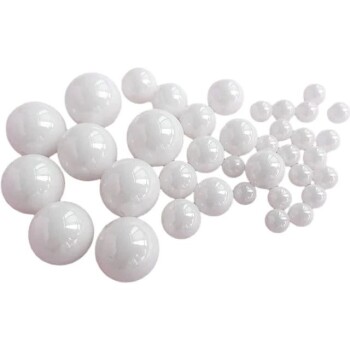
The primary reason zirconia (ZrO₂) grinding jars and balls are the industry standard for milling sulfide solid-state electrolytes is their ability to eliminate contamination during high-energy processing. Their extreme hardness prevents abrasive wear that would introduce foreign particles, while their chemical inertness ensures they do not react with the highly active sulfide precursors.
Core Takeaway The preference for zirconia is driven by the absolute need for chemical purity in solid-state batteries. Unlike stainless steel, zirconia withstands intense mechanical impact without shedding metallic impurities (like iron) and remains chemically neutral, thereby preserving the electrolyte’s high ionic conductivity and electrochemical stability.
The Twin Pillars of Purity and Stability
Sulfide solid electrolytes are exceptionally sensitive materials. Achieving the correct crystal structure and electrochemical performance requires a milling environment that provides high energy without altering the chemical composition of the sample.
Extreme Hardness and Wear Resistance
High-energy ball milling subjects the grinding media to intense, prolonged physical impact. Zirconia possesses exceptional hardness that resists this mechanical stress significantly better than standard metals.
This wear resistance is critical for preventing "media shedding." If the grinding balls or jar walls erode even microscopically, that debris becomes a permanent contaminant in your electrolyte powder.
Eliminating Metallic Impurities
The most detrimental contaminants for solid electrolytes are conductive metals. Using stainless steel jars inevitably introduces iron or chromium impurities due to the abrasive nature of the milling process.
Zirconia eliminates this risk entirely. By preventing the introduction of metallic elements, zirconia ensures the final material remains a pure ionic conductor rather than becoming electronically conductive, which would cause short circuits in a battery cell.
Chemical Inertness Toward Precursors
Sulfide precursors are chemically aggressive and highly reactive. They are prone to reacting with the container walls if the material is not sufficiently stable.
Zirconia is chemically inert. It remains neutral even under the heat and pressure generated during milling, ensuring that the energy is used solely to synthesize the electrolyte and not to fuel side reactions with the jar.
Understanding the Trade-offs
While zirconia is the superior technical choice for this application, it is important to understand the operational context compared to other materials.
Density and Impact Energy
Zirconia is a high-density ceramic. This physical property allows the grinding balls to carry high kinetic energy, which is necessary to drive the mechanochemical reaction (mechanical alloying) of the precursors.
However, this high density means the milling process is aggressive. While zirconia is tough, it is brittle compared to steel; dropping a zirconia jar or subjecting it to thermal shock can cause it to crack, unlike metal which would merely dent.
The "Invisible" Contamination Risk
Even zirconia is not indestructible. While it does not introduce metallic impurities, extreme overuse can eventually lead to minor zirconia contamination.
Fortunately, zirconia is an electrical insulator and chemically compatible with most ceramic electrolytes. Therefore, trace amounts of zirconia contamination are generally considered benign and do not degrade battery performance, unlike iron contamination from steel.
Making the Right Choice for Your Goal
Selecting the correct milling media is a fundamental step in ensuring your synthesis yields valid, reproducible data.
- If your primary focus is High Ionic Conductivity: You must use zirconia to prevent metallic doping, which blocks ion pathways and reduces the overall performance of the electrolyte.
- If your primary focus is Electrochemical Stability: You must use zirconia to avoid introducing iron, which acts as a catalyst for decomposition and side reactions during battery cycling.
- If your primary focus is Synthesis Efficiency: Rely on zirconia's high density to provide the necessary kinetic energy for complete precursor reaction without compromising purity.
For sulfide solid-state electrolytes, zirconia is not just an option; it is a prerequisite for high-performance material synthesis.
Summary Table:
| Feature | Zirconia (ZrO₂) Media | Stainless Steel Media |
|---|---|---|
| Hardness/Wear Resistance | Extremely High (Minimal Shedding) | Moderate (Abrasive Wear) |
| Contamination Risk | Non-conductive, Benign Traces | Metallic (Fe, Cr) Impurities |
| Chemical Stability | Inert to Aggressive Sulfides | Potential for Surface Reactions |
| Impact Energy | High Density for Rapid Synthesis | High Density |
| Electrical Property | Insulator (Safe for Electrolytes) | Conductor (Causes Short Circuits) |
Elevate Your Battery Research with KINTEK Precision
Don't let metallic contamination compromise your solid-state electrolyte's ionic conductivity. KINTEK specializes in high-performance laboratory equipment, providing the industry-leading zirconia grinding jars and milling media required for high-purity synthesis.
Beyond milling, we offer a comprehensive suite of tools for battery researchers, including high-temperature furnaces, hydraulic pellet presses, and electrolytic cells. Partner with us to ensure your materials meet the rigorous standards of next-generation energy storage.
Contact KINTEK Today to Optimize Your Synthesis Workflow
Related Products
- Laboratory Jar Ball Mill with Alumina Zirconia Grinding Jar and Balls
- Laboratory Jar Mill with Agate Grinding Jar and Balls
- Laboratory Ball Mill Jar Mill with Metal Alloy Grinding Jar and Balls
- Precision Machined Zirconia Ceramic Ball for Engineering Advanced Fine Ceramics
- Engineering Advanced Fine Ceramics Head Tweezers with Pointed Elbow Zirconia Ceramic Tip
People Also Ask
- What are the primary functions of using a ball mill for BZCY72 powder? Achieve High Purity and Enhanced Sintering
- In what way does a laboratory ball mill affect material properties when modifying PHBV/pulp fiber composites?
- Why is a laboratory ball mill required for ultra-fine fly ash? Unlock Nano-Scale Adsorption Power
- What is the function of a laboratory ball mill in the preparation of AMMCs? Optimize Dispersion & Grain Refinement
- What is the function of a laboratory ball mill in the pretreatment of waste tire char (WTC)? Optimize Material Reactivity