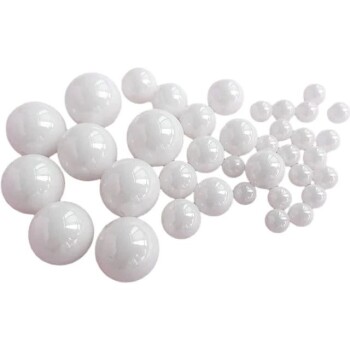
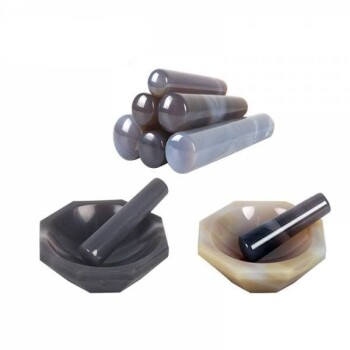
Zirconia grinding media are strictly required for synthesizing sulfide solid-state electrolytes to guarantee chemical purity and prevent reaction failure. Because sulfide materials are exceptionally sensitive to contamination, the extreme hardness and chemical inertness of zirconium oxide (ZrO2) are necessary to prevent the introduction of metallic impurities—specifically iron and chromium—during the violent high-energy ball milling process.
The Core Insight Sulfide electrolytes depend on precise stoichiometry to achieve high ionic conductivity, making them intolerant to foreign particles. Zirconia is the industry standard because it is the only accessible material dense enough to facilitate mechanochemical synthesis without shedding reactive contaminants into the powder.
The Critical Need for Chemical Inertness
Preventing Metallic Contamination
The primary danger during the milling of sulfide electrolytes is the introduction of metallic impurities.
Standard stainless steel jars, while common in other industries, shed microscopic particles of iron and chromium under high-energy impact.
These metallic contaminants are fatal to the electrolyte's performance, potentially causing short circuits or degrading electrochemical stability. Zirconia is non-metallic, eliminating this risk entirely.
Avoiding Side Reactions
Sulfide precursors are highly chemically active.
If exposed to reactive surfaces during the milling process, these precursors can engage in unwanted side reactions.
Zirconia is chemically inert. It acts as a neutral vessel, ensuring that the chemical reactions occur strictly between the raw materials, preserving the intended stoichiometry of the final product.
The Role of Mechanical Properties
Withstanding High-Energy Milling
Preparing sulfide electrolytes often involves mechanochemical synthesis, a process that requires intense kinetic energy to drive chemical changes.
Zirconia possesses exceptional wear resistance. Even during prolonged milling sessions (e.g., five hours or more), it withstands the mechanical stress without degrading.
Lower-grade materials would wear down, introducing significant volume contamination into the powder.
Increasing Impact Efficiency
Zirconia is not just hard; it is highly dense.
The high density of zirconia balls translates to greater kinetic energy upon impact compared to lighter ceramic alternatives.
This increased impact energy is crucial for shortening reaction times and ensuring the synthesis is complete, resulting in a product with high ionic conductivity.
Understanding the Trade-offs
While zirconia is the superior technical choice for this application, it introduces specific operational considerations compared to stainless steel.
Thermal Insulation
Zirconia is a ceramic and a thermal insulator, whereas stainless steel is a conductor. Heat generated during high-energy milling dissipates more slowly in zirconia jars.
For temperature-sensitive sulfides, milling parameters (such as pause intervals) must be carefully managed to prevent overheating the powder inside the jar.
Brittleness and Handling
Unlike metal, zirconia is brittle.
While it has high wear resistance (abrasion), it has lower fracture toughness than steel. Dropping a zirconia ball or jar on a hard floor can cause it to shatter or chip, requiring careful handling protocols in the lab.
Making the Right Choice for Your Goal
When setting up your synthesis protocol, your equipment choice dictates your material's final quality.
- If your primary focus is Electrochemical Performance: You must use zirconia to avoid metallic "doping" that destroys ionic conductivity and causes short circuits.
- If your primary focus is Process Efficiency: Rely on the high density of zirconia to deliver maximum impact energy, reducing the time required to complete the mechanochemical reaction.
Summary: For sulfide solid-state electrolytes, zirconia is not an option but a necessity; it creates the only environment where high-impact synthesis can occur without chemical corruption.
Summary Table:
| Feature | Zirconia (ZrO2) | Stainless Steel | Impact on Sulfide Electrolytes |
|---|---|---|---|
| Chemical Purity | Inert; No metallic shedding | Sheds Fe and Cr | Prevents short circuits and degradation |
| Hardness/Wear | Exceptional resistance | Moderate wear | Eliminates volume contamination |
| Density | High (6.0 g/cm³) | High (7.9 g/cm³) | Maintains high kinetic energy for synthesis |
| Thermal Conductivity | Insulator | Conductor | Requires managed pause intervals to avoid heat |
| Reactivity | Non-reactive | Potential side reactions | Preserves precise material stoichiometry |
Elevate your battery research with KINTEK’s premium laboratory solutions. From high-purity zirconia grinding jars and balls to specialized crushing and milling systems, we provide the tools necessary to prevent contamination in sensitive sulfide solid-state electrolytes. Whether you need planetary ball mills, hydraulic presses for pellet preparation, or high-temperature vacuum furnaces, our experts are ready to support your workflow. Contact us today to optimize your material synthesis and achieve superior ionic conductivity!
Related Products
- Laboratory Jar Ball Mill with Alumina Zirconia Grinding Jar and Balls
- Precision Machined Zirconia Ceramic Ball for Engineering Advanced Fine Ceramics
- Laboratory Jar Mill with Agate Grinding Jar and Balls
- Laboratory Ball Mill Jar Mill with Metal Alloy Grinding Jar and Balls
- Nature Agate Mortar and Pestle for Grinding and Mixing
People Also Ask
- What are the primary functions of using a ball mill for BZCY72 powder? Achieve High Purity and Enhanced Sintering
- In what way does a laboratory ball mill affect material properties when modifying PHBV/pulp fiber composites?
- Why is a laboratory ball mill required for ultra-fine fly ash? Unlock Nano-Scale Adsorption Power
- What is the function of a laboratory ball mill in the preparation of AMMCs? Optimize Dispersion & Grain Refinement
- What is the function of a laboratory ball mill in the pretreatment of waste tire char (WTC)? Optimize Material Reactivity