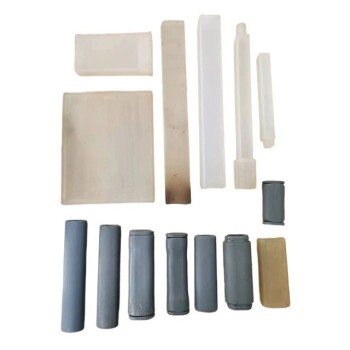
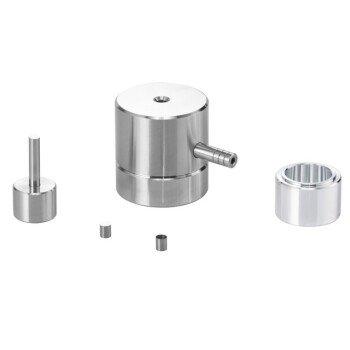
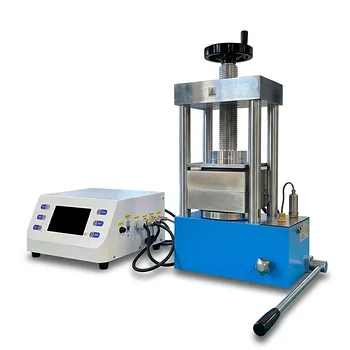
Cold isostatic pressing (CIP) is essential for forming Eu:GAP and Eu:GLAP ceramic rods because it applies omnidirectional pressure to eliminate internal density gradients. This process ensures the green body achieves a high degree of structural homogeneity and density uniformity that traditional mechanical pressing cannot match. By removing internal voids and stresses, CIP prevents deformation during sintering and ensures the rods remain stable during the demanding optical floating zone crystal growth process.
The core function of a cold isostatic press is to transform loosely packed powders into a highly uniform green body by applying equal pressure from all directions. This uniformity is the critical prerequisite for preventing cracks and ensuring the thermal stability required for high-quality ceramic and crystal production.
Overcoming the Limitations of Mechanical Pressing
The Failure of Uniaxial Pressing
Traditional axial or uniaxial pressing relies on a vertical plunger, which creates significant friction against the mold walls. This friction results in an uneven distribution of force, leading to "soft spots" or density gradients within the ceramic rod.
The Advantage of Isostatic Pressure
A cold isostatic press submerges the powder-filled mold in a liquid medium, typically applying pressures between 70 MPa and 300 MPa. Because the liquid transmits pressure equally in all directions, the powder is compacted with perfect symmetry, bypassing the friction issues inherent in rigid molds.
Eliminating Internal Stress
By applying pressure uniformly, CIP eliminates the internal stress imbalances that often lead to delamination. This ensures that the internal structure of the Eu:GAP or Eu:GLAP rod is consistent from the core to the outer surface.
Impact on Sintering and Structural Integrity
Preventing Sintering Deformation
Ceramics shrink significantly during the high-temperature sintering process. If the green body has density gradients, it will shrink unevenly, causing the rod to warp, bend, or crack.
Closing Micro-pores and Voids
The high, multi-directional pressure effectively closes micro-pores and air pockets within the powder mass. This leads to a significantly higher green density, which translates to a denser, more robust final ceramic material after firing.
Enhancing Mechanical Strength
A uniform green body results in a sintered ceramic with superior mechanical strength. For specialized materials like Eu:GGAG or Eu:GLAP, this structural integrity is vital to withstand the thermal shocks of subsequent processing.
The Role in Optical Floating Zone Growth
Ensuring Feed Rod Uniformity
Eu:GAP and Eu:GLAP ceramic rods often serve as feed rods for the optical floating zone (OFZ) method of crystal growth. Any inconsistency in the rod’s density can cause the material to melt at different rates, destabilizing the growth process.
Maintaining a Stable Molten Zone
A stable molten zone is the most critical factor in producing high-quality single crystals. High-density, CIP-treated rods provide a consistent volume of material to the melt, preventing fluctuations that would otherwise introduce defects into the crystal lattice.
Understanding the Trade-offs
Process Complexity and Cost
While CIP is technically superior, it is more time-consuming than uniaxial pressing. It requires specialized flexible molds and a high-pressure liquid system, which increases the initial equipment investment and operational overhead.
Requirement for Pre-forming
CIP is often a secondary step rather than a standalone solution. Most workflows require an initial uniaxial pre-forming stage to give the powder a basic shape before it is sealed in a flexible membrane for isostatic compaction.
Mold Limitations
Unlike rigid molds that can produce complex geometries, CIP is best suited for simple shapes like rods, tubes, or blocks. Achieving precise dimensional tolerances often requires additional machining after the pressing or sintering stages.
How to Apply This to Your Project
Recommendations for Material Formation
To achieve the best results with Eu:GAP and Eu:GLAP ceramics, choose your pressing strategy based on your final performance requirements.
- If your primary focus is crystal growth stability: Utilize CIP at a minimum of 70 MPa to ensure your feed rods do not fluctuate in the molten zone.
- If your primary focus is preventing structural cracks: Ensure a secondary CIP step is used after initial uniaxial forming to eliminate the stress gradients caused by mold friction.
- If your primary focus is maximizing material density: Opt for higher pressure CIP (up to 300 MPa) to ensure all internal micro-pores are closed before the sintering stage begins.
The implementation of cold isostatic pressing is the definitive factor in moving from a fragile powder compact to a high-performance ceramic feed rod ready for advanced optical applications.
Summary Table:
| Feature | Uniaxial Pressing | Cold Isostatic Pressing (CIP) |
|---|---|---|
| Pressure Direction | Vertical (Single axis) | Omnidirectional (360°) |
| Density Uniformity | Low (Internal gradients/soft spots) | High (Structural homogeneity) |
| Internal Stress | Significant (Mold wall friction) | Minimized (Uniform compaction) |
| Sintering Result | High risk of warping/cracking | Excellent dimensional stability |
| Applications | Simple, low-precision parts | High-performance ceramic feed rods |
Elevate Your Material Research with KINTEK Precision
At KINTEK, we specialize in providing high-performance laboratory equipment designed for the most demanding material science applications. Whether you are forming specialized Eu:GAP and Eu:GLAP ceramic rods or conducting advanced crystal growth, our comprehensive range of isostatic and hydraulic presses (pellet, hot, and isostatic) ensures the high-density compaction and structural integrity your project requires.
Beyond pressing solutions, KINTEK offers a full suite of laboratory essentials, including:
- High-Temperature Furnaces: Muffle, tube, vacuum, CVD, and PECVD systems for precision sintering.
- Material Processing: Crushing, milling, and sieving equipment for perfect powder preparation.
- Advanced Solutions: High-temperature high-pressure reactors, autoclaves, and cooling systems (ULT freezers).
- Consumables: High-quality PTFE products, ceramics, and crucibles.
Ready to achieve superior density and eliminate structural defects in your ceramics? Contact us today to discover how KINTEK’s equipment can enhance your lab's efficiency and research outcomes!
References
- Tong Wu, Jianding Yu. Eu3+-Doped (Gd, La)AlO3 Perovskite Single Crystals: Growth and Red-Emitting Luminescence. DOI: 10.3390/ma16020488
This article is also based on technical information from Kintek Solution Knowledge Base .
Related Products
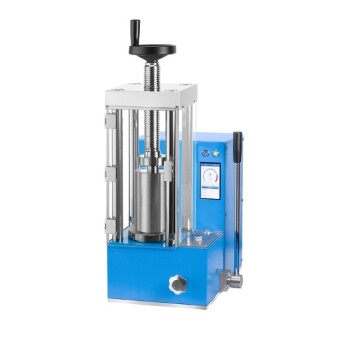
- Electric Split Lab Cold Isostatic Press CIP Machine for Cold Isostatic Pressing
- Electric Lab Cold Isostatic Press CIP Machine for Cold Isostatic Pressing
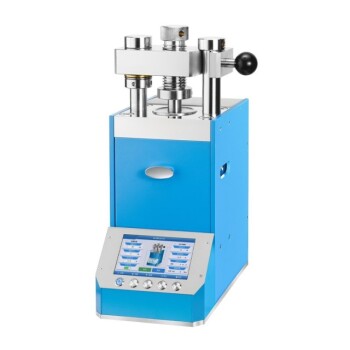
- Automatic Lab Cold Isostatic Press CIP Machine Cold Isostatic Pressing
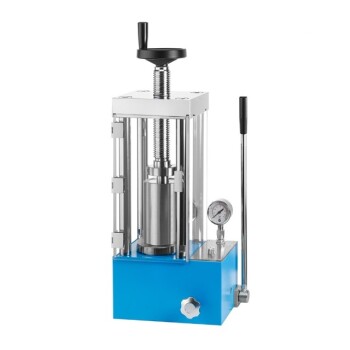
- Manual Cold Isostatic Pressing Machine CIP Pellet Press
- Warm Isostatic Press for Solid State Battery Research
People Also Ask
- How is isostatic pressing equipment utilized to integrate lithium metal anodes during solid-state battery assembly?
- How does isostatic pressing equipment enhance lithium metal anode contact? Optimize Your Solid-State Battery Assembly
- What is the meaning of isostatic pressing? Achieve Uniform Density in Complex Parts
- What is isostatic pressing method for ceramics? Achieve Uniform Density for Complex Parts
- What role does cold isostatic pressing play in the formation of feed rods for single crystal growth? Ensure Stability.