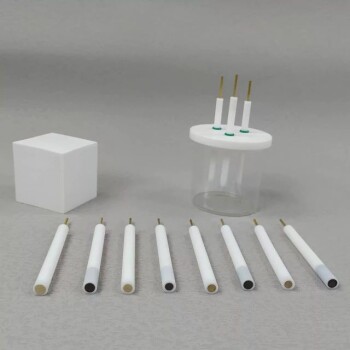
The preferred status of the gel-type silver/silver chloride (Ag/AgCl) electrode stems from its ability to maintain a consistent potential reference amidst the turbulence of water electrolysis. By utilizing a 3 M KCl electrolyte suspended in a gel structure, this specific design insulates the measurement from the chaos of rapid bubble formation and shifting ion concentrations, ensuring that voltage readings are a true reflection of the reaction rather than environmental noise.
Core Takeaway: Water electrolysis creates a physically and chemically volatile environment that distorts data collected by standard liquid electrodes. The gel-type Ag/AgCl electrode mitigates this by stabilizing the liquid junction potential, guaranteeing reproducible polarization characteristics for both hydrogen and oxygen evolution.
Solving the Stability Problem
Water electrolysis is an inherently chaotic process. To obtain accurate data, you must isolate your reference point from the physical disturbances occurring in the cell.
Mitigating Bubble Interference
During electrolysis, the rapid formation of gas bubbles (oxygen and hydrogen) creates physical turbulence.
In standard liquid electrodes, these bubbles can disrupt the electrical continuity at the electrode tip. The gel structure of the preferred Ag/AgCl electrode acts as a physical buffer, maintaining a continuous connection even when the solution is saturated with gas.
Countering Local Ion Shifts
Electrolysis causes rapid changes in local ion concentrations near the electrode surface.
These concentration gradients can cause the potential to drift unpredictably. The 3 M KCl electrolyte combined with the gel matrix provides a stable internal environment that resists these external concentration shifts, ensuring the reference potential remains fixed.
The Impact on Data Integrity
The physical design of the electrode directly translates to the quality of the data collected during experimentation.
Minimizing Liquid Junction Potential Fluctuations
The primary source of error in these measurements is often the liquid junction potential—the voltage difference at the interface between the reference electrode and the test solution.
Because the gel restricts the free flow of the internal electrolyte, it minimizes liquid junction potential fluctuations. This stability is critical for deriving accurate polarization curves.
Resilience in Magnetohydrodynamic (MHD) Conditions
Advanced electrolysis setups often involve complex fluid dynamics, sometimes influenced by magnetic fields (MHD).
A standard liquid electrolyte might wash away or mix turbulently under these conditions. The gel-type electrode holds its internal electrolyte in place, delivering reproducible results even in complex flow environments.
Common Pitfalls to Avoid
When selecting a reference electrode, it is crucial to understand why simpler alternatives fail in this specific application.
The Risk of Liquid-Junction Instability
Using a standard, non-gel Ag/AgCl electrode in a bubbling environment often leads to "noisy" data.
Without the stabilizing gel, the liquid junction is susceptible to pressure changes caused by bubbles. This results in erratic voltage spikes that can mask the true electrochemical behavior of the water splitting reaction.
The Illusion of Stability
Do not assume that all Ag/AgCl electrodes are interchangeable for electrolysis.
A standard porous-frit electrode may function in quiescent solutions, but in the violent environment of gas evolution, it lacks the structural integrity required to prevent electrolyte leaching or back-diffusion.
Making the Right Choice for Your Goal
To ensure your electrochemical measurements are valid, select your instrumentation based on your specific experimental parameters.
- If your primary focus is Polarization Characteristics: Choose the gel-type Ag/AgCl electrode to eliminate noise from gas evolution, ensuring your anodic and cathodic curves are accurate.
- If your primary focus is Complex Flow/MHD Studies: Rely on the gel structure to maintain potential stability where standard liquid junctions would be disrupted by fluid movement.
In the volatile environment of water electrolysis, the gel-type Ag/AgCl electrode is not just a sensor; it is the anchor that ensures your data remains reproducible.
Summary Table:
| Feature | Standard Liquid Electrode | Gel-type Ag/AgCl Electrode |
|---|---|---|
| Stability in Bubbling | High interference/noise | High stability (buffered) |
| Electrolyte Matrix | Free-flowing liquid | 3 M KCl in Gel structure |
| Junction Potential | Fluctuates with pressure | Minimized & stable |
| Complex Flow (MHD) | Prone to leaching/mixing | Maintains internal integrity |
| Data Reliability | High drift risk | Reproducible polarization |
Elevate Your Electrochemical Research with KINTEK
Precision in water electrolysis requires more than just standard tools—it demands instrumentation designed for volatile environments. KINTEK specializes in high-performance laboratory equipment, including specialized electrolytic cells and electrodes designed to deliver noise-free, reproducible data.
Whether you are analyzing hydrogen evolution or conducting complex MHD studies, our range of sensors, high-temperature high-pressure reactors, and battery research consumables provide the stability your project needs.
Ready to anchor your data integrity? Contact our experts today to find the perfect electrode solutions for your laboratory.
References
- Yan-Hom Li, Yen-Ju Chen. The effect of magnetic field on the dynamics of gas bubbles in water electrolysis. DOI: 10.1038/s41598-021-87947-9
This article is also based on technical information from Kintek Solution Knowledge Base .
Related Products
- Reference Electrode Calomel Silver Chloride Mercury Sulfate for Laboratory Use
- Copper Sulfate Reference Electrode for Laboratory Use
- Glassy Carbon Electrochemical Electrode
- Gold Electrochemical Sheet Electrode Gold Electrode
- Gold Disc Electrode
People Also Ask
- What is the function of a reference electrode? Master Precision in Three-Electrode Reactor Reconstruction
- What is the recommended maintenance for the filling solution of a reference electrode? A Guide to Stable & Accurate Readings
- Which electrode is used as a ground reference? Master the Key to Accurate Electrochemical Measurements
- What is the reference electrode in potentiometry? The Key to Stable & Accurate Measurements
- Which electrode is used as a reference? A Guide to Accurate Electrochemical Measurements