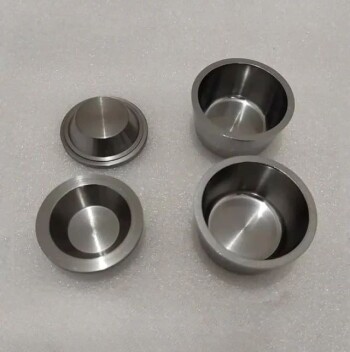
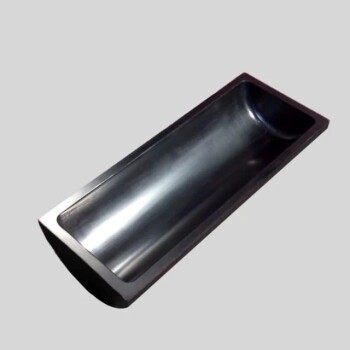
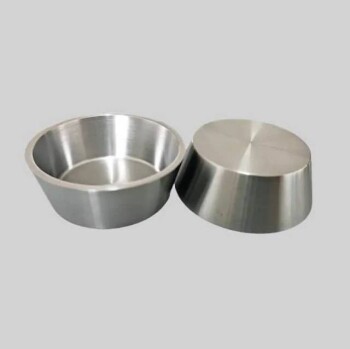
High-purity platinum crucibles are essential for XRF sample preparation because they offer the specific chemical inertness and thermal stability required to melt lignin ash without contaminating the sample.
When lignin ash is fused with fluxing agents at temperatures exceeding 1000°C, a platinum vessel prevents reactions with the alkali metals or silicates present in the ash, ensuring the final analytical results are quantitative and precise.
The fusion process involves aggressive chemical environments that degrade most materials. High-purity platinum ensures that the detected composition is solely from your sample, preventing container-leached impurities from distorting your data.
The Critical Role of Chemical Inertness
Preventing Flux Interaction
To prepare lignin ash for X-ray Fluorescence (XRF) analysis, the sample is typically melted with a fluxing agent, such as lithium tetraborate. This process occurs at extremely high temperatures.
Under these conditions, the flux becomes a powerful solvent intended to dissolve the ash. However, it can also attack the container walls of lesser materials.
High-purity platinum is chemically inert to these aggressive agents. It remains stable, ensuring that the crucible itself does not become part of the solution.
Protecting Against Alkali and Silicate Reactions
Lignin ash contains specific components, including alkali metals and silicates.
In standard crucibles, these elements can trigger chemical reactions with the vessel walls during the melting phase.
Platinum resists this interaction completely. By preventing these reactions, you preserve the chemical purity of the analytical sample.
Ensuring Structural Integrity at High Heat
Withstanding Extreme Temperatures
The fusion preparation process requires temperatures exceeding 1000 degrees Celsius.
At this thermal intensity, many materials soften, oxidize, or degrade.
Platinum crucibles possess exceptional high-temperature resistance, maintaining their structural form and containment capabilities throughout the fusion cycle.
Creating the Perfect Glass Bead
The goal of this high-heat process is to create a homogenous glass bead.
As noted in supplementary contexts regarding similar slag samples, this fusion effectively eliminates mineral effects and grain size effects.
By using a platinum crucible to facilitate this transition from powder to glass without contamination, you significantly improve the precision of the final chemical composition determination.
Understanding the Trade-offs
The Risk of Alternative Materials
Attempting to substitute platinum with lower-grade materials or alternative metals introduces a high risk of container-related contamination.
If the crucible reacts even slightly with the flux or the ash, elements from the crucible wall will leach into the glass bead.
This results in "ghost" peaks or skewed concentration data in the XRF spectrum, rendering the quantitative analysis unreliable.
Necessity vs. Cost
While platinum is a significant investment, it is a functional necessity for fusion, not a luxury.
The trade-off is straightforward: you cannot achieve the required melting point and chemical resistance for lignin ash fusion with ceramic or lower-alloy metallic vessels.
Making the Right Choice for Your Goal
To ensure your XRF analysis of lignin ash yields valid data, consider the following regarding your equipment choices:
- If your primary focus is quantitative accuracy: Ensure your crucibles are verified high-purity platinum to prevent alkali metals and silicates from reacting with the vessel walls.
- If your primary focus is process stability: Maintain temperatures strictly above 1000°C within the platinum vessel to fully eliminate mineral and grain size effects.
Ultimately, the platinum crucible is not just a container; it is a critical instrument that safeguards the integrity of your sample against the harsh environment of fusion preparation.
Summary Table:
| Feature | Importance in Lignin Ash Fusion | Benefit for XRF Analysis |
|---|---|---|
| Chemical Inertness | Resists aggressive fluxing agents (e.g., lithium tetraborate) | Prevents crucible leaching and "ghost" peaks |
| Thermal Stability | Maintains integrity at temperatures exceeding 1000°C | Ensures stable containment during the melting phase |
| Non-Reactive Surface | Prevents reactions with alkali metals and silicates | Guarantees the detected composition is 100% sample-derived |
| Homogenization | Facilitates the creation of a uniform glass bead | Eliminates mineral and grain size effects for accuracy |
Elevate Your Analytical Precision with KINTEK
Don't let container-related contamination compromise your research data. KINTEK specializes in providing high-purity platinum crucibles and premium laboratory consumables designed to withstand the most aggressive fusion environments.
Whether you are performing XRF analysis on lignin ash or processing complex materials, our comprehensive range of high-temperature furnaces, ceramics and crucibles, and sample preparation tools ensures your results are quantitative and precise. Our team of experts is ready to help you select the ideal equipment for your specific laboratory needs.
Ready to secure the integrity of your samples? Contact KINTEK today for a consultation and quote!
References
- Juraj Priščák, Hermann Hofbauer. Investigation of the Formation of Coherent Ash Residues during Fluidized Bed Gasification of Wheat Straw Lignin. DOI: 10.3390/en13153935
This article is also based on technical information from Kintek Solution Knowledge Base .
Related Products
- High Purity Pure Graphite Crucible for Evaporation
- High Purity Pure Graphite Crucible for Electron Beam Evaporation
- High Purity Gold Platinum Copper Iron Metal Sheets
- Arc-Shaped Alumina Ceramic Crucible High Temperature Resistant for Engineering Advanced Fine Ceramics
- Engineering Advanced Fine Alumina Al2O3 Ceramic Crucible for Laboratory Muffle Furnace
People Also Ask
- Why are high-purity graphite crucibles preferred for sulfide solid electrolytes? Achieve Superior Material Purity
- Why is a high-purity graphite crucible required for Chromel-TaC composites? Ensure Peak Purity at 1400°C
- What role do high-purity graphite crucibles play in molten salt corrosion research? Ensure Reactor-Grade Precision
- Why are high-purity graphite crucibles used for magnesium distillation? Ensure 3N8 Purity & Thermal Stability
- Why is a high-purity graphite crucible ideal for nitrogen-doped graphene at 1500 °C? Maximize Purity and Stability