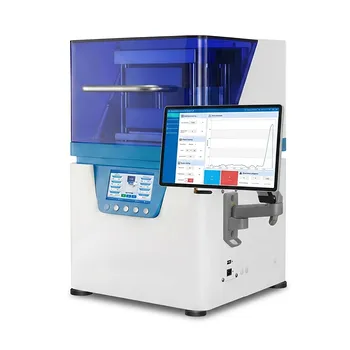
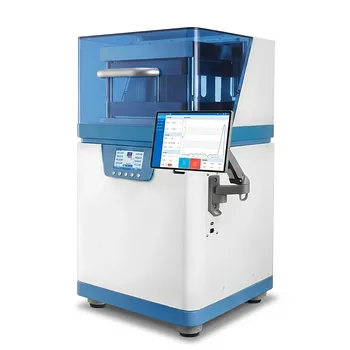
The laboratory hydraulic press is the fundamental engine of thermal compression molding, serving as the only means to apply the simultaneous high pressure and controlled heat required to densify materials. By exerting constant forces—often reaching 3000 psi or more—the press eliminates internal air pockets and forces molten matrix materials to encapsulate reinforcements. This process is essential for transforming loose powders or layered prepregs into high-density, defect-free composite structures.
The primary role of a laboratory hydraulic press is to ensure material homogeneity and structural integrity by excluding voids and maximizing interfacial bonding. It provides the precise mechanical environment necessary for particle fusion, resin infiltration, and the creation of standardized, reproducible specimens.
Achieving Structural Integrity through Compaction
Elimination of Interlayer Air and Voids
During the molding process, air trapped between layers of prepregs or powder particles creates "voids" that act as structural weak points. A hydraulic press applies continuous mechanical pressure to expel this air, preventing internal pores that would otherwise compromise the material's strength.
Strengthening Interfacial Bonding
The application of high pressure while the material is in a molten state is critical for physical bonding. It forces the filler and matrix into intimate contact, strengthening the interfacial bond and ensuring the final composite plate is structurally sound and high-density.
Reducing Water Absorption
By eliminating internal pores and increasing bulk density, the hydraulic press significantly reduces the material's water absorption rate. This is vital for maintaining the long-term durability and performance of composites in humid or outdoor environments.
Driving Material Fusion and Densification
Facilitating Particle Coalescence
In processes involving powders like PTFE, the press drives particle fusion by applying precise loads, typically between 1.2 to 2.4 kN. Maintaining constant pressure during heating ensures that particles coalesce into a single, dense preform rather than remaining a loose collection of grains.
Enhancing Resin Infiltration
For layered composites, the press provides the environment needed for thermoplastic resins to thoroughly infiltrate fiber networks. Stable pressure control (typically 1.5 to 2.5 MPa) ensures the resin flows into every gap, resulting in high-performance laminates without dry spots.
Improving Green Strength
For nanocomposites and advanced ceramics, the press is used to create "green compacts" with specific geometric shapes. This step increases the physical contact area between particles, providing the necessary mechanical strength for subsequent high-pressure experiments or sintering.
Ensuring Precision and Reproducibility
Uniform Sample Thickness
Precise control over the hydraulic ram allows researchers to produce specimens with consistent thickness and smooth surfaces. This level of control is non-negotiable when creating standard test specimens for mechanical analysis or UV aging tests.
Consistency for Mechanical Analysis
A hydraulic press ensures that density remains consistent across multiple samples. This reproducibility allows for accurate benchmarking and comparative studies, as it removes the variability introduced by inconsistent molding conditions.
Efficiency and Waste Reduction
Compared to alternative shaping methods, the hydraulic press is a fast and efficient tool that reduces material waste. By fitting pliable, heated materials into a precise mold under force, it minimizes the need for extensive post-process machining.
Understanding the Trade-offs
Manual vs. Automated Pressure Control
While manual hydraulic presses are cost-effective, they require constant monitoring to maintain pressure as the material relaxes or melts. Automated systems offer superior consistency but come with higher capital costs and increased complexity.
Thermal Lag and Cooling Cycles
The thickness of the press platens can introduce thermal lag, where the material temperature does not immediately match the set point. Additionally, if the cooling cycle is not controlled under pressure, the material may warp or develop internal stresses as it shrinks.
Pressure Limits and Mold Wear
Exceeding the recommended pressure for a specific mold can lead to mechanical deformation of the tool or the press itself. It is critical to balance the need for high-density compaction with the physical limits of the high-precision steel molds.
Applying the Hydraulic Press to Your Project
When integrating a hydraulic press into your workflow, align your choice with your specific technical requirements:
- If your primary focus is producing high-performance laminates: Prioritize a press that offers stable pressure control between 1.5 and 2.5 MPa to ensure complete resin infiltration.
- If your primary focus is powder metallurgy or PTFE preforming: Focus on a system that can provide precise, low-range load control (1.2–2.4 kN) to manage initial particle compaction without fracturing the particles.
- If your primary focus is mechanical property testing: Ensure your press has high-precision platens and digital readouts to guarantee uniform specimen thickness and density reproducibility.
- If your primary focus is maximizing material strength: Utilize a press capable of maintaining at least 3000 psi to maximize the interfacial bonding between the filler and the matrix.
The laboratory hydraulic press is not merely a tool for shaping, but a critical instrument for defining the final physical and mechanical identity of a composite material.
Summary Table:
| Key Function | Impact on Material Quality | Typical Application |
|---|---|---|
| Void Elimination | Removes trapped air to prevent structural weak points | High-density composite fabrication |
| Interfacial Bonding | Forces matrix and filler into intimate contact | Thermoplastic resin infiltration |
| Particle Fusion | Drives coalescence of loose powders into solids | PTFE and ceramic preforming |
| Precision Control | Ensures uniform sample thickness and reproducibility | Mechanical testing specimens |
| Densification | Increases bulk density and reduces water absorption | Advanced material benchmarking |
Elevate Your Material Research with KINTEK Precision
Master the art of thermal compression molding with KINTEK’s advanced laboratory hydraulic presses. Whether you require manual, hot, or isostatic presses, our equipment provides the stability and precision needed to produce defect-free, high-performance specimens.
At KINTEK, we specialize in comprehensive laboratory solutions, including:
- Hydraulic Presses: Pellet, hot, and isostatic systems for maximum densification.
- High-Temperature Furnaces: Muffle, vacuum, CVD, and PECVD options for precise thermal control.
- Sample Preparation: Crushing, milling, and sieving equipment.
- Advanced Tools: High-pressure reactors, autoclaves, and electrochemical cells.
Ready to optimize your molding process and ensure structural integrity? Contact our technical experts today to find the perfect equipment for your specific research needs!
References
- Radhika Mandala, Venkateswara R. Kode. From Waste to Strength: Unveiling the Mechanical Properties of Peanut-Shell-Based Polymer Composites. DOI: 10.3390/jcs7080307
This article is also based on technical information from Kintek Solution Knowledge Base .
Related Products
- Laboratory Hydraulic Press Lab Pellet Press Machine for Glove Box
- Laboratory Hydraulic Press Split Electric Lab Pellet Press
- Fully Automatic Heated Hydraulic Lab Press for Materials Sintering and Sample Preparation
- Automatic Laboratory Hydraulic Press for XRF & KBR Pellet Press
- Laboratory Hydraulic Press Lab Pellet Press for Button Battery
People Also Ask
- How do laboratory hydraulic presses contribute to zero-gap electrolyzers? Optimize Performance & Safety
- Why is a laboratory hydraulic press necessary for ZrO2/Cr2O3 interface analysis? Optimize Sample Density and Accuracy
- How do a precision laboratory hydraulic press and specialized molds contribute to the fabrication of spherical ceramic samples? Achieving High-Density Material Precision
- What is the role of a laboratory hydraulic press in the preparation of rare earth denitrification catalysts?
- How does pressure control of a laboratory hydraulic press affect W-Ti alloys? Optimize Grain Structure & Density