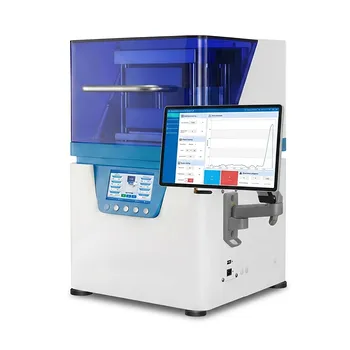
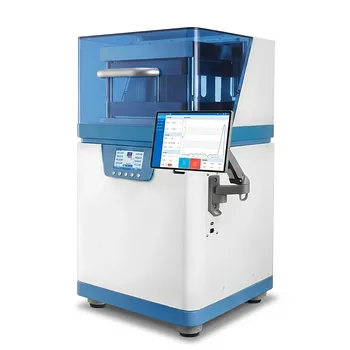
The laboratory hydraulic press is the critical tool for transforming loose precursor powders into chemically reactive $Li_4Sr_2SiP_4$ green bodies. By applying significant uniaxial pressure (often around 5 tons), the press reduces inter-particle gaps and maximizes the surface contact area between the reaction components. This physical compaction is essential because it drastically shortens atomic diffusion distances, which directly accelerates phase formation during the subsequent high-temperature annealing process.
A laboratory hydraulic press provides the high-density environment necessary to facilitate efficient solid-state reactions. Without this initial compaction, the diffusion kinetics would be too slow to achieve the desired $Li_4Sr_2SiP_4$ crystalline phase effectively.
Optimizing Solid-State Reaction Kinetics
Reducing Atomic Diffusion Distance
The primary role of the hydraulic press is to force individual powder particles into intimate contact within a mold. In solid-state synthesis, atoms must migrate across particle boundaries; by minimizing the space between these boundaries, the press enables faster atomic transport during the annealing stage.
Accelerating Phase Formation
$Li_4Sr_2SiP_4$ requires specific thermal treatments to form its complex crystalline structure. The increased contact area created by the press allows chemical reactions to occur more uniformly and rapidly throughout the entire volume of the green body.
Structural Integrity and Reproducibility
Defining Geometric Shape and Strength
The press uses precision molds to create dense, cylindrical pellets with specific mechanical strength. This ensures the green body can be handled and loaded into furnaces or stainless steel canisters without crumbling or losing its defined shape.
Ensuring Uniform Density
By applying precise, static pressure, the laboratory hydraulic press eliminates uneven pore distribution within the powder. This consistency is vital for ensuring that experimental data and physical property tests are reproducible across different batches of samples.
Understanding Technical Trade-offs
Pressure Limits and Mechanical Stress
While higher pressure generally improves density, exceeding the material's limits can cause internal stresses or microscopic cracking. Finding the "sweet spot"—typically around 5 tons of pressure—is necessary to maintain the structural foundation of the green body without inducing defects.
Limitations of Uniaxial Pressing
Uniaxial pressing can sometimes lead to density gradients where the center of the pellet is slightly less dense than the edges. For research requiring ultra-high density or perfectly uniform structures, the hydraulic press is often used as a precursor step to more advanced methods like isostatic pressing.
Applying This to Your Material Synthesis
Selecting the right approach depends on your specific experimental goals for the $Li_4Sr_2SiP_4$ compound.
- If your primary focus is rapid and pure phase formation: Use the hydraulic press to maximize particle contact area, thereby shortening the diffusion path for atomic migration during annealing.
- If your primary focus is sample durability during processing: Calibrate the press to ensure the green body achieves sufficient mechanical interlocking to survive loading into canisters or tube furnaces.
- If your primary focus is experimental reproducibility: Utilize standardized molds and precise pressure settings (e.g., 5 tons) to ensure uniform density and geometric consistency across all synthesized samples.
By mastering the compaction of $Li_4Sr_2SiP_4$ green bodies, you establish the physical foundation required for successful high-temperature chemical synthesis.
Summary Table:
| Feature | Role in Li4Sr2SiP4 Synthesis | Impact on Material Quality |
|---|---|---|
| Uniaxial Compaction | Reduces inter-particle gaps & increases contact | Accelerates atomic diffusion & phase formation |
| High Static Pressure | Eliminates uneven pore distribution | Ensures uniform density across samples |
| Precision Pelletizing | Creates structurally sound green bodies | Prevents crumbling during high-temp annealing |
| Reproducible Force | Standardizes 5-ton pressure settings | Guarantees consistent experimental results |
Elevate Your Solid-State Synthesis with KINTEK Precision
Achieving the perfect crystalline phase for Li4Sr2SiP4 requires more than just chemistry—it requires precision engineering. KINTEK specializes in high-performance laboratory equipment designed to bridge the gap between precursor powders and high-quality research results.
Whether you need robust manual or automated hydraulic presses (pellet, hot, or isostatic) for dense green body preparation, crushing and milling systems for precursor homogenization, or high-temperature muffle and vacuum furnaces for critical annealing stages, we have the expertise to support your lab. Our portfolio also features specialized high-pressure reactors, electrolytic cells, and advanced cooling solutions to meet the rigorous demands of battery research and material science.
Ready to optimize your sample preparation? Contact KINTEK today to consult with our experts and find the ideal equipment for your specific synthesis goals.
References
- Vincent Daiber, Thomas F. Fässler. Synthesis, Crystal structure, electronic structure, and Raman spectra of Li<sub>4</sub>Sr<sub>2</sub>SiP<sub>4</sub>. DOI: 10.1002/zaac.202300244
This article is also based on technical information from Kintek Solution Knowledge Base .
Related Products
- Laboratory Hydraulic Press Lab Pellet Press Machine for Glove Box
- Laboratory Hydraulic Press Split Electric Lab Pellet Press
- Fully Automatic Heated Hydraulic Lab Press for Materials Sintering and Sample Preparation
- Laboratory Hydraulic Press Lab Pellet Press for Button Battery
- Automatic Laboratory Hydraulic Press for XRF & KBR Pellet Press
People Also Ask
- What is the function of a laboratory hydraulic press in W-Cu composites? Control Porosity and Material Ratio
- What is the role of a laboratory hydraulic press in the initial stages of Li6PS5Cl preparation? Key to Green Pellets
- What role does a laboratory hydraulic press play in triboelectric testing? Achieve Precision Alloy Sample Prep
- How can a laboratory hydraulic press be applied to chitosan for wastewater treatment? Optimize Pores & Strength
- How do a precision laboratory hydraulic press and specialized molds contribute to the fabrication of spherical ceramic samples? Achieving High-Density Material Precision