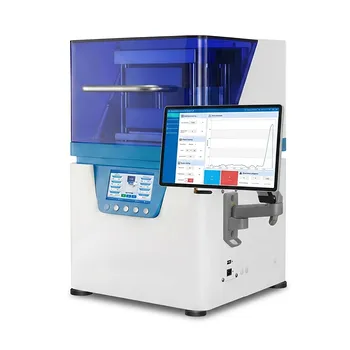
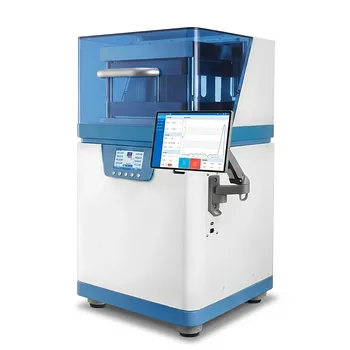
A laboratory hydraulic press is essential for iodine analysis because it transforms loose powder into high-density, uniform pellets that ensure even heating and consistent iodine release. This process eliminates the variability inherent in powdered samples, allowing for the precise measurement of iodine recovery rates during thermal desorption. By standardizing the physical state of the waste simulant, researchers achieve the kinetic efficiency and repeatability required for definitive analytical results.
The use of a laboratory hydraulic press ensures sample uniformity and high-density compaction, which are critical for achieving reproducible iodine recovery rates and efficient thermal desorption kinetics during the analysis of solid waste simulants.
Achieving Kinetic Efficiency through Physical Uniformity
The Role of Even Thermal Distribution
When waste simulants are processed in a tube furnace, the uniformity of the sample is paramount. A hydraulic press creates pellets with regular geometry, ensuring that heat penetrates the material evenly rather than creating localized "hot spots" common in loose powders.
Optimizing the Release of Volatile Iodine
High-density pressure reduces the voids between particles, which standardizes the path that volatile iodine must take to exit the sample. This controlled structure improves the kinetic efficiency of iodine release, ensuring the element is liberated at a predictable rate during thermal desorption.
Enhancing Particle-to-Particle Contact
By compressing the mixture, the press increases the contact area between different components of the waste simulant. This is critical for observing complex interface reactions that occur under high-temperature conditions, such as the formation of specific mineral phases that might trap or release iodine.
Ensuring Reproducibility and Data Integrity
Eliminating Batch-to-Batch Variability
In analytical chemistry, consistency is the foundation of trust. Using a hydraulic press allows researchers to produce pellets of identical mass and dimensions, which directly leads to higher reproducibility of recovery rates between different sample batches.
Preventing Mass Loss and Splashing
Loose powders are susceptible to "splashing" or mechanical loss when exposed to gas flows or rapid heating. Pelletization provides the mechanical strength needed to maintain sample integrity, ensuring that the mass remains constant throughout the combustion or desorption process.
Minimizing Scattering and Interference
A flat, dense pellet surface is necessary for many downstream analytical techniques. By providing a homogenous arrangement of particles, the press prevents physical irregularities that could lead to signal scattering or inaccuracies in detection limits.
Understanding the Trade-offs
The Risk of Over-Compaction
While high density is generally beneficial, excessive pressure can lead to "over-compaction." If a pellet is too dense, it may inhibit the diffusion of gases, potentially trapping iodine within the core of the sample and leading to underestimated recovery rates.
Cross-Contamination Concerns
The internal surfaces of the die set must be meticulously cleaned between samples. Because the press applies high tonnage, any residual material from a previous batch can be embedded into the surface of the new pellet, compromising the purity of the analysis.
Elastic Rebound and Cracking
Different waste simulants have varying elastic moduli. Some materials may expand slightly after the pressure is released, which can lead to internal fractures or "capping," where the top of the pellet delaminates, potentially affecting the evenness of the heating process.
How to Apply Pelletization to Your Iodine Analysis
The following recommendations will help you optimize your sample preparation based on your specific research goals:
- If your primary focus is Maximum Precision: Use a consistent pressure (e.g., 200–600 MPa) and a dwell time of at least 60 seconds to ensure the pellet reaches a stable, high-density state with minimal internal voids.
- If your primary focus is High Throughput: Implement a standardized cleaning protocol for the die sets and consider a multi-pellet die to maintain uniformity across large sample sizes without sacrificing mechanical integrity.
- If your primary focus is Simulating Geological Storage: Adjust the hydraulic pressure to match the specific sedimentary state of the target environment, focusing on reducing porosity to below 5% to replicate deep-earth conditions.
By mastering the pelletization process, you transform a variable powder into a standardized analytical specimen, ensuring that your iodine recovery data is both accurate and defensible.
Summary Table:
| Key Advantage | Impact on Iodine Analysis | Practical Research Benefit |
|---|---|---|
| High Uniformity | Even thermal distribution | Eliminates localized hot spots for consistent heating |
| Superior Density | Standardized volatile release | Improves kinetic efficiency and iodine recovery rates |
| Mechanical Strength | Prevents mass loss/splashing | Maintains sample integrity during thermal desorption |
| Geometric Precision | Batch-to-batch repeatability | Ensures identical mass and dimensions for data integrity |
Elevate Your Analytical Precision with KINTEK
Consistency is the foundation of reliable iodine recovery data. KINTEK specializes in high-performance laboratory hydraulic presses—including pellet, hot, and isostatic models—designed to transform loose powders into perfect, standardized analytical specimens.
Our comprehensive portfolio supports your entire research workflow, featuring high-temperature furnaces (muffle, tube, vacuum), crushing and milling systems, and essential ceramic crucibles. Whether you are analyzing solid waste simulants or conducting complex mineral phase research, we provide the tools to eliminate variability and ensure defensible results.
Ready to optimize your sample preparation? Contact KINTEK today to discover how our precision pressing and thermal solutions can enhance your laboratory's efficiency and accuracy.
References
- Žilvinas Zacharauskas, Ian W. Croudace. Development of an optimised method for measurement of iodine-129 in decommissioning wastes using ICP-MS/MS. DOI: 10.1039/d3ja00045a
This article is also based on technical information from Kintek Solution Knowledge Base .
Related Products
- Laboratory Hydraulic Press Lab Pellet Press Machine for Glove Box
- Laboratory Hydraulic Press Split Electric Lab Pellet Press
- Fully Automatic Heated Hydraulic Lab Press for Materials Sintering and Sample Preparation
- Laboratory Hydraulic Press Lab Pellet Press for Button Battery
- Automatic Laboratory Hydraulic Pellet Press Machine for Lab Use
People Also Ask
- How do laboratory hydraulic presses contribute to zero-gap electrolyzers? Optimize Performance & Safety
- Why is a laboratory hydraulic press necessary for ZrO2/Cr2O3 interface analysis? Optimize Sample Density and Accuracy
- How do a precision laboratory hydraulic press and specialized molds contribute to the fabrication of spherical ceramic samples? Achieving High-Density Material Precision
- What is the role of a laboratory hydraulic press in the preparation of rare earth denitrification catalysts?
- How does pressure control of a laboratory hydraulic press affect W-Ti alloys? Optimize Grain Structure & Density