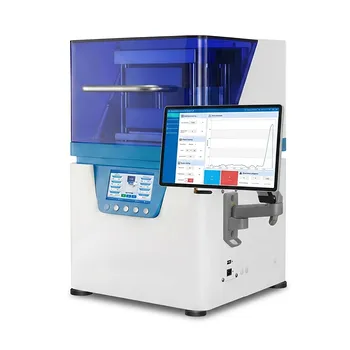
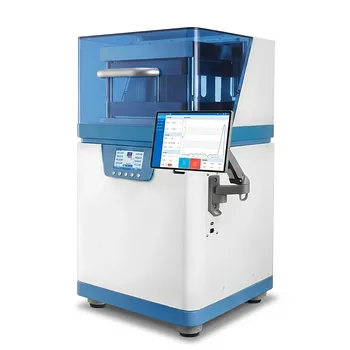
A laboratory hydraulic press is the critical bridge between raw catalyst powders and functional reactor particles.
By applying controlled, high-intensity static pressure, the press transforms synthesized powders into dense "green compacts." This densification is mandatory to ensure the catalyst has the mechanical strength required to withstand high-pressure gas flows in packed-bed reactors without disintegrating into dust or causing flow blockages.
Core Takeaway: The hydraulic press creates structurally sound catalyst pellets that can be crushed and sieved to precise sizes. This process prevents catalyst "powdering," ensures a stable pressure drop within the reactor, and allows for the accurate study of reaction kinetics by eliminating mass transfer inconsistencies.
Ensuring Structural Integrity in High-Flow Environments
Preventing Catalyst Attrition and "Powdering"
In a packed-bed reactor, catalyst particles are subjected to continuous scouring by high-velocity gas flows. Raw powders lack the mechanical strength to resist these forces and would quickly pulverize or "powder."
A hydraulic press compacts these powders into solid forms that maintain their integrity. This prevents the catalyst from being lost within the gas flow field or physically blown out of the reactor zone.
Maintaining Stable Pressure Drops
If catalyst particles break down during operation, the resulting fines fill the voids between particles. This leads to a significant increase in pressure drop across the bed, which can choke the reactor and cause uneven gas distribution.
By using a press to create dense, robust particles, researchers ensure that gas flow channels remain unobstructed. This stability is essential for maintaining consistent operating conditions over long experimental runs.
Precision in Particle Engineering
Achieving Specific Particle Size Ranges
Packed-bed reactors require specific particle sizes (often ranging from 250 µm to 800 µm) to balance surface area with flow permeability. You cannot achieve this precision with loose powder.
The hydraulic press creates a "green body" or disk that is subsequently crushed and sieved. This controlled destruction of a high-density solid is the only way to produce granules with the exact dimensions needed for standardized reactor loading.
Optimizing Diffusion and Kinetic Accuracy
For kinetic studies, it is vital that the measured reaction rate reflects the chemistry rather than physical limitations. Uniform compaction ensures consistent sample density, which is necessary to calculate and eliminate internal mass transfer limitations.
Using a press allows researchers to apply the Weisz-Prater criterion accurately. This ensures that reaction gases penetrate the catalyst layer uniformly and that the data collected represents the intrinsic kinetics of the dual-function material.
Understanding the Trade-offs
The Risk of Over-Compaction
While high pressure increases strength, excessive force can crush the internal pore structure of the catalyst. If the pressing pressure is too high (e.g., significantly exceeding 40 MPa without justification), it may restrict the diffusion paths for reaction gases, effectively "deadening" the center of the catalyst particle.
Uniformity vs. Scalability
Laboratory presses provide excellent uniformity and reproducibility for small batches, but the manual nature of the process can be a bottleneck. Furthermore, while a press creates a "green compact," some catalysts may still require binders or post-pressing calcination to achieve the final hardness needed for industrial-scale simulation.
How to Apply This to Your Project
Making the Right Choice for Your Goal
- If your primary focus is kinetic modeling: Use a hydraulic press to ensure uniform density across all samples, allowing for the precise elimination of mass transfer variables.
- If your primary focus is reactor longevity: Prioritize higher compaction pressures (within the material's limits) to maximize mechanical strength and prevent bed settling or powdering.
- If your primary focus is surface characterization (XRD/XPS): Use the press to create flat, smooth-surfaced pellets to ensure a consistent sample height and maximize signal intensity during analysis.
- If your primary focus is industrial simulation: Combine hydraulic pressing with the use of binders to better mimic the geometric shapes and wear resistance of commercial pellets or rings.
By mastering the compaction process, you transform a sensitive chemical powder into a robust technical material capable of surviving the rigorous environment of a pressurized flow reactor.
Summary Table:
| Key Feature | Role in Catalyst Preparation | Impact on Reactor Performance |
|---|---|---|
| Densification | Converts raw powder into dense "green compacts" | Prevents catalyst attrition and "powdering" under high flow |
| Structural Integrity | Increases mechanical strength of pellets | Maintains stable pressure drops and prevents bed clogging |
| Controlled Sizing | Enables precise crushing and sieving (250–800 µm) | Optimizes gas flow channels and surface area accessibility |
| Uniform Compaction | Ensures consistent sample density | Eliminates mass transfer variables for accurate kinetic modeling |
| Surface Smoothing | Creates flat pellets for characterization | Maximizes signal intensity for XRD and XPS analysis |
Elevate Your Catalyst Research with KINTEK Precision
Achieving the perfect balance between mechanical strength and porous reactivity requires equipment that delivers consistent, repeatable results. KINTEK specializes in high-performance laboratory solutions designed for rigorous material science applications.
Whether you need to produce dense catalyst pellets, prepare samples for kinetic studies, or scale your research, our expert-grade equipment ensures your success:
- Hydraulic Presses: Advanced pellet, hot, and isostatic presses for superior sample densification.
- Material Processing: High-efficiency crushing, milling, and sieving systems to achieve precise particle size distributions.
- Thermal & Chemical Systems: A full suite of high-temperature furnaces (muffle, tube, CVD, PECVD) and high-temperature high-pressure reactors for catalyst synthesis and testing.
- Analytical Support: Essential consumables including crucibles, ceramics, and PTFE products to maintain purity.
Ready to transform your catalyst powders into high-performance reactor particles? Contact KINTEK today to find the ideal press for your lab!
References
- Hai-Ying Chen, Sreshtha Sinha Majumdar. Layer structured bifunctional monolith catalysts for energy-efficient conversion of CO2 to dimethyl ether. DOI: 10.1016/j.apcata.2023.119140
This article is also based on technical information from Kintek Solution Knowledge Base .
Related Products
- Laboratory Hydraulic Press Lab Pellet Press Machine for Glove Box
- Laboratory Hydraulic Press Split Electric Lab Pellet Press
- Fully Automatic Heated Hydraulic Lab Press for Materials Sintering and Sample Preparation
- Laboratory Hydraulic Press Lab Pellet Press for Button Battery
- Automatic Laboratory Hydraulic Press for XRF & KBR Pellet Press
People Also Ask
- What is the function of a laboratory hydraulic press in W-Cu composites? Control Porosity and Material Ratio
- What is the role of a laboratory hydraulic press in the initial stages of Li6PS5Cl preparation? Key to Green Pellets
- What role does a laboratory hydraulic press play in triboelectric testing? Achieve Precision Alloy Sample Prep
- How can a laboratory hydraulic press be applied to chitosan for wastewater treatment? Optimize Pores & Strength
- How do a precision laboratory hydraulic press and specialized molds contribute to the fabrication of spherical ceramic samples? Achieving High-Density Material Precision