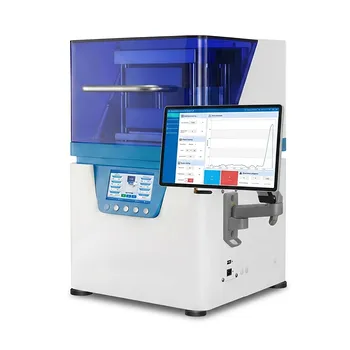
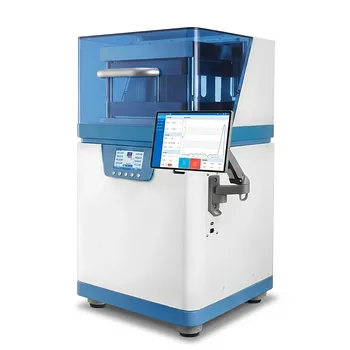
The laboratory hydraulic press is essential for preparing $Gd_2(Ti_{1-x}Zr_x)_2O_7$ green bodies because it provides the extreme axial pressure—often reaching 8 tons—required to compact loose powders into a dense, cohesive form. This process minimizes inter-particle gaps and maximizes contact points, which is a critical prerequisite for the solid-state atomic diffusion necessary to form a stable pyrochlore phase during high-temperature sintering.
Core Takeaway: A hydraulic press transforms loose precursor powders into high-density green bodies, ensuring the structural integrity and chemical phase purity of the final ceramic by facilitating efficient atomic diffusion and minimizing sintering shrinkage.
Optimizing Microstructure through High-Pressure Compaction
Eliminating Voids and Increasing Packing Density
The primary role of the hydraulic press is to apply uniform static pressure to rearrange loose powder particles. This high-pressure environment effectively forces air out of the powder bed and eliminates large inter-particle voids.
By significantly increasing the compaction density, the press ensures that the particles are packed as tightly as possible. This initial densification is vital because it determines the starting porosity of the material before it ever enters the furnace.
Facilitating Solid-State Atomic Diffusion
For complex oxides like $Gd_2(Ti_{1-x}Zr_x)_2O_7$, the transition to a pyrochlore structure requires atoms to move across particle boundaries. This solid-state diffusion is only efficient if the contact area between the reactants is maximized.
The hydraulic press creates these necessary high-surface-area contacts. Without this intimate particle contact, the diffusion rate remains too low, potentially leading to incomplete chemical reactions and an unstable crystal lattice.
Structural Integrity and Phase Formation
Ensuring Pyrochlore Phase Completion
The formation of the pyrochlore phase depends heavily on the homogeneity of the green body. The press helps eliminate uneven pore distribution, which ensures that the chemical reaction occurs uniformly throughout the entire sample.
Consistent density prevents "islands" of unreacted material. This results in a high-density ceramic with a stable disordered rock-salt or pyrochlore structure, depending on the specific zirconium-to-titanium ratio ($x$) used in the composition.
Defining Geometry and Mechanical Strength
A hydraulic press, used in conjunction with precision alloy steel molds, provides the green body with a specific geometric shape, such as a cylinder or disk. This provides the preliminary mechanical strength needed for handling and further processing.
This structural foundation is necessary to prevent the sample from cracking or undergoing excessive shrinkage during the sintering process. A well-compacted green body acts as a stable physical prototype that maintains its shape even as it densifies at high temperatures.
Understanding the Trade-offs and Pitfalls
Pressure Gradients and Internal Stress
While high pressure is necessary, uniaxial pressing (pressing from one or two directions) can create internal pressure gradients. The density near the punch may be higher than in the center of the green body, which can lead to warping during sintering.
The Risk of Lamination and "Capping"
If the pressure is released too quickly or if the powder is over-compacted beyond its elastic limit, the green body may suffer from lamination or capping. This is where the pellet splits into horizontal layers, effectively ruining the structural integrity of the sample.
Friction and Wall Effects
Friction between the powder and the mold walls can prevent the pressure from reaching the center of the pellet. To mitigate this, researchers often use lubricants or specialized mold coatings to ensure a more uniform distribution of force throughout the $Gd_2(Ti_{1-x}Zr_x)_2O_7$ powder.
Applying Compaction to Your Research Goals
How to Apply This to Your Project
To achieve the best results with your $Gd_2(Ti_{1-x}Zr_x)_2O_7$ green bodies, tailor your pressing strategy to your ultimate material requirements.
- If your primary focus is achieving maximum phase purity: Focus on maximizing the contact area by using higher pressures (within the mold's safety limits) to promote total solid-state diffusion.
- If your primary focus is preventing cracks and warping: Use a slower pressure release rate and consider internal lubricants to minimize density gradients and residual stresses.
- If your primary focus is high-volume experimental reproducibility: Utilize a digital hydraulic press with precise MPa control to ensure every green body has the exact same initial density and geometry.
Correct application of a laboratory hydraulic press turns loose powder into a high-performance ceramic precursor, making it the most critical step in the synthesis of dense, phase-pure pyrochlores.
Summary Table:
| Feature | Role in Synthesis | Outcome for Pyrochlore Ceramics |
|---|---|---|
| High Axial Pressure | Eliminates voids and air gaps | Maximizes initial green body density |
| Particle Compaction | Increases inter-particle contact | Facilitates solid-state atomic diffusion |
| Precision Molding | Defines geometric shape | Provides mechanical strength for handling |
| Density Control | Ensures uniform particle packing | Prevents cracking and warping during sintering |
Elevate Your Material Synthesis with KINTEK Precision
Achieving the perfect pyrochlore phase requires more than just pressure—it requires precision. KINTEK specializes in laboratory equipment designed for the most demanding research applications. Whether you are preparing complex oxide green bodies or performing advanced sintering, our comprehensive range of manual and digital hydraulic presses (pellet, hot, isostatic), high-temperature furnaces (muffle, vacuum, CVD), and crushing/milling systems ensures the structural integrity and phase purity your research demands.
From high-performance ceramics to battery research tools, we provide the reliability you need to achieve reproducible results.
Contact KINTEK today to find the perfect solution for your lab!
References
- Armando di Biase, Marco Scavini. Emerging disorder in Gd<sub>2</sub>(Ti<sub>1−<i>x</i></sub>Zr<sub><i>x</i></sub>)<sub>2</sub>O<sub>7</sub> pyrochlores matrices for radioactive waste disposal: symmetry lowering <i>versus</i> defect clustering. DOI: 10.1039/d3ta04847k
This article is also based on technical information from Kintek Solution Knowledge Base .
Related Products
- Laboratory Hydraulic Press Lab Pellet Press Machine for Glove Box
- Laboratory Hydraulic Press Split Electric Lab Pellet Press
- Fully Automatic Heated Hydraulic Lab Press for Materials Sintering and Sample Preparation
- Laboratory Hydraulic Press Lab Pellet Press for Button Battery
- Automatic Laboratory Hydraulic Press for XRF & KBR Pellet Press
People Also Ask
- How do laboratory hydraulic presses contribute to zero-gap electrolyzers? Optimize Performance & Safety
- Why is a laboratory hydraulic press necessary for ZrO2/Cr2O3 interface analysis? Optimize Sample Density and Accuracy
- How do a precision laboratory hydraulic press and specialized molds contribute to the fabrication of spherical ceramic samples? Achieving High-Density Material Precision
- What is the role of a laboratory hydraulic press in the preparation of rare earth denitrification catalysts?
- How does pressure control of a laboratory hydraulic press affect W-Ti alloys? Optimize Grain Structure & Density