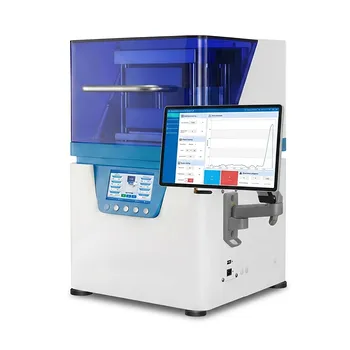
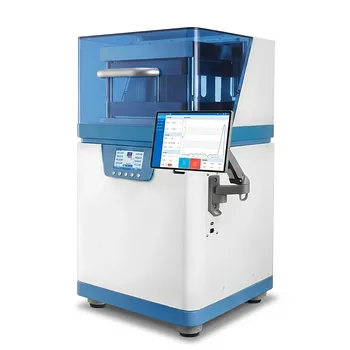
The use of a laboratory hydraulic press is essential for minimizing contact thermal resistance by ensuring a seamless interface between the LSSE sample, the thermal gaskets, and the copper heating/cooling blocks. By applying controlled, uniform pressure, the press eliminates microscopic air gaps that would otherwise impede the flow of heat, ensuring that the temperature gradient critical for the Longitudinal Spin Seebeck Effect is accurately and effectively transferred to the multilayer film sample.
The core necessity of a hydraulic press in LSSE testing lies in its ability to standardize the thermal interface. Without uniform pressure, inconsistent contact between components creates parasitic thermal resistance, leading to inaccurate measurements of the spin Seebeck voltage.
Optimizing Thermal Interface Conductivity
Eliminating Contact Thermal Resistance
In LSSE measurements, the primary challenge is ensuring that the temperature of the copper blocks is identical to the temperature experienced by the sample surface. Thermal conductive silicone gaskets are used to bridge this gap, but they require mechanical pressure to deform into the microscopic textures of the mating surfaces. A hydraulic press provides the necessary force to seat these gaskets perfectly, removing the insulating air pockets that typically occur in manual assemblies.
Ensuring Accurate Gradient Transfer
The Longitudinal Spin Seebeck Effect relies on a precisely defined temperature gradient across the thickness of a multilayer film. If the interface is not uniform, the thermal flux becomes non-linear, which distorts the resulting data. The uniform and moderate pressure provided by a laboratory press ensures that the heat flow remains unidirectional and consistent across the entire surface area of the sample.
Ensuring Sample Integrity and Consistency
Eliminating Microscopic Air Bubbles
Just as in polymer molding or pellet preparation, the assembly of LSSE components must be free of trapped air. Residual micro-bubbles within the gasket or at the interface act as thermal insulators and can cause localized "hot spots" or "cold spots." The high-precision pressure of a hydraulic press expels these air pockets, leading to a more homogeneous thermal environment.
Repeatability of Experimental Data
For LSSE results to be scientifically valid, they must be comparable across different trials and samples. A hydraulic press allows for constant and repeatable pressure control, ensuring that every specimen is assembled under identical conditions. This standardization removes the "human element" of manual tightening, which often leads to variations in material density and interface thickness.
Understanding the Trade-offs
The Risk of Over-Compression
While pressure is necessary to reduce thermal resistance, excessive force can be detrimental to LSSE components. Over-compressing the silicone gaskets may lead to permanent deformation or thinning, which can alter their thermal conductivity or even cause short-circuits if the film sample makes direct contact with the copper blocks.
Material Stress and Substrate Fragility
Many LSSE samples are deposited on fragile substrates like GGG (Gadolinium Gallium Garnet) or sapphire. Applying pressure too rapidly or exceeding the mechanical limits of the substrate can lead to micro-fractures or total structural failure. It is critical to use a press with fine-tuned pressure increments to balance interface quality with the structural integrity of the sample.
Making the Right Choice for Your Goal
How to Apply This to Your Project
To achieve the most accurate LSSE measurements, your approach to pressing should align with your specific material constraints.
- If your primary focus is Measurement Accuracy: Use a hydraulic press with a high-resolution gauge to ensure the thermal gaskets are compressed to their optimal "working thickness" as specified by the manufacturer.
- If your primary focus is Data Comparability: Implement a strict protocol where every sample assembly is subjected to the exact same pressure (e.g., 2.4 MPa) for the same duration to eliminate density gradients.
- If your primary focus is Sample Preservation: Select a press with a slow-closure manual or digital valve to avoid sudden pressure spikes that could shatter brittle crystalline substrates.
By mastering the application of uniform pressure, you ensure that your LSSE data reflects true material properties rather than interface inefficiencies.
Summary Table:
| Feature | Benefit for LSSE Testing | Impact on Research |
|---|---|---|
| Uniform Pressure | Eliminates microscopic air gaps | Ensures linear thermal flux and accurate data |
| Interface Optimization | Seats gaskets into surface textures | Minimizes parasitic contact thermal resistance |
| Precision Control | Protects fragile substrates (e.g., GGG) | Prevents micro-fractures and structural failure |
| Repeatability | Standardized assembly protocols | Removes human error for consistent trial results |
Elevate Your LSSE Research with KINTEK Precision
Achieving the perfect thermal interface for Longitudinal Spin Seebeck Effect testing requires more than just force—it requires absolute precision. KINTEK specializes in high-performance laboratory solutions, offering a versatile range of hydraulic presses, including pellet, hot, and isostatic presses designed to deliver uniform pressure for sensitive material assemblies.
Whether you are working with fragile crystalline substrates or need to eliminate every micro-bubble in your silicone gaskets, our equipment ensures:
- Unmatched Accuracy: Guarantee the thermal gradient transfer necessary for valid LSSE voltage measurements.
- Sample Integrity: Use fine-tuned pressure increments to protect brittle substrates like sapphire or GGG.
- Comprehensive Workflow: Seamlessly integrate your pressing process with our high-temperature furnaces, crushing systems, and specialized consumables (crucibles, ceramics, and PTFE).
Don't let interface inefficiencies compromise your data. Contact KINTEK today to find the ideal hydraulic press for your LSSE sample preparation!
References
- Zhaozhao Zhu, Jianwang Cai. Crossover from Positive to Negative Spin Hall Signal in a Ferromagnetic Metal Induced by the Magnetization Modulated Interface Effect. DOI: 10.1002/apxr.202300017
This article is also based on technical information from Kintek Solution Knowledge Base .
Related Products
- Laboratory Hydraulic Press Lab Pellet Press Machine for Glove Box
- Laboratory Hydraulic Press Split Electric Lab Pellet Press
- Fully Automatic Heated Hydraulic Lab Press for Materials Sintering and Sample Preparation
- Laboratory Hydraulic Press Lab Pellet Press for Button Battery
- Automatic Laboratory Hydraulic Press for XRF & KBR Pellet Press
People Also Ask
- How do laboratory hydraulic presses contribute to zero-gap electrolyzers? Optimize Performance & Safety
- Why is a laboratory hydraulic press necessary for ZrO2/Cr2O3 interface analysis? Optimize Sample Density and Accuracy
- How do a precision laboratory hydraulic press and specialized molds contribute to the fabrication of spherical ceramic samples? Achieving High-Density Material Precision
- What is the role of a laboratory hydraulic press in the preparation of rare earth denitrification catalysts?
- How does pressure control of a laboratory hydraulic press affect W-Ti alloys? Optimize Grain Structure & Density