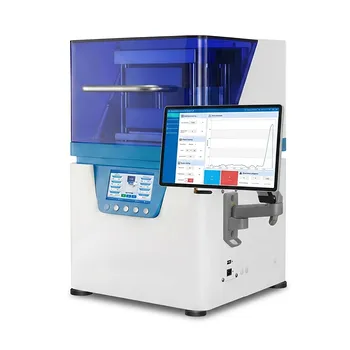
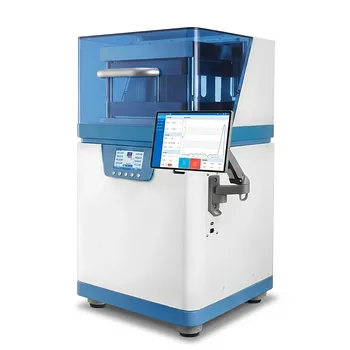
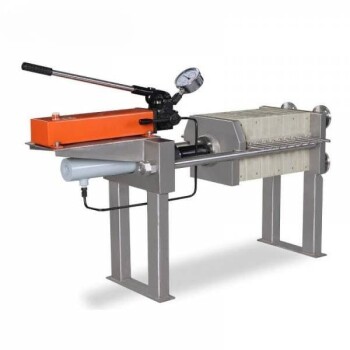
A laboratory hydraulic press is the critical bridge between a deposited material and a functional electronic device. It provides the synchronized high pressure, often up to 40 MPa, required to physically compact the loose network of nanosheets within a printed film. This densification is the essential step that converts a non-conductive, porous layer into a high-performance thermoelectric pathway.
Core Takeaway: The laboratory hydraulic press is necessary because it forces tight mechanical contact between nanosheets, effectively eliminating internal porosity and interface resistance to enable efficient charge transport.
Achieving Structural Densification
Compacting the Nanosheet Network
Printed thermoelectric films often begin as a loose, disordered "green" body with significant internal voids. A hydraulic press applies uniform pressure to physically compress these nanosheets into a singular, cohesive structure. This process increases the bulk density of the material, which is foundational for any high-performance electronic application.
Eliminating Porosity and Trapped Air
Internal porosity acts as a barrier to both electrical and thermal flow. The press works to exclude interlayer air and residual moisture that may have been trapped during the printing or filtration process. By removing these gaps, the press ensures the film is solid and free of the microscopic defects that cause structural failure.
Ensuring Uniform Film Thickness
Precision pressing allows for the creation of films with highly consistent thickness across the entire surface. This uniformity is vital for standardized testing and ensures that the thermoelectric properties are predictable throughout the sample. A smooth surface also reduces roughness, often by more than 90%, which is critical for integration into multi-layered devices.
Optimizing Thermoelectric Performance
Reducing Interface Resistance
In its as-deposited state, a film’s nanosheets have poor physical contact, leading to high electrical resistance at every junction. The hydraulic press forces tight mechanical contact, significantly lowering the interface resistance. This transformation is what allows a previously non-conductive film to support a high-performance electrical current.
Microscopic Sintering and Fusion
When combined with heat, the pressing process acts as a form of microscopic sintering. The pressure promotes inter-particle extrusion and fusion, encouraging the materials to bond at a molecular level. This leads to induced grain growth and specific crystal orientation, both of which are essential for optimizing the movement of charge carriers.
Strengthening Interfacial Bonding
Beyond electrical benefits, the press strengthens the physical bond between the filler material and the matrix. This intensified bonding improves the dielectric constant and ensures the film remains flexible and self-supporting. Without this pressure, the film would likely remain brittle and prone to delamination under stress.
Understanding the Trade-offs
Balancing Pressure and Material Integrity
While high pressure is necessary for densification, excessive force can lead to micro-cracking or the total collapse of the nanosheet structure. If the pressure exceeds the material’s structural limits, it can cause substrate deformation, especially if the film is printed on flexible polymers.
The Complexity of Thermal Management
Applying pressure simultaneously with heat (hot-pressing) is more effective but introduces thermal stress. If the cooling process is not controlled, the difference in thermal expansion between the film and the mold can cause the sample to warp or lose its uniform density.
How to Apply This to Your Process
Making the Right Choice for Your Goal
- If your primary focus is Maximum Conductivity: Use a high-pressure setting (up to 40 MPa) to ensure the lowest possible interface resistance between nanosheets.
- If your primary focus is Material Flexibility: Opt for moderate pressure combined with controlled heating to ensure bonding without making the film too brittle.
- If your primary focus is Surface Smoothness: Utilize precision-ground molds and a slow, synchronized pressure application to reduce surface roughness and ensure uniform thickness.
By precisely controlling the compaction of the nanosheet network, the laboratory hydraulic press transforms a raw printed deposit into a robust, high-efficiency thermoelectric material.
Summary Table:
| Key Pressing Action | Impact on Thermoelectric Material | Research & Device Benefit |
|---|---|---|
| Nanosheet Compaction | Eliminates internal voids and trapped air | Maximizes bulk density and structural integrity |
| Interface Reduction | Forces tight mechanical contact between layers | Significantly lowers electrical resistance |
| Precision Levelling | Ensures highly consistent film thickness | Predictable properties and easy device integration |
| Microscopic Sintering | Promotes inter-particle fusion and grain growth | Optimized charge transport and material strength |
Elevate Your Material Research with KINTEK Precision
Transform your printed deposits into high-performance electronic devices with KINTEK’s advanced laboratory hydraulic presses. Specialized in supporting cutting-edge material science, we offer a comprehensive range of manual, power, and isostatic hydraulic presses designed to provide the precise pressure control (up to 40 MPa and beyond) required for nanosheet densification and thermoelectric optimization.
Beyond pressing, KINTEK provides a full ecosystem of laboratory solutions, including:
- High-Temperature Furnaces: Muffle, vacuum, and CVD systems for advanced sintering.
- Sample Preparation: Crushing, milling, and sieving equipment for uniform precursors.
- Consumables: High-purity ceramics, crucibles, and PTFE products.
Ready to eliminate interface resistance and achieve superior film uniformity? Contact our technical experts today to discuss how KINTEK can streamline your post-printing treatment process.
References
- Jacob Manzi, Harish Subbaraman. Plasma-jet printing of colloidal thermoelectric Bi<sub>2</sub>Te<sub>3</sub> nanoflakes for flexible energy harvesting. DOI: 10.1039/d2nr06454e
This article is also based on technical information from Kintek Solution Knowledge Base .
Related Products
- Laboratory Hydraulic Press Lab Pellet Press Machine for Glove Box
- Laboratory Hydraulic Press Split Electric Lab Pellet Press
- Fully Automatic Heated Hydraulic Lab Press for Materials Sintering and Sample Preparation
- Laboratory Hydraulic Press Lab Pellet Press for Button Battery
- Automatic Laboratory Hydraulic Press for XRF & KBR Pellet Press
People Also Ask
- How do laboratory hydraulic presses contribute to zero-gap electrolyzers? Optimize Performance & Safety
- Why is a laboratory hydraulic press necessary for ZrO2/Cr2O3 interface analysis? Optimize Sample Density and Accuracy
- How do a precision laboratory hydraulic press and specialized molds contribute to the fabrication of spherical ceramic samples? Achieving High-Density Material Precision
- What is the role of a laboratory hydraulic press in the preparation of rare earth denitrification catalysts?
- How does pressure control of a laboratory hydraulic press affect W-Ti alloys? Optimize Grain Structure & Density