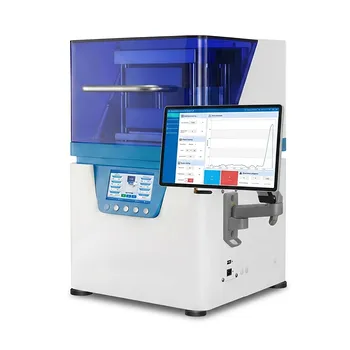
A laboratory hydraulic press is essential for synthesizing $\text{Ni}_2\text{Mo}_3\text{O}_8$ because it provides the mechanical force necessary to compress reactant powders into dense "green bodies." This compaction maximizes the effective contact area between nickel and molybdenum precursors, which significantly reduces diffusion resistance and ensures the high phase purity required for this complex oxide.
The use of a hydraulic press in solid-state synthesis transforms loose powder into a dense pellet to facilitate rapid atomic diffusion. By minimizing the physical distance between reactants, the press overcomes kinetic barriers, leading to shorter reaction times and more homogenous crystalline structures.
Optimizing Reaction Kinetics
Reducing Atomic Diffusion Distance
In solid-state synthesis, reactants do not have a liquid or gas medium to facilitate movement; reactions occur strictly at the interfaces where particles touch. By applying high tonnage pressure, a hydraulic press forces these particles into intimate contact, effectively shortening the diffusion path that ions must travel to form the $\text{Ni}_2\text{Mo}_3\text{O}_8$ lattice.
Lowering the Thermal Energy Barrier
When particles are loosely packed, the energy required to initiate a reaction is significantly higher due to the gaps between grains. Compacting the powder into a pellet increases the coordination number of each particle, which lowers the overall energy barrier and allows the chemical reaction to proceed more efficiently at high temperatures.
Accelerating Phase Formation
Without the use of a press, the formation of $\text{Ni}_2\text{Mo}_3\text{O}_8$ might be incomplete or result in undesirable intermediate phases. The close contact ensured by pelletizing allows for a complete reaction at lower calcination temperatures, preventing the evaporation of volatile components or the formation of secondary impurities.
Ensuring Material Integrity and Density
Elimination of Porosity and Voids
The pressing process is critical for expelling air trapped between powder particles, which would otherwise create large internal pores. Minimizing these voids is vital for the structural integrity of the final product and ensures that the material achieves a high green density before the sintering process begins.
Uniform Shrinkage During Sintering
A well-pressed pellet shrinks more uniformly during high-temperature treatment, reducing the risk of internal cracks, lamination, or structural defects. This physical stability is necessary for researchers who need to measure the material's physical properties, such as hardness or thermal conductivity, on consistent sample geometries.
Improving Crystalline Phase Purity
Because $\text{Ni}_2\text{Mo}_3\text{O}_8$ requires precise stoichiometry, any localized area with poor contact will fail to react fully. The hydraulic press ensures stoichiometric homogeneity across the entire sample, resulting in a final polycrystalline product with high crystallinity and minimal residual reactants.
Understanding the Trade-offs
The Risk of Over-Pressing
While high pressure is beneficial, exceeding the material's limit can lead to capping or lamination, where the pellet splits into layers upon release from the mold. This occurs when trapped air is compressed to the point that it expands violently when the external pressure is removed, compromising the sample's integrity.
Mold Wear and Contamination
Repeated use of high-pressure steel molds can introduce trace amounts of metallic contamination into the sample if the surfaces are not properly maintained or lubricated. Furthermore, if the pressure is not applied uniaxially or consistently, the resulting density gradients can cause the pellet to warp or crack during the subsequent heating phase.
Applying Compaction to Your Synthesis
Making the Right Choice for Your Goal
To achieve the best results when preparing $\text{Ni}_2\text{Mo}_3\text{O}_8$ or similar complex oxides, tailor your pressing strategy to your specific experimental needs.
- If your primary focus is Phase Purity: Use a hydraulic press to create high-density pellets (e.g., aiming for less than 5% porosity) to ensure complete atomic diffusion.
- If your primary focus is Physical Property Testing: Ensure precise control over the applied tonnage to create samples with consistent dimensions and uniform internal density.
- If your primary focus is Reducing Reaction Time: Utilize pelletization to enable faster mass transfer, allowing for shorter calcination cycles at lower temperatures.
Proper mechanical compaction is the foundational step that ensures the chemical potential of your reactants is fully realized during the synthesis of advanced materials.
Summary Table:
| Key Benefit | Mechanism of Action | Impact on Synthesis |
|---|---|---|
| Enhanced Diffusion | Minimizes physical distance between particles | Accelerates reaction kinetics and ensures phase purity. |
| Lower Energy Barrier | Increases particle coordination number | Allows complete reactions at lower calcination temperatures. |
| Porosity Elimination | Expels trapped air during compaction | Improves green density and prevents internal structural defects. |
| Physical Integrity | Ensures uniform sample shrinkage | Reduces lamination/cracking for reliable property testing. |
Elevate Your Material Synthesis with KINTEK Precision
Achieving the perfect $\text{Ni}_2\text{Mo}_3\text{O}_8$ lattice requires more than just high temperatures—it requires precision compaction. KINTEK specializes in high-performance laboratory equipment designed to meet the rigorous demands of advanced material research.
Our extensive portfolio includes:
- Hydraulic Presses: Manual and automatic pellet, hot, and isostatic presses for superior sample density.
- High-Temperature Furnaces: Muffle, tube, and vacuum furnaces for precise sintering and calcination.
- Milling & Crushing Systems: Ensure stoichiometric homogeneity before you press.
- Specialized Consumables: High-purity crucibles, ceramics, and PTFE products to prevent contamination.
Whether you are a researcher focused on phase purity or a distributor seeking reliable laboratory solutions, KINTEK delivers the expertise and reliability you need to succeed. Contact our technical team today to find the ideal pressing and heating solution for your specific application!
References
- Poonam Yadav, Sungkyun Choi. Noncollinear magnetic order, in-plane anisotropy, and magnetoelectric coupling in the pyroelectric honeycomb antiferromagnet <mml:math xmlns:mml="http://www.w3.org/1998/Math/MathML"><mml:mrow><mml:msub><mml:mi>Ni</mml:mi><mml:mn>2</mml:mn></mml:msub><mml:msub><mml:mi>Mo</mml:mi><mml:mn>3</mml:mn></mml:msub><mml:msub><mml:mi mathvariant="normal">O</mml:mi><mml:mn>8</mml:mn></mml:msub></mml:mrow></mml:math>. DOI: 10.1103/physrevresearch.5.033099
This article is also based on technical information from Kintek Solution Knowledge Base .
Related Products
- Laboratory Hydraulic Press Lab Pellet Press Machine for Glove Box
- Laboratory Hydraulic Press Split Electric Lab Pellet Press
- Fully Automatic Heated Hydraulic Lab Press for Materials Sintering and Sample Preparation
- Laboratory Hydraulic Press Lab Pellet Press for Button Battery
- Automatic Laboratory Hydraulic Press for XRF & KBR Pellet Press
People Also Ask
- How do laboratory hydraulic presses contribute to zero-gap electrolyzers? Optimize Performance & Safety
- Why is a laboratory hydraulic press necessary for ZrO2/Cr2O3 interface analysis? Optimize Sample Density and Accuracy
- How do a precision laboratory hydraulic press and specialized molds contribute to the fabrication of spherical ceramic samples? Achieving High-Density Material Precision
- What is the role of a laboratory hydraulic press in the preparation of rare earth denitrification catalysts?
- How does pressure control of a laboratory hydraulic press affect W-Ti alloys? Optimize Grain Structure & Density