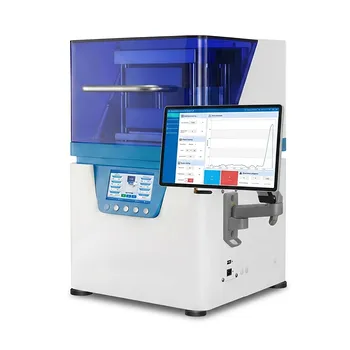
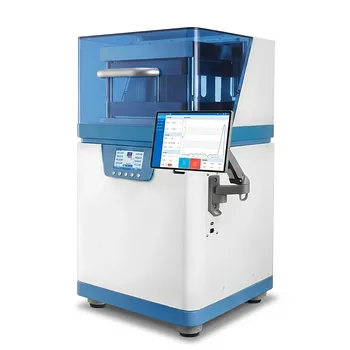
Pelletizing with a laboratory hydraulic press is essential for transforming loose Cs-Ru/CeO2 powder into a dense, geometrically uniform solid. This process eliminates the air-filled voids between particles that would otherwise distort electrical measurements. By creating a solid disk, researchers ensure the consistent electrical contact and precise sample dimensions required to accurately measure dielectric loss tangent and resistivity.
The core purpose of using a hydraulic press is to standardize the physical state of the catalyst, ensuring that the collected data reflects the material's intrinsic properties rather than the inconsistencies of a loose powder pack.
Eliminating Voids and Ensuring Measurement Accuracy
The Influence of Inter-particle Voids
Loose powders contain significant air gaps that act as insulators and disrupt the flow of electrical current. A hydraulic press applies constant high pressure to collapse these voids, ensuring that the measured conductivity represents the catalyst itself rather than the air trapped within it.
Achieving Uniform Sample Density
Inconsistent packing leads to "noisy" and irreproducible data. The press ensures a uniform density throughout the sample, which is a fundamental requirement for acquiring reliable dielectric loss tangent and resistivity data.
Reducing Ion Transport Tortuosity
For ionic conductivity measurements, high porosity can create long, winding transport paths for ions. By applying precise pressure—often up to 40 MPa—the press reduces porosity to minimal levels (frequently below 5%), facilitating a more direct path for ion transport.
Geometric Consistency and Electrical Contact
Optimizing Surface-to-Electrode Contact
Accurate resistivity measurements depend on perfect contact between the sample surface and the testing electrodes. The hydraulic press creates flat, smooth surfaces that minimize contact resistance, which is critical for obtaining the material's true electrical profile.
Precision in Geometric Dimensions
Calculating dielectric properties requires knowing the exact thickness and surface area of the sample. Pelletizing produces a regular geometric shape with a consistent surface height, allowing for the precise calculations necessary for valid analytical results.
Maintaining Structural Integrity
Beyond electrical testing, pelletizing provides the mechanical strength needed for the sample to withstand handling. This ensures the sample does not crumble or shift during the measurement process, which would lead to immediate data fluctuations.
Understanding the Trade-offs and Pitfalls
Risk of Structural Alteration
While high pressure is necessary, excessive force can lead to the deformation of the catalyst’s active sites or the collapse of essential internal pores. It is vital to find a pressure balance that ensures density without compromising the catalyst's chemical functionality.
Impact of Grain Boundaries
The process of pressing powder into a solid creates grain boundaries where the individual particles meet. These boundaries can sometimes introduce their own resistance, which researchers must account for when interpreting conductivity data.
Pressure-Induced Phase Changes
In some sensitive materials, the high static pressure of a hydraulic press can trigger phase transitions or changes in crystallinity. This could result in measuring a material state that does not exist under normal operating conditions.
Making the Right Choice for Your Research Goal
How to Apply This to Your Project
To ensure your Cs-Ru/CeO2 characterization is accurate and reproducible, consider the specific requirements of your testing equipment and the nature of your catalyst.
- If your primary focus is dielectric characterization: Use the press to create pellets with the highest possible surface flatness to maximize signal intensity and ensure a consistent sample height.
- If your primary focus is ionic conductivity: Focus on using sufficient tonnage to reduce porosity to below 5%, which minimizes tortuous paths and prevents short circuits.
- If your primary focus is kinetic evaluation in a reactor: Use the press to create "green bodies" that can be crushed and sieved to specific particle sizes, such as 60-80 mesh, to prevent gas bypassing and pressure drops.
By mastering the pelletizing process, you provide the physical foundation necessary for capturing high-fidelity data that truly represents your catalyst's performance.
Summary Table:
| Key Benefit | Impact on Electrical Measurement | Recommended Parameter/Detail |
|---|---|---|
| Void Elimination | Removes insulating air gaps; ensures intrinsic material data. | High pressure (up to 40 MPa) |
| Uniform Density | Eliminates 'noisy' data; ensures reproducible results. | Constant high-pressure application |
| Geometric Precision | Allows exact calculation of dielectric loss and resistivity. | Regular disk shape & flat surfaces |
| Improved Contact | Minimizes contact resistance between sample and electrode. | Smooth surface finish |
| Reduced Tortuosity | Facilitates direct ion transport paths. | Porosity target: < 5% |
Elevate Your Catalyst Research with KINTEK Precision
High-fidelity material characterization starts with perfect sample preparation. KINTEK specializes in providing researchers with the robust laboratory equipment needed to ensure repeatable, publication-quality data. Whether you are pelletizing catalysts for conductivity tests or preparing samples for high-temperature analysis, our comprehensive range of laboratory hydraulic presses (pellet, hot, and isostatic) delivers the consistent pressure and reliability your project demands.
Beyond pelletizing, KINTEK offers an extensive portfolio to support your entire workflow, including:
- High-Temperature Furnaces: Muffle, tube, vacuum, and atmosphere furnaces for catalyst calcination.
- Material Processing: Advanced crushing, milling, and sieving systems for uniform powder preparation.
- Electrochemical Tools: High-pressure reactors, autoclaves, and specialized electrolytic cells.
- Consumables: High-purity ceramics, crucibles, and PTFE products for contamination-free testing.
Ready to optimize your sample preparation and achieve superior data accuracy? Contact KINTEK today to find the perfect solution for your laboratory.
References
- Alazar Araia, Jianli Hu. Insight into Enhanced Microwave Heating for Ammonia Synthesis: Effects of CNT on the Cs–Ru/CeO<sub>2</sub> Catalyst. DOI: 10.1021/acsami.3c00132
This article is also based on technical information from Kintek Solution Knowledge Base .
Related Products
- Laboratory Hydraulic Press Lab Pellet Press Machine for Glove Box
- Laboratory Hydraulic Press Split Electric Lab Pellet Press
- Fully Automatic Heated Hydraulic Lab Press for Materials Sintering and Sample Preparation
- Automatic Laboratory Hydraulic Press for XRF & KBR Pellet Press
- Laboratory Hydraulic Press Lab Pellet Press for Button Battery
People Also Ask
- How do laboratory hydraulic presses contribute to zero-gap electrolyzers? Optimize Performance & Safety
- Why is a laboratory hydraulic press necessary for ZrO2/Cr2O3 interface analysis? Optimize Sample Density and Accuracy
- How do a precision laboratory hydraulic press and specialized molds contribute to the fabrication of spherical ceramic samples? Achieving High-Density Material Precision
- What is the role of a laboratory hydraulic press in the preparation of rare earth denitrification catalysts?
- How does pressure control of a laboratory hydraulic press affect W-Ti alloys? Optimize Grain Structure & Density