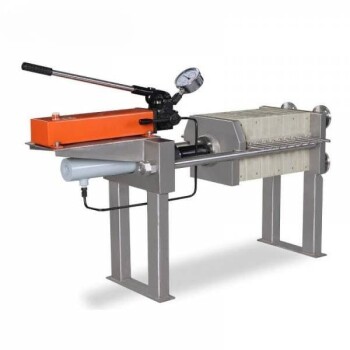
Precision specimen preparation is the foundation of reliable cable safety testing. A laboratory hydraulic press is required to transform raw materials into standardized, high-density specimens that are free from structural defects. This process ensures that the results of flame retardancy tests reflect the material's true chemical properties rather than inconsistencies in the sample's physical structure.
The laboratory hydraulic press provides the precise temperature and pressure control necessary to eliminate air bubbles and density gradients within a specimen. This standardization is critical for achieving the accuracy and repeatability required by international combustion standards like the Limiting Oxygen Index (LOI).
Ensuring Structural Integrity through Controlled Compression
Eliminating Internal Defects
The press removes micro-pore defects and residual air bubbles that could otherwise act as unintended fuel pockets or insulation gaps during a fire test. By expelling these voids, the press ensures the material reacts to heat uniformly, providing a scientifically sound baseline for evaluation.
Uniform Density Gradients
Multi-stage pressure-holding functions ensure the internal structure of the specimen is consistent from the core to the surface. Without this uniformity, "weak spots" in the material density could lead to premature ignition or uneven burning, which would skew the test data.
Enhancing Material Fusion
For polymer matrices like PVC, the press provides the thermal energy required to remelt and fuse the material into a single, cohesive sheet. This ensures that conductive fillers or flame-retardant additives are distributed evenly throughout the specimen.
Standardization for Comparative Analysis
Achieving Precise Thickness
Combustion tests such as cone calorimetry require specimens to meet exact dimensional standards, often 1.0mm or 3.0mm. The hydraulic press maintains these thicknesses to within strict tolerances, ensuring that the "heat sink" capacity of the material remains constant across different tests.
Reproducibility Across Batches
Automated heating and cooling cycles allow laboratories to create identical specimens across different production runs. This consistency is the only way to objectively compare the performance of different flame-retardant formulations or to verify compliance with safety regulations.
Smoothing Surface Topography
The high-pressure environment of the press creates a smooth, flat surface on the specimen. A uniform surface is vital for tests involving radiant heat, as surface irregularities can cause uneven heat absorption and unpredictable flame spread.
Potential Pitfalls and Trade-offs
Risks of Thermal Degradation
If the heating program is set too high or held for too long, the material may undergo chemical degradation before the actual flame test begins. This can deplete the flame retardants within the sample, leading to results that suggest the material is less safe than it actually is.
Residual Thermal Stress
Rapid cooling cycles can trap internal thermal stresses within the plastic or rubber sheet. These stresses may cause the specimen to warp or crack when exposed to the intense heat of a test flame, compromising the structural integrity of the sample during the analysis.
Optimizing Specimen Preparation for Your Testing Goals
How to Apply This to Your Project
- If your primary focus is regulatory compliance (ASTM/ISO): Use a press with programmable multi-stage cycles to ensure your specimens meet the exact thickness and density tolerances mandated by international standards.
- If your primary focus is material R&D: Utilize precise pressure control to experiment with different compaction levels, allowing you to determine the optimal density for maximizing the effectiveness of new flame-retardant additives.
A correctly prepared specimen ensures that your test data is a reflection of material science, not a result of preparation error.
Summary Table:
| Key Feature | Benefit to Specimen | Impact on Flame Retardancy Testing |
|---|---|---|
| Controlled Compression | Eliminates air bubbles & micro-pores | Prevents premature ignition and inconsistent burning |
| Precision Heating | Ensures uniform material fusion | Guarantees even distribution of flame retardant additives |
| Dimensional Control | Precise thickness (e.g., 1.0mm/3.0mm) | Ensures constant heat sink capacity for LOI/Cone Calorimetry |
| Multi-stage Cycles | Uniform density gradients | Provides repeatable data required by ASTM/ISO standards |
Elevate Your Cable Safety Testing with KINTEK
Precision in specimen preparation is the difference between passing a safety audit and facing a product recall. KINTEK specializes in high-performance laboratory hydraulic presses (including pellet, hot, and isostatic models) designed to eliminate structural defects and ensure the uniform density required for rigorous flame retardancy analysis.
Whether you are focusing on material R&D or strict regulatory compliance, our equipment provides the thermal and pressure stability needed for consistent, reproducible results. Beyond presses, explore our full range of high-temperature furnaces and crushing systems to complete your lab setup.
Ready to optimize your testing workflow? Contact our experts today for a tailored solution that guarantees accuracy and reliability!
References
- Iacopo Bassi, Gianluca Sarti. A New Perspective on Hydrogen Chloride Scavenging at High Temperatures for Reducing the Smoke Acidity of PVC Cables in Fires, IV: The Impact of Acid Scavengers at High Temperatures on Flame Retardance and Smoke Emission. DOI: 10.3390/fire6070259
This article is also based on technical information from Kintek Solution Knowledge Base .
Related Products
- Laboratory Hydraulic Press Lab Pellet Press Machine for Glove Box
- Laboratory Hydraulic Press Split Electric Lab Pellet Press
- Fully Automatic Heated Hydraulic Lab Press for Materials Sintering and Sample Preparation
- Laboratory Hydraulic Press Lab Pellet Press for Button Battery
- Automatic Laboratory Hydraulic Press for XRF & KBR Pellet Press
People Also Ask
- What is the function of a laboratory hydraulic press in W-Cu composites? Control Porosity and Material Ratio
- What is the role of a laboratory hydraulic press in the initial stages of Li6PS5Cl preparation? Key to Green Pellets
- What role does a laboratory hydraulic press play in triboelectric testing? Achieve Precision Alloy Sample Prep
- How can a laboratory hydraulic press be applied to chitosan for wastewater treatment? Optimize Pores & Strength
- How do a precision laboratory hydraulic press and specialized molds contribute to the fabrication of spherical ceramic samples? Achieving High-Density Material Precision