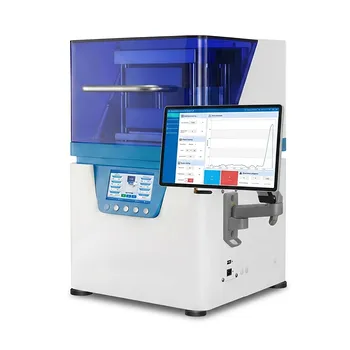
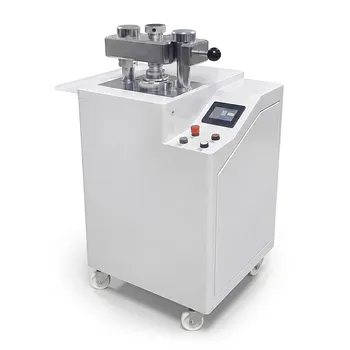
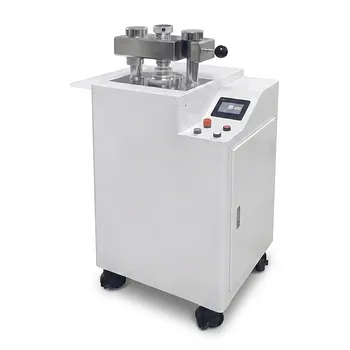
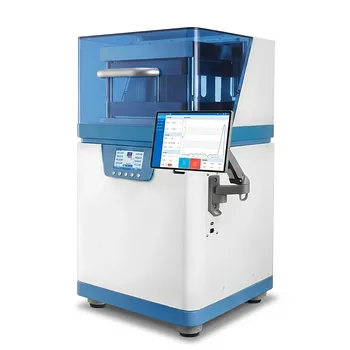
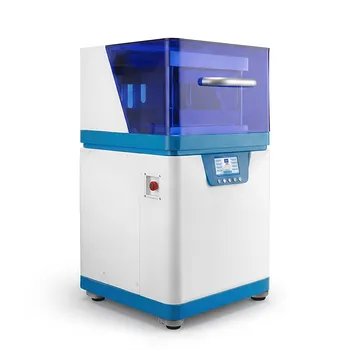
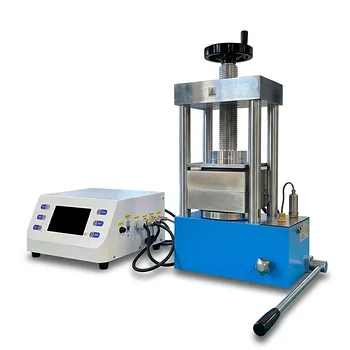
The laboratory hydraulic press is the critical tool used to transform loose $Fe_3O_4$ nanopowder into a dense, solid pellet known as a "green body." This compaction is essential because it eliminates the air gaps and voids inherent in loose powders, establishing the continuous electrical pathways required for accurate resistivity measurements. Without this process, the high contact resistance between individual nanoparticles would yield inconsistent data that fails to reflect the material's true physical properties.
To obtain reliable electrical data from $Fe_3O_4$ nanopowders, you must eliminate inter-particle porosity and ensure uniform contact. A hydraulic press achieves this by applying controlled, high-pressure loads to create a structurally sound specimen with repeatable geometric dimensions.
The Role of Compaction in Electrical Continuity
Eliminating Inter-particle Voids
Loose nanopowders are primarily composed of air and irregular gaps between particles, which act as insulators. By applying high pressure, typically ranging from 1 MPa to 30 MPa, a hydraulic press forces these particles into a tightly packed arrangement.
This physical compression removes the voids that would otherwise obstruct the flow of current. The result is a dense cylindrical pellet where the internal density is high enough to support stable electron transport.
Establishing Low-Resistance Contact
Accurate resistivity measurements, particularly using the four-probe method, require excellent electrical contact both within the particle network and between the sample and the electrodes. The press ensures that the surface of the $Fe_3O_4$ pellet is flat and uniform, providing a consistent interface for the measurement probes.
Reducing this contact resistance is vital for isolating the intrinsic resistivity of the material. When particles are forced into close contact, the "bottlenecks" at grain boundaries are minimized, allowing for a true assessment of the sample's conductivity.
Impact on Material Characterization
Detecting Non-Stoichiometric Properties
$Fe_3O_4$ (magnetite) is highly sensitive to oxygen loss or cation vacancies, which significantly alter its electrical behavior. A hydraulic press allows researchers to create standardized samples that reflect these non-stoichiometric properties without the interference of structural flaws.
Because the compaction process is repeatable, scientists can compare different batches of nanopowder with confidence. This consistency is the only way to ensure that changes in resistivity are due to the material's chemistry rather than variations in how the powder was packed.
Ensuring Geometric Uniformity
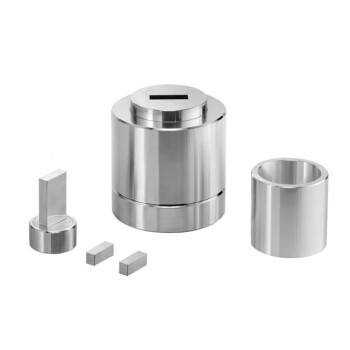
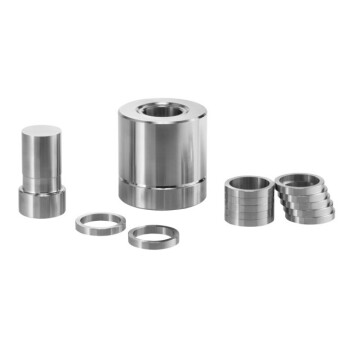
Resistivity calculations depend heavily on the precise dimensions (thickness and diameter) of the sample. A hydraulic press used with a precision die set produces pellets with consistent geometric shapes.
This uniformity eliminates porosity fluctuations that can lead to "noisy" or inaccurate data. By controlling the molding process, you ensure that the internal density is homogenous throughout the entire specimen.
Understanding the Trade-offs
The Risk of Pressure-Induced Alterations
While high pressure is necessary for density, excessive force can sometimes cause structural damage to the nanoparticles themselves. It is crucial to find the "sweet spot" where the powder reaches maximum density without undergoing unintended phase changes or mechanical crushing.
Structural Integrity vs. Measurement Stability
If the pressure is too low, the resulting "green body" may be fragile and prone to crumbling. A pellet that lacks structural integrity will produce unstable readings during electrochemical cycling or when the measurement probes apply downward force.
How to Apply This to Your Research
Making the Right Choice for Your Goal
- If your primary focus is material characterization: Use a high-precision hydraulic press to ensure the pellet density is high enough to accurately reflect the effects of oxygen vacancies.
- If your primary focus is electrode manufacturing: Focus on applying a repeatable tonnage (such as 1.8 metric tons) to ensure tight contact between active particles and conductive agents for better current collection efficiency.
- If your primary focus is subsequent sintering: Utilize the press to create a pre-formed green body with sufficient density to facilitate efficient mass transfer and grain boundary migration during high-temperature processing.
By mastering the compaction of $Fe_3O_4$ nanopowders, you bridge the gap between loose chemical precursors and the high-fidelity physical data required for advanced material science.
Summary Table:
| Feature | Role in Fe3O4 Processing | Impact on Electrical Measurement |
|---|---|---|
| Void Elimination | Removes air gaps between nanopowders | Establishes stable electron transport pathways |
| Contact Optimization | Forces particles into a tightly packed arrangement | Minimizes contact resistance at grain boundaries |
| Geometric Uniformity | Produces pellets with consistent dimensions | Ensures accurate resistivity calculations (ρ = RA/L) |
| Structural Integrity | Creates a solid "green body" specimen | Prevents sample crumbling during probe application |
| Repeatability | Applies controlled, high-pressure loads | Allows for comparison of non-stoichiometric properties |
Elevate Your Material Research with KINTEK Precision
Achieving high-fidelity electrical data starts with superior sample preparation. KINTEK specializes in high-performance laboratory hydraulic presses, including manual, electric, and isostatic models, paired with precision pellet dies to ensure your $Fe_3O_4$ nanopowders reach optimal density every time.
Beyond compaction, we provide a full ecosystem for advanced material science—from high-temperature furnaces and CVD systems for sintering to high-pressure reactors and specialized electrolytic cells for battery research.
Ready to eliminate measurement inconsistency? Contact our technical experts today to find the ideal pressing solution for your lab and ensure your research is backed by repeatable, accurate data.
References
- Gopal Niraula, S. K. Sharma. Observation of magnetic vortex configuration in non-stoichiometric Fe<sub>3</sub>O<sub>4</sub> nanospheres. DOI: 10.1039/d3na00433c
This article is also based on technical information from Kintek Solution Knowledge Base .
Related Products
- Automatic Laboratory Hydraulic Pellet Press Machine for Lab Use
- Laboratory Manual Hydraulic Pellet Press for Lab Use
- Automatic Laboratory Hydraulic Press for XRF & KBR Pellet Press
- Laboratory Hydraulic Press Split Electric Lab Pellet Press
- Laboratory Hydraulic Press Lab Pellet Press Machine for Glove Box
People Also Ask
- What is the role of a laboratory hydraulic pellet press and stainless steel molds in the fabrication of RuO2/NbC anodes?
- What role does a laboratory pellet press play in the enhancement of biomass energy products? Optimize Fuel Efficiency
- What is the purpose of using a laboratory pellet press when evaluating the electronic conductivity of carbon powders? Guide
- How does a laboratory hydraulic pellet press contribute to SiCw/2024 aluminum composite preforms? Optimize Densification
- What is the significance of applying 200 MPa of pressure with a laboratory hydraulic pellet press for composite ceramics?