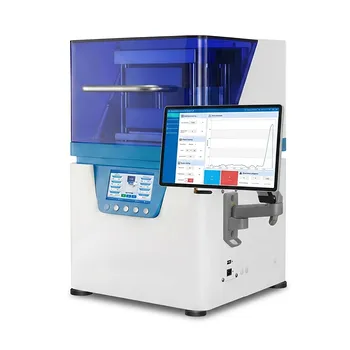
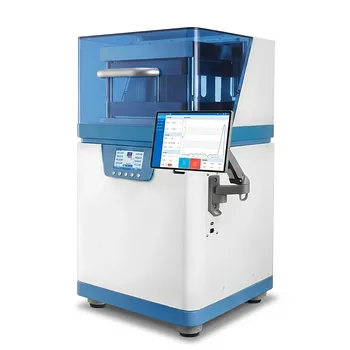
The laboratory hydraulic press is the standard instrument for converting loose alumina composite powders into high-density "green bodies" with precise geometric dimensions. By applying controlled uniaxial pressure within a mold, the press ensures uniform particle packing and eliminates the random variables associated with manual forming, providing a repeatable baseline for all subsequent sintering and mechanical analysis.
The laboratory hydraulic press serves as the foundation for experimental integrity in ceramic research by ensuring that every test specimen possesses identical initial density and geometry. This standardization is critical for isolating the effects of material composition and sintering parameters from the noise of inconsistent sample preparation.
Establishing a Reliable Data Benchmark
Eliminating Manual Forming Errors
A hydraulic press removes the subjectivity and inconsistency of manual powder compaction. This precision allows researchers to create standardized specimens that serve as a control group, especially when comparing traditional forming to modern methods like 3D printing.
Evaluating Intrinsic Material Properties
By providing constant pressure, the press ensures that any observed differences in the final ceramic product are due to the material's chemistry or the sintering process rather than flaws in the initial forming stage. This makes it possible to accurately evaluate the intrinsic properties of new alumina composites.
Maximizing Green Body Density
Driving Particle Displacement and Deformation
Under high pressures—often reaching 100 MPa to 300 MPa—powder particles undergo displacement and plastic deformation. This mechanical force increases the contact area between particles, which is the physical requirement for effective mass transport during high-temperature sintering.
Reducing Internal Porosity
Precise pressure control promotes particle rearrangement, which effectively fills microscopic voids and reduces large-scale internal pores. This densification is a prerequisite for achieving the strong interfacial bonding required in high-performance alumina composites.
Geometric Precision for Analytical Accuracy
Ensuring Parallelism and Uniform Thickness
For electrical and dielectric testing, samples must have near-perfect parallelism and consistent thickness. A precision hydraulic press with dedicated molds minimizes geometric deviations that would otherwise lead to significant errors when calculating dielectric constants or conductivity.
Enhancing Thermal and Mechanical Consistency
Compressing powder into specific geometries, such as 0.3g pellets or thin plates, ensures uniform heat conduction during subsequent thermal treatments or plasma calcination. This uniformity prevents internal stresses and ensures that mechanical tests accurately reflect the material's true strength.
Understanding the Trade-offs
Limitations of Uniaxial Pressing
While highly effective, uniaxial pressing can create pressure gradients within the sample, where the density near the plunger is higher than in the center. This can lead to non-uniform shrinkage or warping during the sintering process if not carefully managed.
Geometry and Surface Constraints
The use of rigid molds limits specimens to relatively simple geometries, such as cylinders or rectangular bars. Additionally, while the press eliminates air bubbles, improper pressure release (decompression) can occasionally cause "capping" or laminations, where the sample cracks into thin layers.
How to Apply This to Your Research
Making the Right Choice for Your Goal
To achieve the best results in alumina composite research, the application of the hydraulic press should be tailored to the specific analytical requirement.
- If your primary focus is mechanical strength testing: Use high-pressure compaction (300 MPa) to maximize initial density and ensure the absence of large internal voids that act as fracture initiators.
- If your primary focus is dielectric or impedance measurements: Prioritize a precision mold setup that guarantees perfectly flat, parallel surfaces to minimize geometric measurement errors.
- If your primary focus is sintering kinetics or comparative studies: Maintain a strictly constant pressure across all samples to ensure that density is a controlled variable, allowing for an objective evaluation of thermal effects.
By mastering the precision of the laboratory hydraulic press, researchers can transform raw composite powders into the highly standardized specimens required for world-class ceramic engineering.
Summary Table:
| Key Feature | Research Benefit | Technical Impact |
|---|---|---|
| Powder Compaction | Standardized "Green Bodies" | Eliminates manual variables and ensures repeatable data benchmarks. |
| High Pressure (100-300 MPa) | Maximized Density | Drives particle deformation and reduces internal porosity for sintering. |
| Precision Mold Shaping | Geometric Accuracy | Ensures parallelism and uniform thickness for analytical accuracy. |
| Controlled Pressure | Reliable Comparison | Isolates intrinsic material properties from forming inconsistencies. |
Elevate Your Ceramic Research Precision with KINTEK
Achieve uncompromising accuracy in your material science workflows with KINTEK’s high-precision laboratory hydraulic presses. Whether you require pellet, hot, or isostatic pressing, our systems are engineered to provide the uniform density and geometric parallelism essential for world-class alumina composite research.
At KINTEK, we provide a complete ecosystem for laboratory excellence:
- Sample Preparation: Advanced hydraulic presses, crushing and milling systems, and sieving equipment.
- Thermal Processing: A comprehensive range of high-temperature furnaces, including muffle, vacuum, CVD, and atmosphere models.
- Specialized Tools: High-pressure reactors, autoclaves, and essential consumables like high-purity ceramics and crucibles.
Ready to transform your raw powders into highly standardized specimens? Contact our technical experts today to find the perfect equipment solution tailored to your research goals.
References
- Xin He, Weixi Ji. Effects of the Sintering Process on Al2O3 Composite Ceramics Fabricated Using Material Extrusion and Photo-Polymerization Combined Process. DOI: 10.3390/cryst13121679
This article is also based on technical information from Kintek Solution Knowledge Base .
Related Products
- Laboratory Hydraulic Press Lab Pellet Press Machine for Glove Box
- Laboratory Hydraulic Press Split Electric Lab Pellet Press
- Fully Automatic Heated Hydraulic Lab Press for Materials Sintering and Sample Preparation
- Laboratory Hydraulic Press Lab Pellet Press for Button Battery
- Automatic Laboratory Hydraulic Press for XRF & KBR Pellet Press
People Also Ask
- How do laboratory hydraulic presses contribute to zero-gap electrolyzers? Optimize Performance & Safety
- Why is a laboratory hydraulic press necessary for ZrO2/Cr2O3 interface analysis? Optimize Sample Density and Accuracy
- How do a precision laboratory hydraulic press and specialized molds contribute to the fabrication of spherical ceramic samples? Achieving High-Density Material Precision
- What is the role of a laboratory hydraulic press in the preparation of rare earth denitrification catalysts?
- How does pressure control of a laboratory hydraulic press affect W-Ti alloys? Optimize Grain Structure & Density