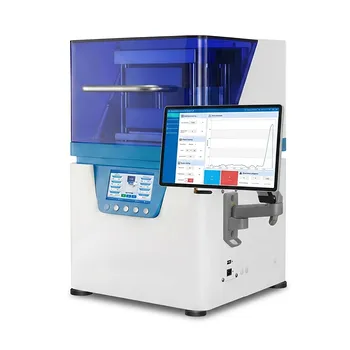
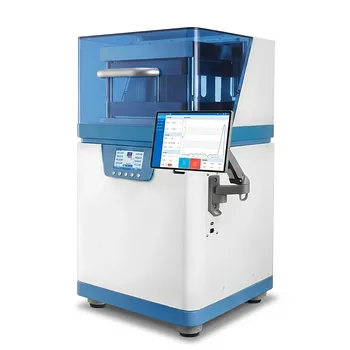
A laboratory hydraulic press is the fundamental tool used to transform LaTiO2N-M powder into dense "green bodies," enabling the artificial construction of grain boundaries. By applying precisely controlled pressure, the press ensures the uniform particle contact necessary for high-temperature sintering. This process allows researchers to create polycrystalline structures that can be directly compared against single-crystal counterparts to study charge transport.
The laboratory hydraulic press serves as the bridge between raw powder and a structured solid, providing the mechanical force required to simulate intergranular contact. This enables the isolation of grain boundary effects, which is essential for understanding how charge transport differs in polycrystalline versus single-crystal materials.
Creating the Structural Foundation for Sintering
The Role of the Green Body
A hydraulic press compresses loose LaTiO2N-M powder into a specific geometric shape known as a green body. This compacted form provides the structural integrity needed for the material to be handled and processed in subsequent steps.
Ensuring Precise Particle Proximity
The primary function of the press is to achieve high-density contact between individual powder particles. Without this mechanical force, the gaps between particles would be too large for atomic diffusion to occur effectively during the heating process.
Enabling the Sintering Process
Precise pressure control is a prerequisite for high-temperature sintering, where the particles fuse to form a solid. This fusion creates the "artificial" grain boundaries that are the focus of the comparative study.
Facilitating Comparative Material Analysis
Simulating Polycrystalline Environments
By creating a cohesive solid from powder, the hydraulic press allows researchers to simulate a polycrystalline environment. This environment mimics the complex internal structures found in real-world materials, which often contain many internal interfaces.
Comparing Single-Crystal and Polycrystalline Transport
The press makes it possible to study charge transport differences by providing a consistent polycrystalline sample. Researchers can then measure how grain boundaries hinder or facilitate the movement of charges compared to a seamless single-crystal structure.
Achieving Uniformity for Scientific Accuracy
The uniform compressive force provided by a laboratory-grade press ensures that the density of the sample is consistent throughout. This consistency is vital for ensuring that experimental results are repeatable and that observed effects are due to grain boundaries rather than structural voids.
Understanding the Trade-offs and Limitations
The Risk of Pressure Gradients
If pressure is not applied evenly, the green body can develop internal density gradients. This may lead to uneven sintering and cracking, which can obscure the true effects of the grain boundaries being studied.
Surface Contamination Risks
The high pressure involved can sometimes lead to minor contamination from the die walls or the pressing environment. Any impurities introduced at this stage can significantly alter the electrical properties of the LaTiO2N-M, potentially skewing the results of the comparative study.
Mechanical Stress and Structural Defects
Excessive force can cause micro-cracking or unwanted phase changes in the LaTiO2N-M powder. Researchers must balance the need for density with the physical limitations of the material to avoid introducing artifacts that interfere with charge transport analysis.
Making the Right Choice for Your Goal
To maximize the effectiveness of a laboratory hydraulic press in material studies, consider the following objectives:
- If your primary focus is Grain Boundary Engineering: Ensure the press offers high precision in pressure maintenance to create consistent intergranular contact across all samples.
- If your primary focus is Comparative Charge Transport: Use standardized die sets and pressure settings to ensure that polycrystalline samples are as uniform as possible when compared to single crystals.
- If your primary focus is Material Purity: Utilize high-quality, hardened die materials and consider vacuum-pressing options to minimize the introduction of atmospheric or metallic contaminants.
A laboratory hydraulic press is not merely a compaction tool, but a precision instrument that provides the physical foundation required to unlock the secrets of charge transport in complex oxide materials.
Summary Table:
| Function | Role in LaTiO2N-M Research | Key Scientific Outcome |
|---|---|---|
| Green Body Formation | Compresses powder into a geometric solid | Structural foundation for handling |
| Particle Proximity | Ensures high-density contact between particles | Enables atomic diffusion during sintering |
| Structural Simulation | Creates an artificial polycrystalline environment | Isolates grain boundary effects |
| Force Uniformity | Provides consistent compressive pressure | Ensures repeatable charge transport data |
| Comparative Analysis | Produces solid samples for transport studies | Allows comparison to single-crystal structures |
Achieve Superior Sample Uniformity with KINTEK
Precision in materials science starts with consistent sample preparation. At KINTEK, we understand that isolating grain boundary effects in materials like LaTiO2N-M requires flawless pellet density and structural integrity. We offer a comprehensive range of laboratory hydraulic presses (pellet, hot, and isostatic) designed to provide the precise pressure control necessary for high-quality green body formation.
Beyond compaction, KINTEK supports your entire research workflow with high-temperature furnaces (muffle, tube, vacuum) for sintering, crushing and milling systems for powder preparation, and essential ceramic crucibles and PTFE consumables. Whether you are exploring charge transport or advanced oxide ceramics, our equipment ensures your results are accurate and repeatable.
Ready to elevate your material research? Contact our specialists today to find the perfect press for your lab!
References
- Ran Wang, Xiaoxiang Xu. Unleashing Photocarrier Transport in Mesoporous Single‐Crystalline LaTiO<sub>2</sub>N for High‐Efficiency Photocatalytic Water Splitting. DOI: 10.1002/aenm.202302996
This article is also based on technical information from Kintek Solution Knowledge Base .
Related Products
- Laboratory Hydraulic Press Lab Pellet Press Machine for Glove Box
- Laboratory Hydraulic Press Split Electric Lab Pellet Press
- Fully Automatic Heated Hydraulic Lab Press for Materials Sintering and Sample Preparation
- Laboratory Hydraulic Press Lab Pellet Press for Button Battery
- Automatic Laboratory Hydraulic Press for XRF & KBR Pellet Press
People Also Ask
- How do laboratory hydraulic presses contribute to zero-gap electrolyzers? Optimize Performance & Safety
- Why is a laboratory hydraulic press necessary for ZrO2/Cr2O3 interface analysis? Optimize Sample Density and Accuracy
- How do a precision laboratory hydraulic press and specialized molds contribute to the fabrication of spherical ceramic samples? Achieving High-Density Material Precision
- What is the role of a laboratory hydraulic press in the preparation of rare earth denitrification catalysts?
- How does pressure control of a laboratory hydraulic press affect W-Ti alloys? Optimize Grain Structure & Density